

 This product has already been purchased.

If you judged 2026 purely by the financial press, you’d assume directors spent their year consumed by generative AI, cyber crisis and ASIC enforcement battles. But the AICD’s reading data tells a very different story.
When directors closed their boardroom packs and clicked on what actually mattered to them, the macro headlines took a back seat. Instead, the AICD’s most-read articles list reveals a strong appetite for the practical realities of board life: How to secure a directorship, sharpen a board CV, build influence and navigate the behaviours that can derail boardroom decisions.
The results point to a readership looking beyond the big governance debates to the skills, relationships and career moves that shape effective directors.
Here are the 10 articles that commanded directors’ attention this year and the playbooks to take into 2027.
Boardroom etiquette: What new directors must learn fast
Newly minted directors often sprint into their first board meeting eager to flex years of operational muscle memory only to discover that management doesn’t need another backseat driver with an Excel fixation. True boardroom influence is built on tactical restraint – keeping quiet until you can genuinely tilt a decision, resisting the urge to ping nervous executives with an 11pm email, and staying inside the governance lane rather than dabbling in management’s business.
The 2027 playbook: Run your interventions through a high-impact filter. Unless your input materially changes the strategic trajectory or stress tests enterprise risk, hold your fire. When you do speak, wrap the challenge in a clear, dispassionate context so you don’t look like you’re interrogating management for sport.
Beyond the CV: What chairs look for in first-time directors
Spoiler: Your glowing executive resume won’t save you if you can’t build genuine rapport around the table.
Chairs are candid that a track record of stellar executive decisions guarantees precisely nothing in the boardroom, where direct command gets replaced by consensus building and conversational nuance. What chairs actually screen for behind closed doors is high emotional bandwidth, an egoless pivot from “doer” to inquisitive steward, and references who can vouch that you’ll keep your cool and collaborate even when debates become existential.
The 2027 playbook: Pitch your boardroom value proposition around your ability to elevate collective decision making, to build strong networks, and your stellar reputation rather than technical brilliance. In high-friction board evaluations, the decisive metric is rarely your credentials, it's whether you’re capable of thinking like a director.
Five myths about getting your first board role
Not all advice on landing a board seat is created equal and following the wrong script might actually be stalling your progress. Securing a seat at any table is rarely about having the loudest title on LinkedIn. Instead, it’s an exercise in deliberate, long-game networking and proving you have the strategic altitude to govern rather than manage.
The 2027 playbook: Build peer-level relationships with chairs long before vacancies surface, and pitch how your judgement navigates ambiguity rather than reciting your operational track record.
Eight ways to master the art of boardroom influence
Dumping an 80-slide deck onto the table is usually an admission you don’t know what point you’re trying to make. Boardroom influence is about brevity, clarity and knowing when to stop talking. The directors who actually move the needle don’t hold up the agenda, they lead with a single compelling idea, ground high-level numbers in reality and deliver fresh arguments that hold up under cross-examination.
The 2027 playbook: Stop trying to impress the room with volume, help the room make a decision with clarity. Influence in the boardroom comes from having the discipline to distill complex operational detail down to a single memorable takeaway and a clear call to action.
The nine boardroom behaviours that kill good decisions
Every board table has its familiar tripwires – from the director who dominates every discussion to the chronic sceptic who shoots down every initiative without offering an alternative. When these behaviours go unchecked, meetings devolve into political manoeuvring while critical risks slip past unnoticed. The cure isn’t polite collective silence, but proactive chairing and peers who are willing to call time on disruptive behaviour.
The 2027 playbook: Put behavioural boundaries into practice. When a habitual naysayer pushes back on strategic change, don’t let them hide behind cynicism, prompt them on the spot to put forward a concrete, workable alternative within the agreed risk appetite.
How to nail the board interview
The single biggest mistake executives make in a board interview is treating it like an internal promotion pitch. Nominations committees aren’t looking for operational war stories about how you closed a deal five years ago, they’re assessing how you think, how you collaborate and how you hold leadership accountable without clipping their wings. They want to see that you understand the fundamental difference between steering the ship and grabbing the wheel.
The 2027 playbook: Reframe your answers from “Here’s what I built” to “Here’s how I interrogate risk and support management”. Tie your experience directly to modern board pressures, from AI and cyber resilience to regulatory scrutiny, and prove you know how to govern with an independent mind.
Qantas turnaround: How to repair a broken brand and rebuild customer trust
Rebuilding an iconic brand after catastrophic reputational fallout isn’t solved in the Chairman’s Lounge or through polished PR releases. Stepping into the top job amid regulatory battles and customer fury, Vanessa Hudson’s turnaround shows that cultural repair starts with radical visibility and board-management discipline. For directors, governing through crisis requires resisting the urge to micromanage operational recovery from afar, instead creating early strategic alignment, holding the room to the same behavioural standards expected of management and listening directly to frontline reality.
The 2027 playbook: Bring the board into strategic planning earlier, not at the final sign-off stage. Demand genuine presence around the table and treat direct, unfiltered customer and frontline feedback as an indispensable governance check on corporate recovery.
Being “nice” in the boardroom can pose a risk to good governance
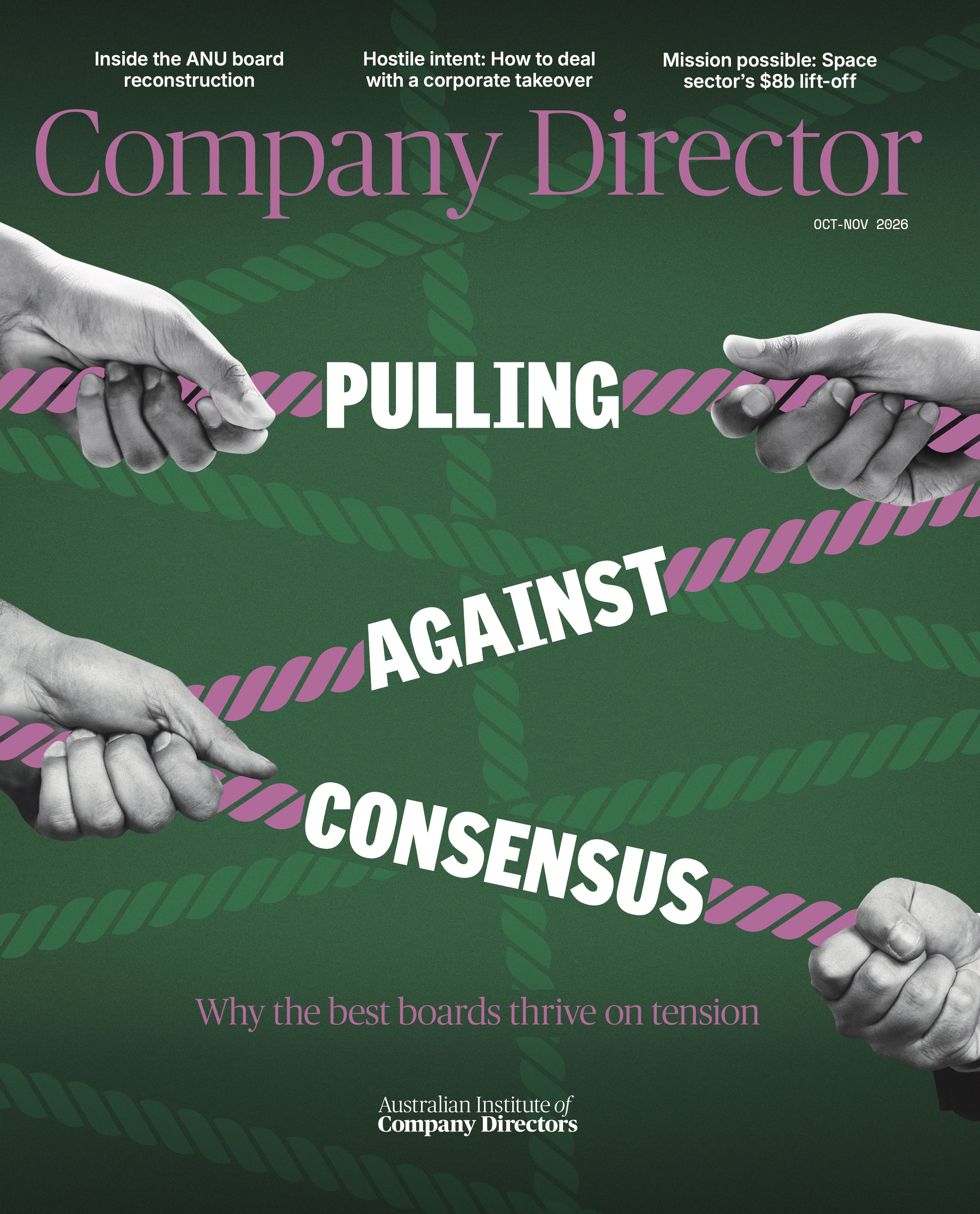
Polite consensus is the quietest killer of sound governance. When a board values harmony, polite nods, and frictionless unanimous votes over rigorous debate, directors self-censor and warning lights go ignored. True psychological safety isn’t a comfortable group hug, it’s an environment robust enough that a director can ask the awkward question without being treated as an obstacle to progress.
The 2027 playbook: Institutionalise constructive friction. Embed structured invitations to dissent into ordinary meetings, prompt the CEO and directors to articulate the strongest arguments against their own recommendations and treat unbroken consensus as a warning sign to probe deeper.
Boardroom chemistry: What directors need from their chairs
High-performing boards rely on chairs who know how to conduct an orchestra without trying to play every instrument. An authoritarian chair stifles independent thinking, while a passive one lets dominant voices hijack the strategy. Exceptional board dynamics require a chair who manages airtime rigorously, fosters transparent dialogue with the CEO and invests in continuous one-on-one relationships so that tricky disagreements are resolved over coffee rather than blowing up during the meeting.
The 2027 playbook: Treat boardroom chemistry as an ongoing discipline rather than a lucky accident. Use structured, off-agenda check-ins with the chair to surface concerns early, ensuring the board can debate aggressively in private while maintaining strategic alignment in public.
When executive pay betrays company culture
Remuneration is the loudest cultural signal a board sends, yet it remains the easiest place to trigger an investor revolt. When incentive scorecards get cluttered with competing priorities, they dilute accountability, tempting leadership to chase short-term financial targets while stated values, risk management and customer outcomes slip out the back door. The warning signs rarely stay hidden – when executive bonuses reward behaviour the board claims to discourage, shareholders and regulators notice almost immediately.
The 2027 playbook: Boards should explore whether current pay structures are genuinely championing the culture they say they want, or quietly encouraging something else. Are your goals simple and transparent enough that both leaders and everyday employees actually understand what good performance looks like?
Latest news
Already a member?
Login to view this content