

 This product has already been purchased.


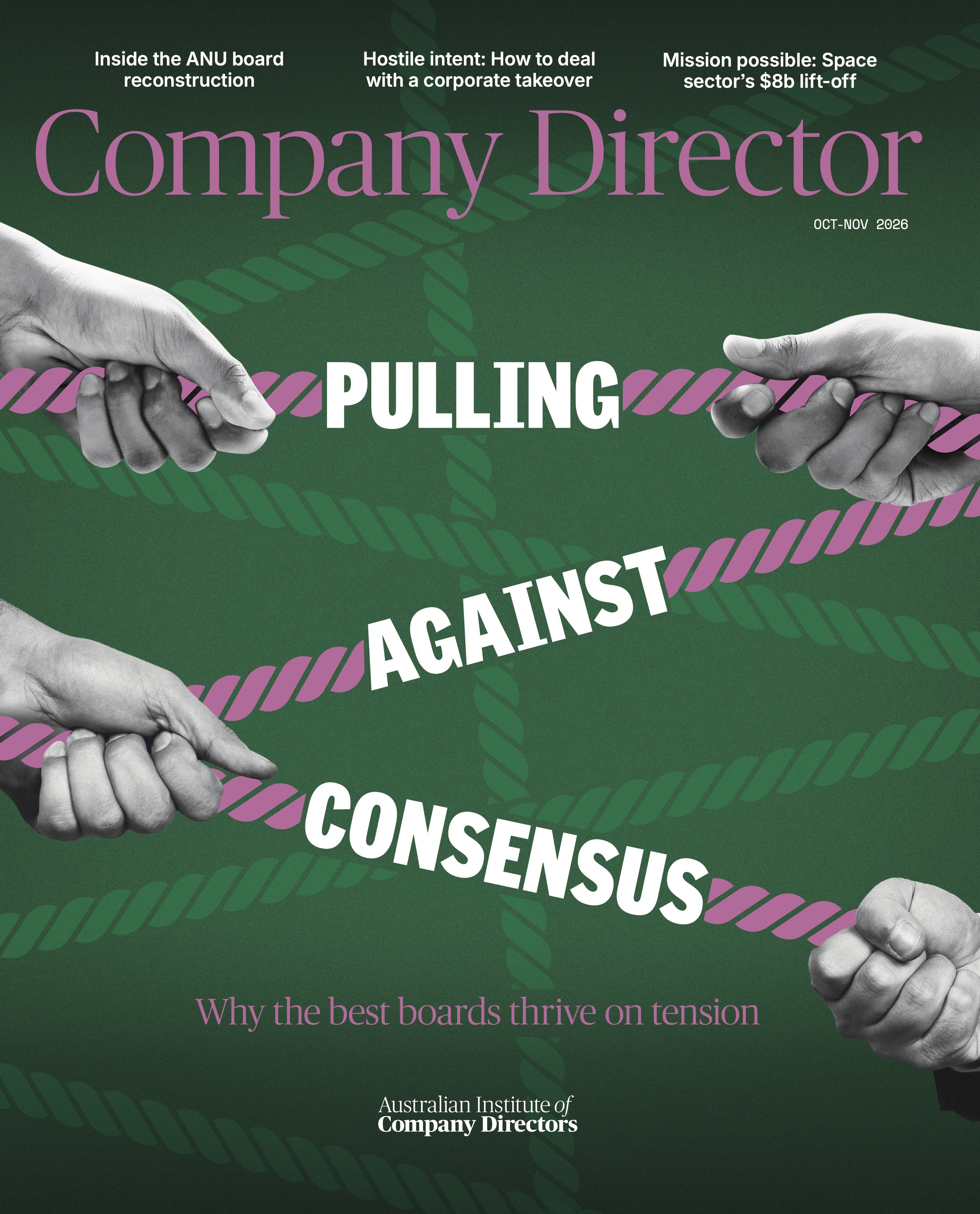
- A chair’s leadership style can determine whether a board thrives on open debate or slips into dysfunction.
- Strong chairs encourage challenge, information flow and balanced participation, while overly dominant or disengaged leaders can weaken oversight and decision making.
- Directors and governance experts say the most effective boards are built on trust, adaptability and a culture where every voice can contribute.
Research shows a chair’s leadership style has a direct impact on engagement, debate and decision making. An overly dominant chair can suppress other directors’ contributions, while a less engaged chair can fail to stimulate constructive challenge and robust oversight.
A board’s effectiveness is impacted by the sociopsychological processes that foster group participation and interaction, according to a 2021 research paper from the Academy of Management. Leadership styles can vary widely, with some approaches more likely to stifle genuine debate and oversight.
“The role of the chair on any board is fundamentally important,” says Nicole Salimbeni, a partner at MinterEllison Consulting.
“The chairs I have seen produce higher-quality governance outcomes are those able to facilitate a discussion with other members of the board in a way that gets the best from that individual.”
Chairs who tailor their questioning style to ensure the discussion raises the most pertinent and factually correct information will drive a high-functioning board, she adds.
By contrast, the researchers found that boards become dysfunctional when the process is “a charade of productive, problem solving… [in which] important issues aren’t discussed openly.”
Salimbeni believes that while the chair holds a pivotal position on the board, the contribution of each director is equally vital.
“High-performing boards are distinguished by a strong culture of open communication – where regular one-on-one meetings between the chair and individual directors, combined with candid, two-way feedback, form the backbone of effective governance. This ongoing exchange not only strengthens relationships, but also ensures all voices are valued, fostering accountability and driving consistently better outcomes.”
Why directors need to keep up the chat
Andrew Fraser GAICD was the inaugural chair of Australian Retirement Trust and led the $350 billion superannuation fund from its 2022 merger until his retirement in November 2025. He believes the leadership style most likely to produce higher-quality discussion and better risk scrutiny is one that encourages the flow of information.
“A flattened leadership style through the board and the management team, which doesn’t insist upon ‘apex’ forms of communication, can provide stronger governance outcomes,” says Fraser, former Queensland Treasurer and Deputy Premier, and current Chancellor of Griffith University and chair of Bank of Queensland, Orange Sky Australia and Motorsport Australia.
He applies the footy field rule of “keep up the chat” as the most efficient and effective way to achieve open communication.
“It’s a term used a lot in team sports – and I think governance is a team sport. Everyone knows what they’re meant to be doing, but it’s important to make sure people are talking to each other throughout to ensure the information is flowing. Remind people of their focus and what’s in front of them. Don’t just presume they know everything – keep up the flow of information.”
In the organisations Andrews chairs, he doesn’t insist directors channel through him to communicate with management.
“I don’t use either the chair role or the CEO as gatekeepers. Instead, I encourage a flatter, more open style of communication and engagement,” he says.
“I also emphasise the importance of respecting the boundaries with management and their capacity. I like to talk to colleagues about having a ‘question budget’. Make sure you spend your question budget well, with an inquiry that isn’t simply a matter of mere curiosity. The answer should be a high value-add for the organisation.”
Why directors need to adapt to different leadership styles
In his experience, organisations in the past were more apex-structured. Today, the pace of change and the level of agility required of organisations means those with inefficient communication flows will spend too much time on navigating internal communication flows – which will come at the expense of the end user.
“I chair a bank, a sporting body, a charity and a university – and each of those relationships with the directors and CEO are different,” he says.
“For directors, it’s about ensuring you adapt to the style of the organisation. There will be different levels of communication at different points. More experienced CEOs might require less, but in a big transaction or challenge, you can expect greater engagement.”
He recalls once observing a board chair who would go around the table and ask for each director’s view on each particular topic or issue being discussed. A decision would then be made along the lines of ‘majority rule’.
“This, in my view, is not an effective way of managing a board discussion,” says Fraser. “Different board members will bring different skills, capabilities and experiences to a board table and a good chair will know when to bring those skills and capabilities to the forefront of the conversations and/or decision-making process.”
He still sees chairs in corporate Australia who persist with a strict ‘command and control’ approach. He contends that this leadership style stifles open debate, discourages directors from raising concerns and ultimately undermines the effectiveness of the board.
“A truly high-performing board thrives when the chair sets a tone that empowers directors to speak up, brings out the best in each member and fosters an environment where issues are escalated without fear of backlash,” he says.
“Equally, we’ve seen instances where chairs become too close to their CEOs, losing the objectivity needed to hold them accountable. This poses its own risks to governance. The key is balance. Outstanding chairs draw on a range of leadership traits, adapting their style to the context and needs of the board, to ensure robust scrutiny, constructive challenge and the highest standards of governance.”
How directors can respond to ineffective or dysfunctional chairs
When directors find themselves serving under an ineffective chair or within a dysfunctional board, Salimbeni says it is crucial to respond with both courage and professionalism.
“The first step should be to approach the chair directly, providing honest, constructive feedback about the issues at hand and suggesting practical ways to improve the board’s performance,” she says.
“Where direct communication isn’t enough, advocating for an independent external review can really help. Such reviews can reveal underlying problems and provide a clear roadmap for positive change.”
She adds that facilitated board workshops or group discussions can also be powerful tools to surface concerns, rebuild trust and reset expectations among members.
“However, if after exhausting all reasonable avenues a director genuinely believes they can no longer fulfil their legal and ethical obligations, they must seriously consider whether remaining on the board is in the best interests of the organisation and themselves.”
Latest news
Already a member?
Login to view this content