

 This product has already been purchased.


AI can deliver major productivity gains and help people thrive. Australian organisations are beginning to turn that potential into measurable results, but adoption is uneven and we are losing ground to global leaders.
Artificial intelligence (AI) has the potential to drive significant productivity gains for Australian organisations, but are organisations adopting fast enough to keep pace with the rest of the world? And are we using it in a way that not only benefits the economy, but allows people to thrive?
Only a few years ago, AI appeared in Australian annual reports as something to watch, a risk to manage or an opportunity somewhere over the horizon, if it was mentioned at all.
That changed radically after ChatGPT brought AI into the mainstream at the end of 2022. Medibank reports reducing complaint-resolution time by 60%, Commonwealth Bank uses AI to identify up to 3,000 confirmed fraudulent cases each day, and Westpac reports saving more than 12,000 assessor hours a year, with some outcomes delivered up to twelve times faster through AI agents.
AI has the potential to multiply what people are capable of: improving health and education, making work safer, helping companies become far more productive and allowing us to tackle problems we have not been able to solve before.
Those benefits won’t arrive automatically. Every powerful technology disrupts work and institutions, and its effects depend on the choices we make while adopting it. This is where boards and leaders matter: they shape where AI is used, who benefits, what remains under human control and whether the gains reach workers, customers and the wider community.
Much of this activity is not yet visible in traditional productivity statistics. To look for earlier signs of how AI adoption is progressing, AITAI analysed nearly 400,000 pages of annual reports from more than 400 companies across Australia, Canada, Singapore, the United Kingdom and the United States between FY2021 and FY2025.
Australia is maturing quickly, while still losing ground
AI is now mentioned in about 80% of Australian annual reports, up from about 50% in FY2021.
A mention shows AI has reached the corporate agenda. Our maturity model tracks ASX-listed companies from Stage 0, no mention, to Stage 5, AI-native.
On this ladder, the number of companies at Stage 0 fell from 52% in FY2021 to 18% in FY2025, routine or embedded use rose from 20% to 47%, and embedded use grew from 0 to 11%.
Routine use means AI is live beyond one team. Embedded use spans several functions and connects to value creation;
AI-native companies are built to run on AI.
Directors can see where their companies are on the maturity model here.
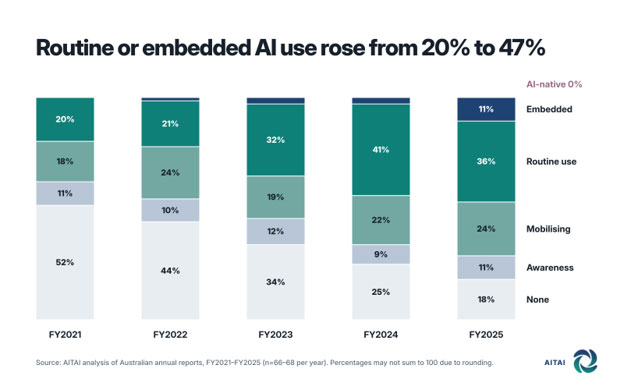
Most Australian companies we followed from FY2021 to FY2025 moved to a higher maturity stage. By FY2025, most of the largest companies were mobilising or using AI routinely, while a smaller group was beginning to embed it across the business.
No Australian company had reached AI-native by FY2025, a stage that remained exceptionally rare across all five markets, but will get more common in the future.
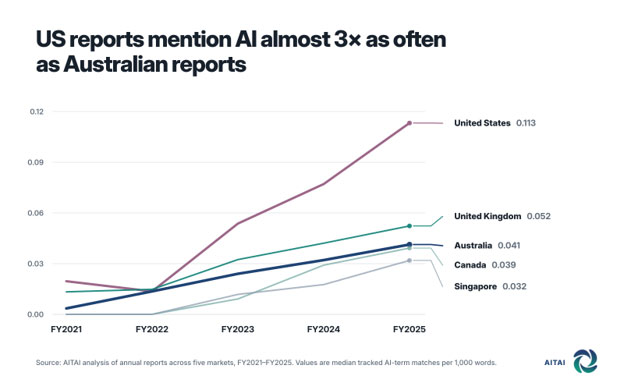
While Australian companies have rapidly matured, Australia has not kept pace with the world leaders.
AI value to Australian companies is becoming clear
Adopting AI is only meaningful if AI is producing outcomes. More than half of the Australian reports described an AI outcome, and about one in five could point to a realised result with a hard number attached, up from just 3% in FY2021. For directors, the gap between reported outcomes and hard numbers raises a practical question: how much value is being created, measured and disclosed?
The outcomes mentioned are broad: speeding up processes, reducing costs, supporting growth, catching fraud, serving customers, improving clinical and research work and making operations safer.
Companies are maturing quickly into the agentic era
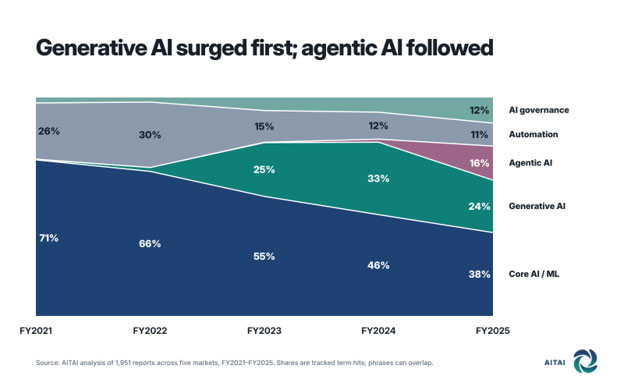
When you follow the words companies use, you can almost watch one era of AI roll into the next, beginning with the established language of machine learning and automation, which accounted for more than 96 per cent of tracked terminology in the pre-ChatGPT era.
Generative AI then arrives like a wave with the release of ChatGPT, growing to almost a quarter of the vocabulary in FY2023 and one third in FY2024, and by FY2025 the next wave is already forming as agentic terminology accounts for around one in six tracked terms.
Annual reports are lagging indicators: they record change only once it reaches formal corporate disclosure. The first FY26 disclosures already show agentic AI in live or planned use at Coles, Medibank, Orica, Westpac, WiseTech, REA and Xero, across employee productivity, customer messaging, data, logistics, search, internal processes and autonomous decisions.
Questions directors should ask as AI matures
The questions boards can ask as the organisation moves through the AI maturity ladder include:
- Early in the journey: Where can AI create meaningful value? What evidence will justify scaling? What risks do we accept?
- As AI becomes routine: Which systems are live, how far do they reach and what measurable outcomes do they produce? Which should be scaled or stopped, and is the company keeping pace internationally?
- As AI becomes embedded: What company data and systems can AI agents access? What can they decide and do without human approval? How do we measure return on our investments?
Further guidance from the AICD on how boards can engage with management on AI adoption, including overseeing AI risks, is contained in A Director’s Guide to AI Governance.
AI is already moving rapidly through Australian companies. The opportunity for boards is to shape that adoption, so it creates measurable value, strengthens Australia’s competitiveness and helps people thrive.
Latest news
Already a member?
Login to view this content