

 This product has already been purchased.


- True psychological safety in the boardroom is not about “being nice” or maintaining artificial harmony, but about empowering directors and executives to voice uncomfortable truths.
- When boards substitute politeness for accountability, dissenting views are shut down, leading to high-profile governance failures.
- Chairs must actively invite constructive conflict during routine meetings.
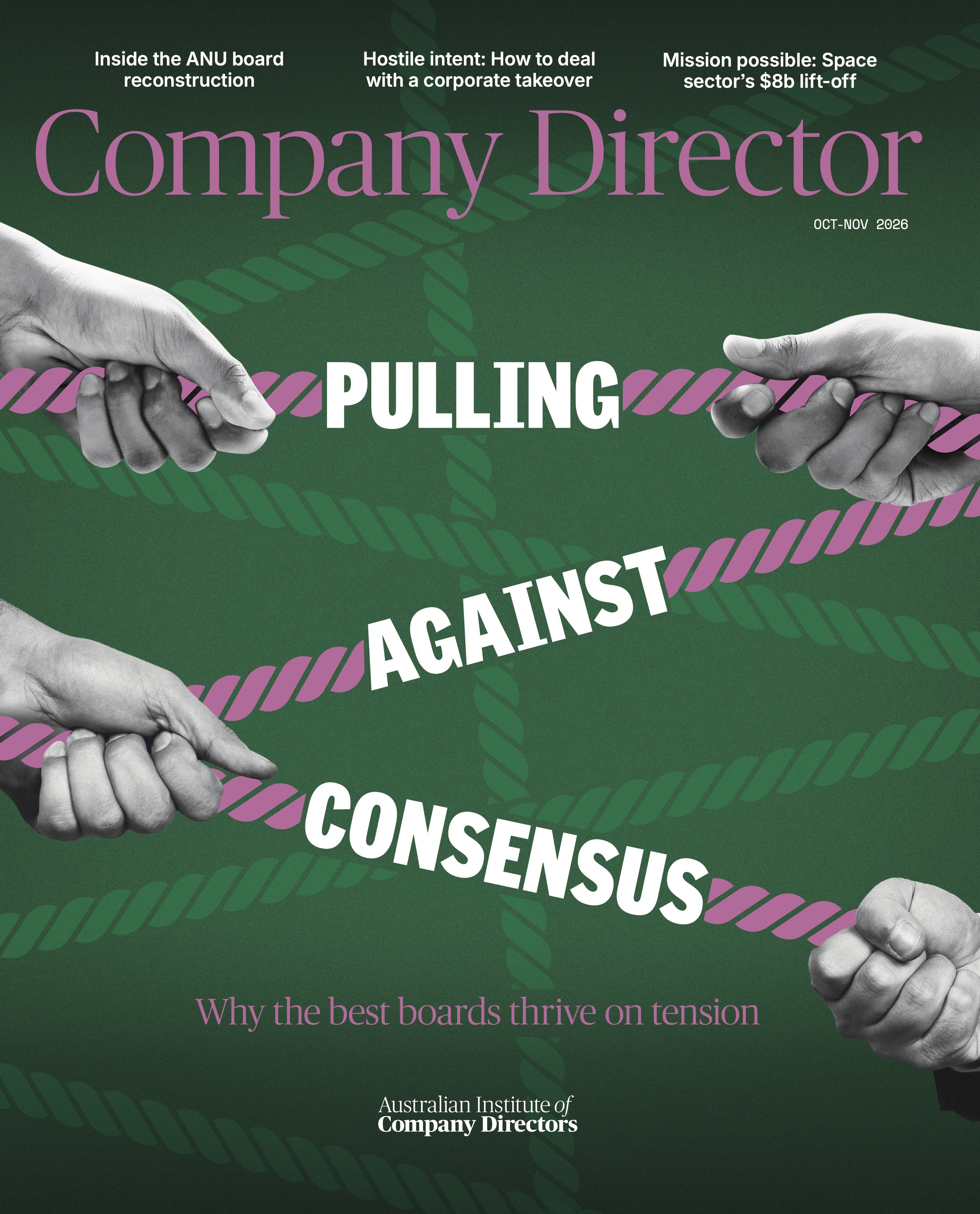
Expressing doubt, inviting dissent and raising awkward questions – how many catastrophic board failures could be avoided if directors practiced true psychological safety?
Psychological safety in the boardroom is not a “hygiene factor” of the working environment, such as physical safety or freedom from harassment. Rather, says Amy Edmondson, Novartis Professor of Leadership and Management at Harvard Business School in the US, creating psychological safety “constitutes a high standard, an ambition that allows an organisation to be truly excellent and capable of transformation”.
Edmondson first cracked open the benefits of psychological safety in a 1999 paper, Psychological Safety and Learning Behavior in Work Teams, which linked the desirable group “climate” of psychological safety to improved learning in the workplace. Her research found that of 51 teams in a manufacturing company, those that felt able to take interpersonal risks in each other’s presence reported more mistakes at work than others. Because they felt they could raise observed issues or doubts, therefore they were more able to openly discuss them, and subsequently they learned how to improve processes and outcomes.
Today, Edmondson is still coaching against the corruption of the term, as it has been written into company policies and board codes of conduct. In a session titled The dangers of being agreeable, for the BigThink+ Leadership Lessons series, she emphasises that psychological safety is not about “being nice” or keeping things comfortable for all, but about “dialling it up on candour, telling the truth even when it might be uncomfortable”.
Psychological safety supports best board practice
Roger Chao FAICD, an accomplished board chair, non-executive director, CEO and governance adviser, has more than two decades of leadership experience across the corporate, public and not-for-profit sectors. He says psychological safety in the boardroom has a specific meaning.
In work teams, it is feeling able to share mistakes, raise relevant information, including questions that at other times might be awkward or unpopular, information that might be uncertain or even contrary to the dominant view. In any context, he says, the intention to pursue rigorous discussion can easily become “condensed or softened” in favour of supporting a sense of “collegiateness”.
But the boardroom, he says, “is not a therapy circle”, it’s an “accountability body”. Board members have “a fiduciary duty to their organisation, and to exercise expert judgement on its behalf”.
We don’t necessarily know the interpersonal conditions experienced around various board tables. It’s easy to say from the outside, and in retrospect, that alarm bells should have been ringing prior to signing off on any number of unwise decisions that have since been exposed to the public eye.
The dangers of cover-ups, secrets and lies
The recent discovery that the Geelong Cats AFL club had signed a secret concussion waiver with player Jake Kolodjashnij – to indemnify the organisation against future potential litigation over head injury – seems from the outside to have been immoral and risky for the member-owned club. At the time of writing, the Cats were expected to be fined a six-figure sum for defying AFL regulations, and details of how the decision came to be agreed on were still to be released. The main issue for the Cats is non-disclosure of the agreement.
Whether we’re considering the Cats’ decision not to lodge the Kolodjashnij contract clause with the AFL governing body, as is required; or the deaths caused by aerospace and defence corporation Boeing in concealing a flaw in its automated flight control system; or AMP’s misleading of ASIC, the corporate regulator, over charging its customers fees for no service – psychological safety is likely to have been lacking.
In 2021, Edmondson wrote in Psychology Today, “From a distance, it’s easy to underestimate how difficult it is to speak up and disagree with the boss [in the board setting, a chair or founder]. But it’s human nature not to want to ruffle feathers… We instinctively recognise that messengers get shot … Even in the absence of bullies or bosses who send the clear message that pushback is unwelcome, people naturally hold back – feeling somehow that dissent is rude.” As a result, she says, quoting fellow Stanford professor in the field of management science Bob Sutton, “bosses live in a fool’s paradise” where they come to view silence as agreement.
Shedding light, not pointing the finger
The spectrum of psychologically unsafe behaviour and influence in governance ranges from out and out bullying, to deferring to a board’s loudest (perhaps most experienced or most jocular) voices; to self-censoring in favour of the appearance of board cohesion. But when directors fail to question, drill down or expand on the information to hand, outcomes are likely to be compromised.
Instead, says Chao, boards should aim to cultivate an environment in which questions are expected and there’s no shame in uncertainty. He advocates asking questions calmly and directly, for example, “Well, I don’t understand the basis for that assumption, could you please give us a bit more detail?”
From the point of view of the executive, he says a CEO should feel able to respond with something like, “We’re less certain about this than it appears in the papers, and we don’t actually have an answer to that.” Psychological safety means the CEO can be honest, without fearing he or she will lose the confidence of the board. “That’s a critical piece,” says Chao.
Elucidating, not subsuming
Bullying and overbearing behavior were among the reasons reported by media following oil and gas giant BP’s unanimous decision to remove Albert Manifold as chair in May 2026, after a tenure of less than a year. The company itself cited “serious concerns” relating to “governance standards, oversight and conduct” as cause for his dismissal.
Shareholder dissatisfaction was also a contributing factor, with one example of poor governance being that the company had refused to include a resolution filed by climate activists at its annual general meeting. Manifold claimed the resolution had been incorrectly filed.
Such shutting down of dissenting views can become part of company culture at all levels. Under a veneer of politeness, a chair might appear to welcome a discordant question or perspective, thank the speaker, say their point has been noted, and quickly move on to the next speaker or board item.
Chao suggests other board members can help to turn the discussion to deeper consideration by saying something like, “Actually, I’d like to come back to Jane’s point because I think there’s a governance issue in that.” He adds, “It’s not saying the chair has done something wrong, it just brings everyone back to that point.”
Overall, it’s the chair’s role to nurture a culture in which directors’ various strengths are sought and brought into play; and to understand the differences in how each director reacts in discussion – are they a first responder or someone who prefers to consider all facets before chiming in? Best practice is to draw everyone’s view into the light.
Intently listening and engaging with alternative views
In a psychologically safe environment, says Edmondson, “You should see conflict. You should see people asking questions. You should see people listening intently to one another.”
Chao recommends embedding habitual healthy conflict with structured invitations to challenge – “asking the CEO and other directors to find weaknesses in the proposition” and “to articulate the strongest argument against” the proposal, or “to find the weaknesses” in a suggested line of action.
Deliberately courting challenge helps organisations to catch seemingly insubstantial missteps before they pile into catastrophe, make decisions more precisely in the interests of the organisation and its stakeholders, and deal confidently with crises as they arise.
When things go wrong: Double down on rigorous investigation
In times of severe organisational stress – such as happened with both Telstra and Optus when parts of their critical infrastructure, including 000 access, failed – the natural reaction of the board is to show decisiveness, not ambiguity.
In those situations, says Chao, “the critical thing is to distinguish between urgency and panic”, and to separate decisions that must be immediately made from those that can and should be more thoroughly debated.
“The chair’s role is to distill, triage and ask, ‘What happens if we take another day, another week, another meeting cycle’ to work through this with due diligence?” Chao believes this is critical to finding a viable path out of crisis, because some decisions can’t be reversed without causing further harm to stakeholders.
He adds, “A board that has never practised psychological safety in ordinary meetings will struggle to do so in a crisis, because it’s not a norm. A board that routinely tests assumptions, that routinely creates and welcomes uncertainty and conflict, is much better equipped to respond to crises.”
Both Chao and Edmondson advocate consistently setting the stage for dissent. Individual directors, says Chao, should channel their own moral obligation to rigorously interrogate the reasoning behind decisions on the table.
Leaders/chairs, says Edmondson, should frequently remind their teams of the nature of their work “calling attention to the aspects of the work that make people’s voice valuable.” Otherwise, she says, “people will operate unconsciously with the assumption that it’s always safer to hold back”.
Latest news
Already a member?
Login to view this content