

 This product has already been purchased.


Overview
- Intensified conflict in the Persian Gulf has pushed oil prices back above US$90/b at the time of writing. Many of the factors that cushioned the first phase of the energy shock are still present, but inventories are lower, demand destruction is likely to involve more pain, and chokepoint risks have risen elsewhere (including in the Red and Black Seas).
- As before, the economic consequences will depend on the scale and duration of the associated supply shock. The feedback loop between prices and the risk of conflict will also matter.
- Other potential international inflation risks worth keeping an eye on include commodity price pressures from an impending ‘Super El-Niño’ plus an incoming round of new US tariff measures.
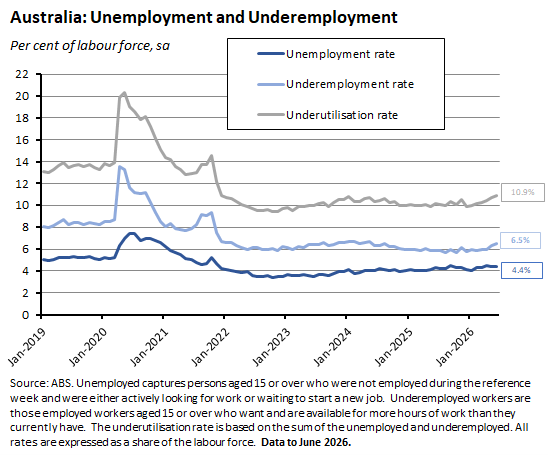
- Australia’s June 2026 labour force data delivered some mixed messages as a strong rise in employment was accompanied by a stable unemployment rate alongside rising underemployment and underutilisation rates.
Once again, the economic backdrop has delivered most of the news since the previous update:
- An intensification of the war in the Persian Gulf has prompted a warning from the International Energy Agency (IEA) as oil prices have pushed up through US$90/b.
- Higher energy prices are not the only source of international inflation pressures. There are mounting concerns that a looming ‘Super El Niño’ could trigger commodity-driven inflation, particularly in Asia.
- In addition, the Trump administration in the United States has announced a new 25% tariff on Brazil and a new 50% tariff on Canada ahead of plans for a raft of new trade measures in response to the expiration of the time-limited 10% tariff introduced after the US Supreme Court struck down previous tariffs. President Trump has also flagged plans to introduce new levies on generic medicines from 2028, with a starting rate of 100%.
- Meanwhile, the tech world has bounced from fretting about the implications of the release of Kimi K3 by Chinese start-up Moonshot to worrying about the news that an AI agent from OpenAI has triggered a major cyber-breach.
- China’s economic growth in the second quarter printed at a subdued 4.3%. That was down from the first quarter’s 5% result, below the official 2026 growth target of 4.5-5%, and the lowest reading since 2022. Setting aside the pandemic period, the June quarter growth outcome represented a multi-decade low.
On the domestic front, the main economic news came in the form of the June 2026 labour force release. Here, the numbers painted a mixed picture: employment growth at 76,300 was much stronger than the consensus forecast; the unemployment rate was unchanged at 4.4% and in line with market expectations; growth in hours worked was subdued; and the underemployment and underutilisation rates both rose to multi-year highs. In its latest forecasts, the RBA projects a 4.2% average June quarter unemployment rate, rising to 4.3% by the December quarter of this year, suggesting that the labour market may be softening a little bit faster than the central bank had anticipated.
More detail on the potential economic fallout from the Middle East conflict and on the new Australian labour market data below, along with the usual roundup of other data releases plus some suggested further reading and listening.
Oil prices are heading up again
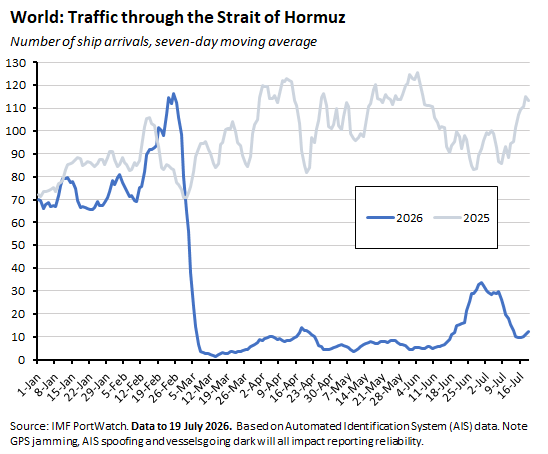
The resumption of conflict in the Middle East has sent oil prices higher. As noted in the previous update, the interim peace agreement between Tehran and Washington had triggered a sharp fall in oil prices to pre-conflict levels alongside a marked increase in the number of tankers transiting the Strait of Hormuz. Prices had dipped below US$70/b and some analysts had started to flag the possibility of an oil glut.
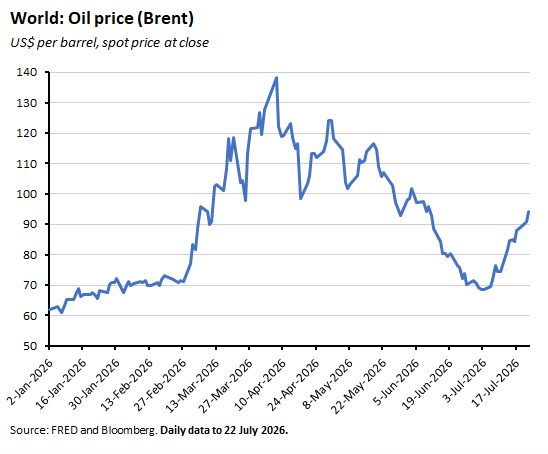
Yet now measured transits through the Strait have fallen back again and oil prices have rebounded, rising to above US$90/b at the time of writing, albeit still well below the peaks reached during the earlier months of the war.
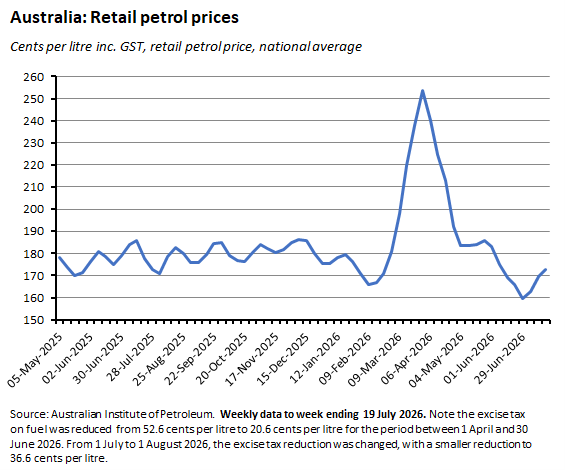
The impact of recent developments has yet to be felt on Australian petrol prices, where the government will face a choice at the end of this month as to the future of the temporary reduction in the fuel excise. The latter has already been scaled back from the initial three-month-long reduction in excise from 52.6 cents/litre pre-war to 20.6 cents/litre to this month’s 36.6 cents/litre. That measure is due to expire after 1 August.
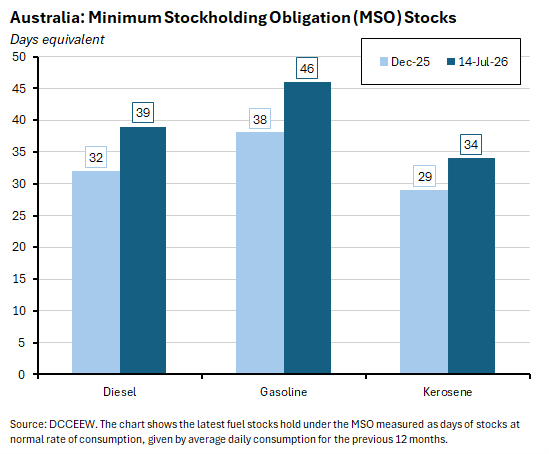
For now, Australia’s current reported fuel stocks remain above their pre-war levels.
Earlier this week, the International Energy Agency (IEA) issued a statement on oil markets warning that the ‘escalation in hostilities affecting the Strait of Hormuz and energy infrastructure in the region increases security of supply concerns and uncertainty over the market outlook.’ It added that threats ‘to the Bab el-Mandeb Strait, which has become increasingly important as a route to bypass the Strait of Hormuz, exacerbate these concerns further.’ The Agency did note that there were ‘several cushioning factors in play’ including significant Gulf supplies through alternative routes, increased oil exports from non-regional producers, and ongoing emergency oil stock releases. Another cushion comes from record volumes of oil-on-water after oil shipments from Gulf exporters jumped to nearly 80% of pre-war levels in late June and early July this year.
Is this time different?
Inevitably, recent developments have come with a big dose of déjà vu attached. Familiar debates around the likely scale of price moves, the probability of another TACO, and more are all back. So, will things play out as before, with a fair bit of sound and fury alongside a resilient global economy in the short term plus some uncertainties over the longer-term implications?
One important question here relates to the nature of the adjustment mechanisms that operated during the previous phase of the conflict, and the extent to which we can expect a repeat performance. Those included the presence of a global oil surplus pre-war; the structural decline in the oil intensity of production; significant demand destruction, particularly in Asia, thanks partly to the ability to substitute a mix of coal and renewables for oil (and gas) and partly to some regional economies’ large stocks of oil reserves; substantial drawdowns from oil stocks more generally, including the IEA’s largest ever release of emergency stocks, which saw global oil inventories fall by an average 3.8 million barrels per day after the start of the conflict; the availability of alternative routes for Gulf exporters that have allowed them to partially bypass the Strait of Hormuz, such as Saudi Arabia’s use of its East-West pipeline and exports via the port of Yanbu on the Red Sea; and higher production elsewhere.
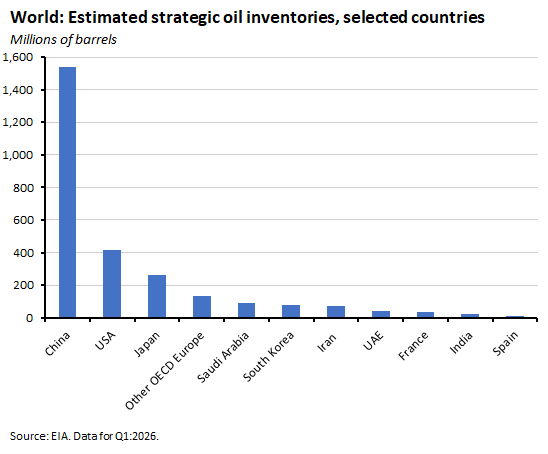
As the IEA noted in that latest statement, many of these options remain in play. Even so, there are also some differences to be mindful of. Yes, there is still significant scope for governments to draw down further on inventories, for example. But levels are now lower than they were.
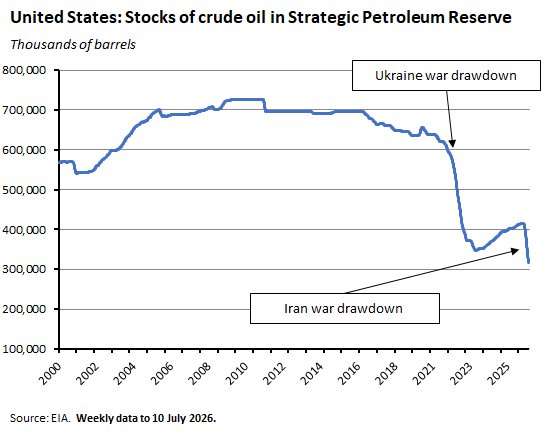
Likewise, further demand destruction is possible but is also likely to be increasingly economically painful (that is, it seems reasonable to assume that the easier and less costly oil efficiency measures will already have been implemented at this point). Then there is the Houthis’ declaration of a blockade on Saudi vessels transiting the Red Sea, which represents another complication. This is also happening at the same time as Ukraine has upped its targeting of Russian energy infrastructure including refining capacity and oil tankers in the Black Sea.
A second question involves the relationship between the oil price, the risk of conflict, and the broader economic fallout. During the first phase of the war, the broad approach to this was: (1) Estimate the likely size and duration of disruption to supply; (2) apply an estimated price elasticity of demand to this supply loss and estimate the likely impact on price; (3) take this estimated price impact and estimate the likely impact on global inflation and growth.
Those kinds of calculations still make sense. But the story is also more complicated than that because there are feedback mechanisms in place between the oil price and the probability of conflict. At low oil prices, the economic cost of war to the global economy (and hence also the associated political fallout) will be lower, which might embolden Washington to be more aggressive in dealing with Iran. As prices and economic costs rise, so does the probability of TACO. Conversely, at low oil prices (and with no robust agreement on issues such as tolls over the Strait), the temptation for Iran to do things that will push up the price and therefore oil revenues will increase. That calculation by Tehran might also be informed by the rush by other Gulf oil exporters to build alternative supply routes, which implies that the leverage given by chokepoint risk over the Strait of Hormuz could be a wasting asset.
Australian employment jumped in June
According to the latest ABS Labour Force report, Australian employment rose by a seasonally-adjusted 76,300 people in June 2026. Full-time employment grew by 29,300 and part-time employment increased by 47,000. That was up from a 44,000 total increase in May and represented a much stronger result than the market consensus forecast for a 15,000 rise. The Bureau noted that part of the growth came from workers who had been waiting to start a job in May, which it said represented ‘a stronger June movement than has been observed in recent years.’
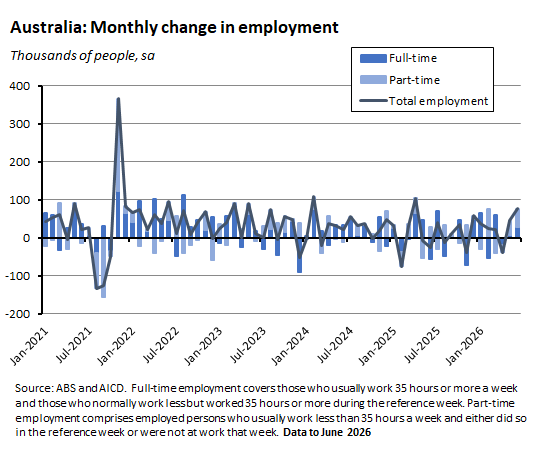
Monthly hours worked in all jobs rose by a modest 0.2% (5 million hours) over the month.
The employment-to-population ratio rose 0.3 percentage points to 64% while the participation rate was also up 0.3 percentage points, climbing to 67%.
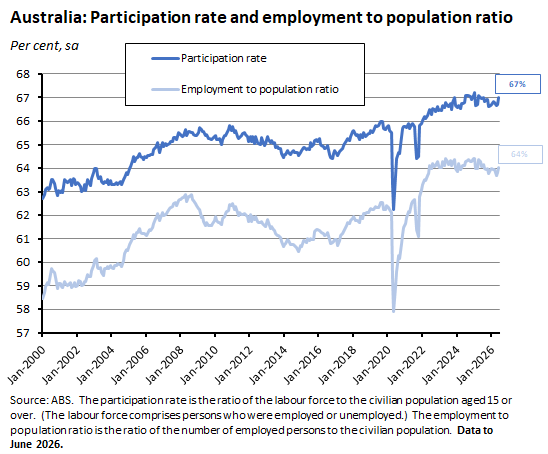
Australia’s seasonally adjusted unemployment rate was unchanged at 4.4% last month, in line with the market consensus forecast (although the ABS notes that in unrounded terms, the rate edged up by 0.1 percentage points). The underemployment rate rose 0.2 percentage points to 6.5% (its highest rate since August 2024) and the underutilisation rate increased by 0.3 percentage points to 10.9%, marking its highest result since December 2021.
Other Australian data points to note
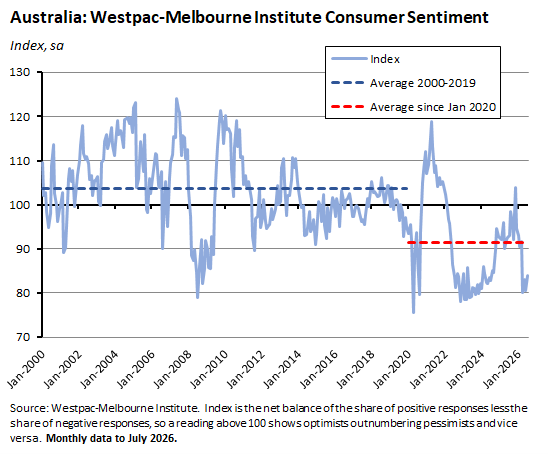
From last week, the July 2026 Westpac-Melbourne Institute Consumer Sentiment Index was up 4.1% over the month to 83.9. The monthly improvement reflected gains in the ‘family finances vs a year ago’ (up 5.6% to a still subdued 71.1) and the ‘family finances, next 12 months’ (up 13.4% to 96.5) subindices, likely reflecting a combination of lower actual fuel prices and a shift in interest rate expectations following the RBA’s decision to leave rates on hold last month. Despite the increase, however, Westpac emphasised that sentiment remained deep in negative territory, with July’s reading located in the bottom 10% of results across the survey’s 50-year history. Moreover, sentiment measures taken after the resumption of conflict in the Middle East showed a ‘significant weakening’ over the course of the survey week.
Also from last week, the June 2026 NAB Monthly Business Survey reported a rebound in business confidence, which rose 9 points from May’s reading to -5 index points. That leaves confidence in negative territory but also means that much of the slump recorded in March after the onset of the Middle East conflict has now been unwound.
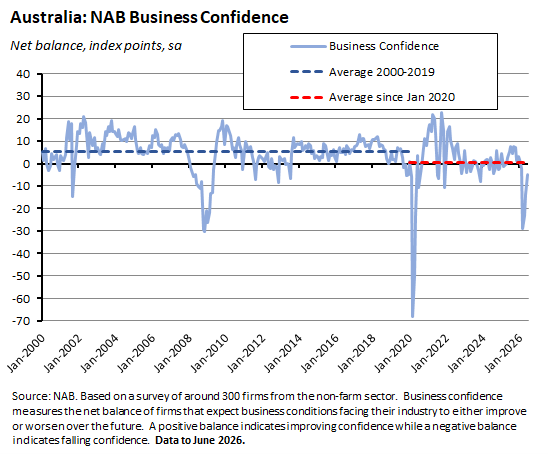
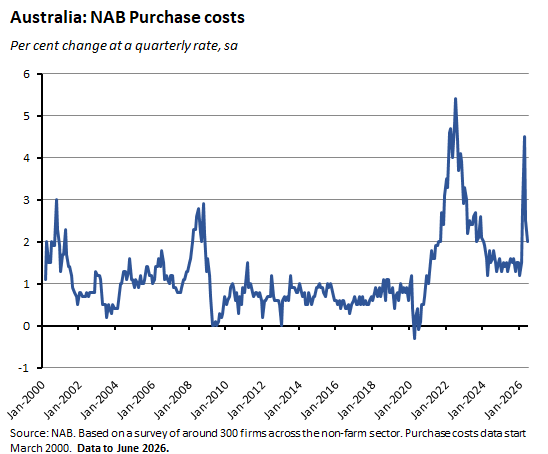
Business conditions were unchanged for a third consecutive month at +3 index points while capacity utilisation was also little changed at 82%. Purchase cost growth slowed again in June, dropping to 2% (quarterly rate) to be well down on April’s 4.5% spike. Growth in labour costs, on the other hand, rose from 1.5% in May to 2% in June.
Further reading and listening
- From the Parliamentary Budget Office (PBO), the 2026-27 Medium-term Budget Outlook. The PBO’s latest medium-term projections suggest a notably improved fiscal position over the coming decade relative to last year’s projections. This improvement is driven by a mix of higher forecast commodity prices over the forward estimates period to 2029-30 and the consequent boost to company tax revenues (due to the Middle East conflict) plus changes to government spending (the Budget 2026 measures to reduce projected NDIS payments by $37.8 billion over the forward estimates) and to taxation (the Budget 2026 changes to negative gearing, capital gains tax, the taxation of trusts and the FBT treatment of EVs are together estimated to increase revenues by just $10.1 billion over forward estimates but by $101.1 billion between 2030-31 and 2036-37). The PBO’s analysis also highlights the ongoing importance of personal income tax as the only major revenue source expected to grow as a share of the economy over the medium term. Under the PBO’s baseline assumption of no further changes to income tax settings, for example, personal income tax revenue as a share of GDP is projected to rise from 12.6% in 2026-27 to 14.7% in 2036-37, largely due to bracket creep. That in turn would imply average tax rates increasing from 24.9% to an historic high of 28.6% over the same period. The PBO does note that in practice, governments will return at least some of this bracket creep in the form of tax cuts. It also follows that, in the case of full indexation to remove bracket creep, the implication would be a persistent deterioration in the fiscal position, absent major offsetting adjustments elsewhere.
- This new Treasury working paper looks at competition and firms’ innovation outcomes. It finds that competition is strongly associated with higher innovation at lower to moderate levels, with the predicted probability of innovation rising by 10-15 percentage points when firms move from monopoly to roughly five or more competitors. The authors note that this is important because a large share of Australian firms face limited competition as around two in five operate with fewer than five competitors while around one in seven report no effective competition.
- The e61 Institute compares AI and internet adoption across Australian consumers and finds that while the pace of adoption of paid AI services is very similar to the early pace of internet adoption, the breadth of AI adoption has been broader.
- Why are Australian workers changing jobs less frequently than in the past, and does it matter?
- A new RBA Bulletin article reports the results of a survey of community attitudes to the economy and the central bank. It finds that inflation is the top economic concern for Australians (cited as a top three economic concern by about 68% of respondents), comfortably ahead of second-placed housing (cited by around 40%). Most respondents reported moderate-to-high levels of trust in the RBA, with a median score of 6 out of 10 (where 0 was no trust at all and 10 was trust completely). The same survey also finds a clear inverse relationship between trust in the RBA and inflation expectations.
- A Lowy Institute Policy Brief considers the Iran war, great power rivalry in the Indian Ocean and the stakes for Australia.
- How oil price shocks change the map of conflict.
- On tank bottoms and oil inventories.
- Two interesting Big Reads from the FT. The first is on the start of the Kevin Warsh era at the US Federal Reserve and highlights an aversion to forward guidance and a reduction in the volume and frequency of communications as the Fed balances the risks of encouraging market complacency with triggering greater market volatility. The second looks at how the changing US-China relationship has impacted US and Brazilian agricultural exports.
- The WSJ’s Greg Ip on sky-high deficits and the US bond market.
- The Global balance sheet 2026 (McKinsey Global Institute).
- The Economist magazine on Earth’s falling albedo and a warming planet.
- The Peterson Institute estimates that the global economic cost from the impending Super El Nino could be around US$686 billion, or 0.6% of world GDP. Over a five-year period, cumulative losses could reach US$3.1 trillion.
- From the Deutsche Bank Research Institute, Mapping the world’s prices 2026. Lots of interesting comparisons here. On the report’s quality-of-life rankings, two Australian cities are ranked in the top 50, with Melbourne (#11) ahead of Sydney (#14), while the top three spots go to Luxembourg, Copenhagen, and Amsterdam. On the disposable income rankings (based on two persons working and renting a three-bedroom apartment), Melbourne (#9) makes it into the top ten while Sydney (#29) is ranked much lower. Notably, both Australian cities are rated as having some of the most expensive public transport.
- A new BIS Bulletin on Frontier AI and cyber risk warns that while frontier AI models increase the speed, scale and complexity of cyberattacks while also boosting cyber defences, an asymmetric distribution of costs may favour attackers over defenders. Also from the BIS, a new working paper on the AI investment race.
- What will be left for us to work on? (AI As Normal Technology).
- I’m a bit late to this one, but this is an interesting two-part article in the WSJ on the inside story of Europe’s rupture with the United States.
- The IEA’s Global Critical Minerals Outlook 2026 highlights the arrival of a ‘raft’ of new export restrictions from leading suppliers alongside price volatility and geopolitical tensions.
- The OECD’s Corporate Tax Statistics 2026 reports that the share of corporate tax revenues in total tax revenues decreased slightly in 2023, falling from 17.8% in 2022 to 17.3% on average across the 146 jurisdictions covered in the report’s database. The share of these revenues in GDP likewise decreased slightly, easing from 3.6% to 3.5% on average. The OECD also reported an ongoing stabilisation in corporate tax rates, with statutory rates of corporate income tax remaining stable over the 2020 to 2026 period after having trended lower over the previous two decades. From 2020 to 2026, the average statutory rate has remained around 21.2%. That average disguises some significant variation in rates: in 2026, 14 jurisdictions had a statutory tax rate of less than 10%; 33 jurisdictions a rate between 10% and 20%; 74 jurisdictions a rate of between 20% and 30%; and 25 jurisdictions a rate greater than 30%. Australia currently has a standard 30% rate with a reduced 25% rate for smaller businesses (but note that the presence of dividend imputation in the Australian tax system makes simple cross-country statutory rate comparisons problematic).
- The latest IMF Article IV report on the UK economy reckons that the Iran war has dampened near-term growth prospects, as the UK’s reliance on net energy imports leaves it vulnerable to higher oil and gas prices. It also warns that over the coming decades, the UK will face large and persistent pressures from population ageing, higher defence commitments, and the climate transition, which together could lift public spending by around 7% of GDP by 2050. At the same time, medium-term growth prospects are weighed down by weaker total factor productivity (TFP) growth and subdued capital deepening. The Fund points to slower innovation, diffusion and scaling of new technologies in intangible-intensive sectors as contributing to the UK’s weak TFP performance and urges progress on labour mobility, skills gaps, and financing for innovation. Relatedly, the latest OECD Economic Survey of the UK highlights ‘persistent headwinds’ including ‘high and volatile energy prices, rising fiscal pressures, weak productivity growth and lasting regional disparities.’
- George Magnus examines China’s great game for the Arctic.
- A look at the solarisation of Pakistan’s energy economy (Ember).
- The Ancient World beyond Greece and Rome.
- The Odd Lots podcast in conversation with the creator of Claude Code.
- The FT’s Unhedged podcast considers prediction markets.
- Bloomberg’s Trumponomics podcast investigates the rising price of fun.
- The Rest is History podcast has two episodes on The Odyssey. Related (from back in 2019) the Conversations with Tyler podcast talks to Emily Wilson about the difficulties of translating Homer into English.
Latest news
Already a member?
Login to view this content