

 This product has already been purchased.


Overview
A deep dive into the war-driven discussion on the weaponisation of chokepoints in the world economy, Australia’s vulnerability to a squeeze on liquid fuel imports, and the broader debate around national economic resilience and supply chain security.
Below we consider:
- The war as an example of ‘chokepoint risk.’
- The state of the debate on national economic resilience and supply chain risk.
- Pre-war thinking on Australia’s liquid fuel security.
- Australia’s current energy footprint and our growing reliance on fuel imports.
- Why (so far) it’s all about oil, not gas.
- Liquid fuel and the transport sector.
- Australia’s pre-war energy security framework.
- How we measure our stocks of liquid fuel.
- The government’s policy response to date.
- We finish with some thoughts on the implications of recent developments.
- A short annex looks at the fuel supply chain, the pricing of petrol and diesel and the role of tax and fuel excise.
War, energy shocks, and ‘chokepoint risk’
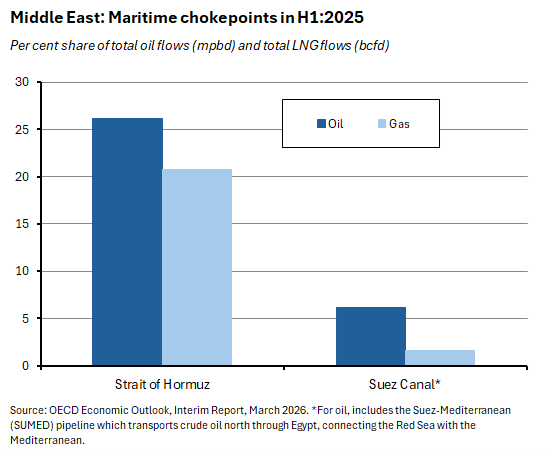
The war in the Middle East that began on 28 February this year has already triggered what the International Energy Agency (IEA) has described as the largest supply disruption in the history of the global oil market. With supplies of LNG also squeezed by a combination of the effective closure of the Strait of Hormuz and damage to regional infrastructure, the result has been an unfolding global energy shock that serves as a particularly potent example of chokepoint risk in action. Tehran has successfully combined geography and force to squeeze the global economy.
The consequent disruption to physical supply has already had an impact that extends beyond the impact of elevated energy prices to include policy-driven efforts to manage demand. Governments across the world are now driving one of the biggest efforts to shift fuel-consumption habits seen since the 1970s, relying on a mix of voluntary actions, soft restrictions and incentives, with the probability of harsher interventions on the rise. On 20 March, the IEA released a new report on sheltering from oil shocks, suggesting ten demand-side options to reduce the pressure on energy prices. Since then, already-announced measures including the introduction of a four-day work week for state institutions and schools (Sri Lanka), two weeks of school closures (Pakistan), and university closures and restrictions on air conditioning usage (Bangladesh, Cambodia). The IEA’s 2026 Energy Crisis Policy Response Tracker lists other measures including restrictions on travel for public officials (Indonesia), the promotion of public transport through fare caps or freezes (Chile, Egypt, Philippines), government encouragement to WFH (Thailand, Vietnam), and the introduction of caps on fuel purchases (Slovakia, Slovenia), with the list growing by the day.
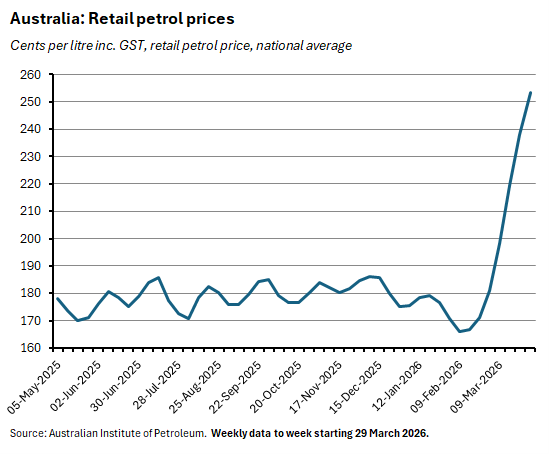
Here in Australia, the shock has manifested in higher prices for petrol and diesel at the pump, a running tally of petrol stations without one or more forms of fuel, outbreaks of localised fuel shortages, and growing concerns that a lengthier interruption to supply will require direct government intervention in the form of the allocation, prioritisation, and rationing of fuel supplies. That said, Canberra continues to insist that it will work hard to avoid that outcome.
Much of the initial economic analysis of the war in the Persian Gulf has focused on the macro fallout in terms of the potential implications for economic activity, inflation, and financial stability (see for example our notes here, here and here). But in parallel, recent developments can also be viewed in the context of the intensifying debate around building national economic resilience and managing global supply chain security in the face of intensifying chokepoint risk.
National economic resilience and supply chain risk
The breakdown of the post-Cold War unipolar order, the intensification of geoeconomic competition between (but not restricted to) Beijing and Washington, and a growing willingness to weaponise international economic integration from restrictions on key exports and limits on market access for imports through to the aggressive deployment of financial sanctions, have all encouraged a rethink on the appropriate policy approach to globalisation, national economic resilience, and international supply chain security.
These concerns were given further impetus, first by COVID-19. The pandemic concentrated policymakers’ minds on threats to the availability of a range of products from face masks and other personal protective equipment (PPE) to vaccines. Then came the Ukraine war, with its disruption to energy and food markets and the consequent spike in prices that contributed to a synchronised global inflationary shock.
More recent additions to this lengthening worry list included demonstrations of the vulnerability of key maritime chokepoints, from the low water levels in the Panama Canal in 2023 and 2024 that restricted shipping flows to the Houthi’s attacks on vessels seeking to transit the Red Sea and the Bab-el-Mandeb Strait. Back in March 2024, for example, we wrote on the impact of geopolitical tensions on maritime trade, cautioning that ‘this is not the first time global maritime trade has been threatened by geopolitics, and probably won’t be the last.’ In the same month, David Uren’s report for ASPI on trade routes and economic security highlighted ‘our reliance on and need to defend Australia’s trade routes’ in the context of the ‘vulnerability of Australia’s limited stockpiles of critical goods and its concentrated sources of supply.’
This new international environment is now forcing policymakers to reconsider existing national economic models. Back in June 2024, we argued that the government’s new Future Made in Australia policy program should be seen in the context of an attempt to restructure the Australian growth model in response to a new and much less benign international environment, and more recently we highlighted the challenges raised by an expanding security state. Current events look certain to provide more impetus to such efforts, which will have their own implications for government spending and intervention in the economy, and hence for productivity and growth.
Pre-war thinking on Australia’s liquid fuel security
While talk of the weaponisation of global economic chokepoints is relatively new, worries about supply chain vulnerability in general and Australia’s liquid fuel security in particular have been around for some time. Indeed, at least some Australian security analysts are currently having a ‘we told you so’ moment, pointing to longer-term concerns over Australian dependence on imported fuel. And it is fair to say that we had been warned.
Back in 2013, for example, the NRMA published a report by John Blackburn on Australia’s Liquid Fuel Security which cautioned that Australia had:
‘…adopted a “she’ll be right” approach to fuel security, relying on the historical performance of global oil and fuel markets to provide in all cases. Unfortunately, as a result of our limited and decreasing refining capacity, our small stockholdings and long supply chains, our society is at significant risk if any of the assumptions contained in the vulnerability assessments made to date prove false. We would not be the first country to get our assumptions wrong.’
The next year brought a related report from Engineers Australia on what it described as the ‘wicked problem’ of energy security, including a section on the need to address ‘liquid fuel insecurity’ which it argued ‘poses an enduring risk to Australia’s economic security, national security, food security, and social stability.’ Other, similar warnings have followed. See in this context, Fuel Security in Australia: An annotated bibliography.
In March 2018, the Australian government announced a Liquid Fuel Security Review, and an interim report was published in 2019. A draft final report was also prepared in 2020 although – derailed by the pandemic – it was never formally published. That draft told readers that:
‘Many Australians have not experienced a major fuel shortage or disruption. We have enjoyed over 40 years of relatively stable supply, but there is no room for complacency. Our economy relies on liquid fuel, and large, long-term disruptions would have widespread impacts on our way of life…Liquid fuel is the backbone of the Australian economy. It underpins every aspect of our daily life, from our groceries to our commute to work and our emergency services.’
Despite that four-decade-long history of relative success in delivering energy security, the draft final report cautioned that ‘although unlikely, there could be fuel shortages in some scenarios.’
Of particular note given current events is that the Review’s authors considered multiple scenarios intended to capture a range of possible disruptions to Australia’s fuel supply. Today’s events look to be a blend of three of them: one involving a conflict in the Middle East; one in which there is a disruption to maritime trade through the Strait of Hormuz; and a ‘worst case’ scenario under which Australia does not receive any imports of liquid fuel (crude oil and refined products).
In the case of the first two scenarios, the Review’s assumption was that the main impact would be felt through higher oil prices rather than physical fuel shortages. Hence, higher prices were expected to fulfil their market-equilibrating function of demand destruction. That would allow a relatively wealthy Australia to secure supply, albeit at a greater cost (and presumably also at the expense of less wealthy importing countries). In the Middle East conflict scenario, for example, the draft report argued that ‘the nature of the global markets is such that supply can be maintained (that is, increased prices would reduce the demand)…history suggests that the risk of supply interruption would be unlikely.’
The report also thought that Australia would be protected by our limited reliance on direct supplies from the Middle East (but see the section on Australia’s energy below), and that our access to supply from refiners based in East Asia would be ‘unlikely to lead to refined fuel shortages, as these countries would be able to draw down on their large commercial stocks and, if necessary, emergency stocks.’
Likewise, in the scenario involving a blockage to the Strait of Hormuz, the draft report reckoned that ‘a maritime disruption…is only likely to be for a matter of weeks, given the international naval resources deployed in the area.’ Hence the shock would again be felt in prices rather than shortages.
To generate a scenario under which physical shortages of fuel were the likely outcome, the report turned to a ‘worst case’ scenario, under which Australia would not receive any imports of liquid fuel:
‘Circumstances under which Australia would receive no imports of fuel would require multiple and simultaneous failures in the global system, such as global armed conflict, and multiple and escalating natural disasters. It is highly unlikely that this scenario would occur.’
Under these circumstances, the scenario envisioned that the Government would have to manage fuel supplies by declaring a national liquid fuel emergency under the Liquid Fuel Emergency Act 1984 (LFE Act) and thereby prioritise fuel for essential users. Under the Act, ‘essential users’ comprises: Australian defence services; ambulance, corrective, fire and rescue and police services; public transport services; state emergency services and equivalent organisations; and taxi services. The LFE Act also gives the Minister for Climate Change and Energy powers in a declared emergency to control industry-held stocks of crude oil and liquid fuels, the production of Australian refineries, and fuel sales across Australia.
It is striking, then, that in the current situation, there is already speculation that this kind of government intervention will soon be required, and in circumstances considerably less dire than those assumed in the report. Chokepoint risk in action.
One last piece of pre-war analysis worth reviewing here is the Productivity Commission (PC)’s July 2021 study on Vulnerable supply chains. This was a response to the way ‘Australia’s experience with the COVID-19 pandemic has highlighted Australia’s potential vulnerability to global supply chain disruptions.’ The government directed the PC ‘to examine the nature and source of risks to the effective functioning of the Australian economy and Australians’ wellbeing associated with disruptions to global supply chains, identifying any significant vulnerabilities and possible approaches to managing them.’
In its overall assessment, the PC found that despite disruption from COVID and trade tensions, ‘most essential supply chains have proved resilient’ and argued that for imports ‘only a few traded products are vulnerable’ (mainly some chemicals and some items of PPE). The PC judged that ‘businesses can usually manage these risks through stockpiling, contracts and diversification.’
The PC’s approach to assessing import vulnerability involved identifying which imports were highly concentrated (defined as where the main supplier accounted for more than 80 per cent of the total imports of a product), whether there were limited alternative suppliers available (defined as where the main exporter accounted for more than 50 per cent of global exports), and whether Australia sourced its concentrated imports from the main global supplier in a concentrated market. The Commission’s next step was to determine whether these vulnerable imports were also essential.
Returning again to recent developments, it is notable this approach did not identify petroleum products as vulnerable. In Box 4.4 in the PC report, the Commission explains that a finding of vulnerability would have required significant changes to its data-driven approach including: broadening the geographic scope and product classifications used (to capture refined fuels as vulnerable, given six Asian economies then accounted for over 90 per cent of imports of refined fuels); examining more tiers in the supply chain (since 70 per cent of imported refined fuels at the time originated from crude oil from the Middle East); and using lower thresholds of market concentration (since just five economies accounted for about 50 per cent of global exports of crude oil and 40 per cent of global exports of refined fuels).
Aware of the issues involved, the PC reflected that these kinds of considerations showed that industry experts were required to complement its data-driven approach.
Similarly, in Box 7.2 in the same study, the Commission noted that liquid fuels were not identified as vulnerable due to the range of suppliers from which Australia imported. The Commission said that this did not mean that Australia would be immune from disruption to its supply of critical fuels, but that it did follow that there were likely to be several options available.
Australia’s energy consumption by fuel and by sector
So much for the pre-war discussion. But how should we understand the actual state of play in terms of energy and liquid fuel security?
One helpful starting point is the mix of Australia’s energy consumption. Total energy consumption measures total energy consumed within the economy in net terms, and is equal to the consumption of all fuels, less the domestic production of secondary fuels (primary fuels are forms of energy obtained directly from nature, requiring only extraction or collection and include fossil fuels [coal, oil, gas] and renewables [wind, solar and hydro]. Secondary fuels are forms of energy produced by transforming primary fuels or other secondary fuels into other energy sources and include electricity and petroleum products from refineries).
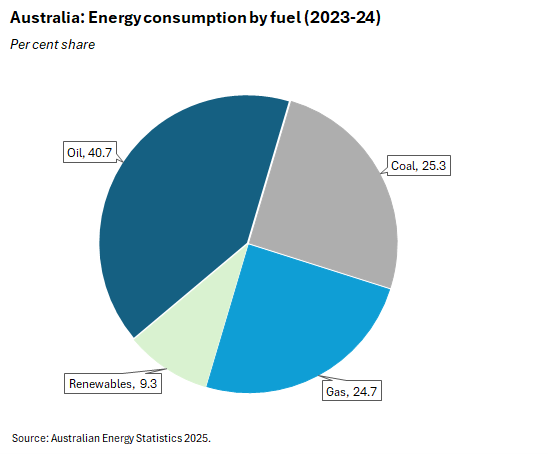
According to the latest Australian Energy Statistics, Australia’s total energy consumption in 2023-24 was 5,977 petajoules (PJ) in 2023-24. Of that, about 41 per cent came from oil, around 25 per cent each from coal and gas, and nine per cent from renewables.
By sector, energy use is dominated by transport (about 30 per cent), electricity supply (23 per cent), manufacturing (about 16 per cent) and mining (15 per cent), which collectively account for more than 80 per cent of total energy consumption.
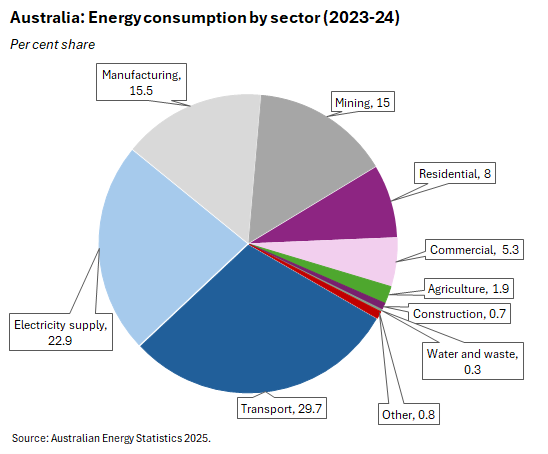
Final energy consumption is a measure of energy demand by the final consumer. Total final energy consumption is equal to the total energy consumed in final or end-use sectors and is given by total energy consumption less energy consumed or lost in conversion (for example, in refining crude oil into petroleum products or turning gas and coal into electricity), transmission and distribution.
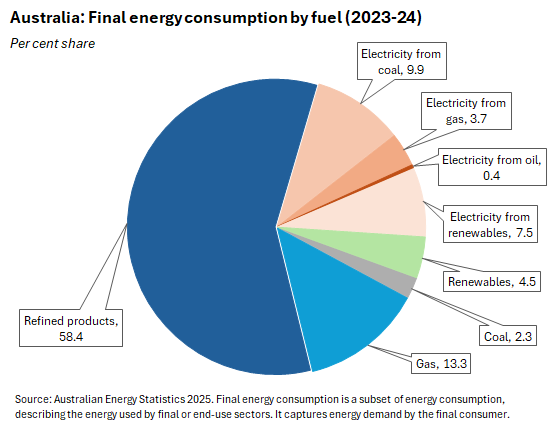
In 2023-24, Australia’s total final energy consumption was 4,035.5 PJ. Of that, about two per cent came from coal, 13 per cent from gas, 58 per cent from refined products (such as gasoline, aviation fuel and diesel fuel), 22 per cent from electricity, and five per cent from renewables.
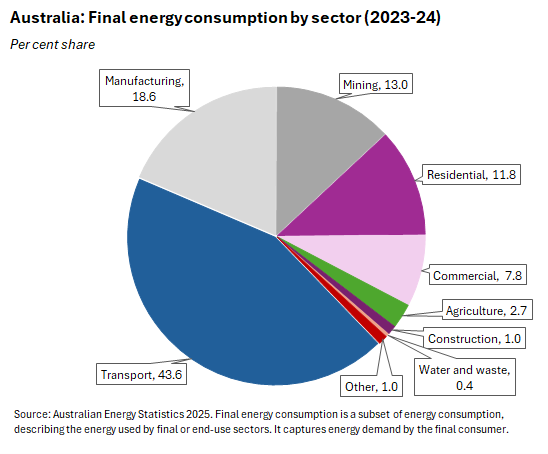
In terms of end use, final energy consumption is dominated by transportation, which accounts for about 44 per cent, followed by manufacturing (19 per cent), mining (13 per cent) and residential use (12 per cent).
Australia’s dependence on imports of crude and refined products
Australia exports most of its domestic energy production (about 80 per cent in 2023-24) and is a substantial net energy exporter overall, with net exports equal to about 67 per cent of production in the same year. For example, in 2023-24, 88 per cent of black coal energy production, 74 per cent of domestic natural gas production, and 96 per cent of crude oil production was exported.
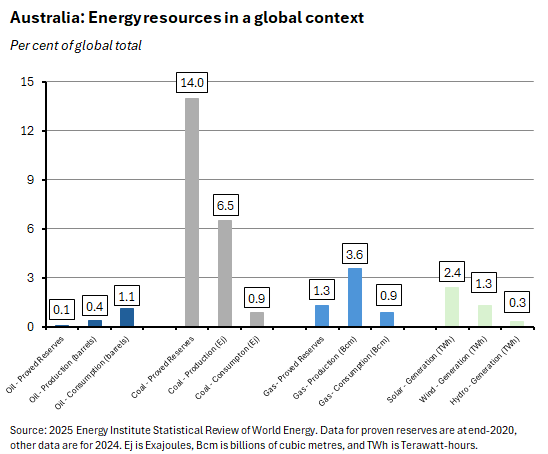
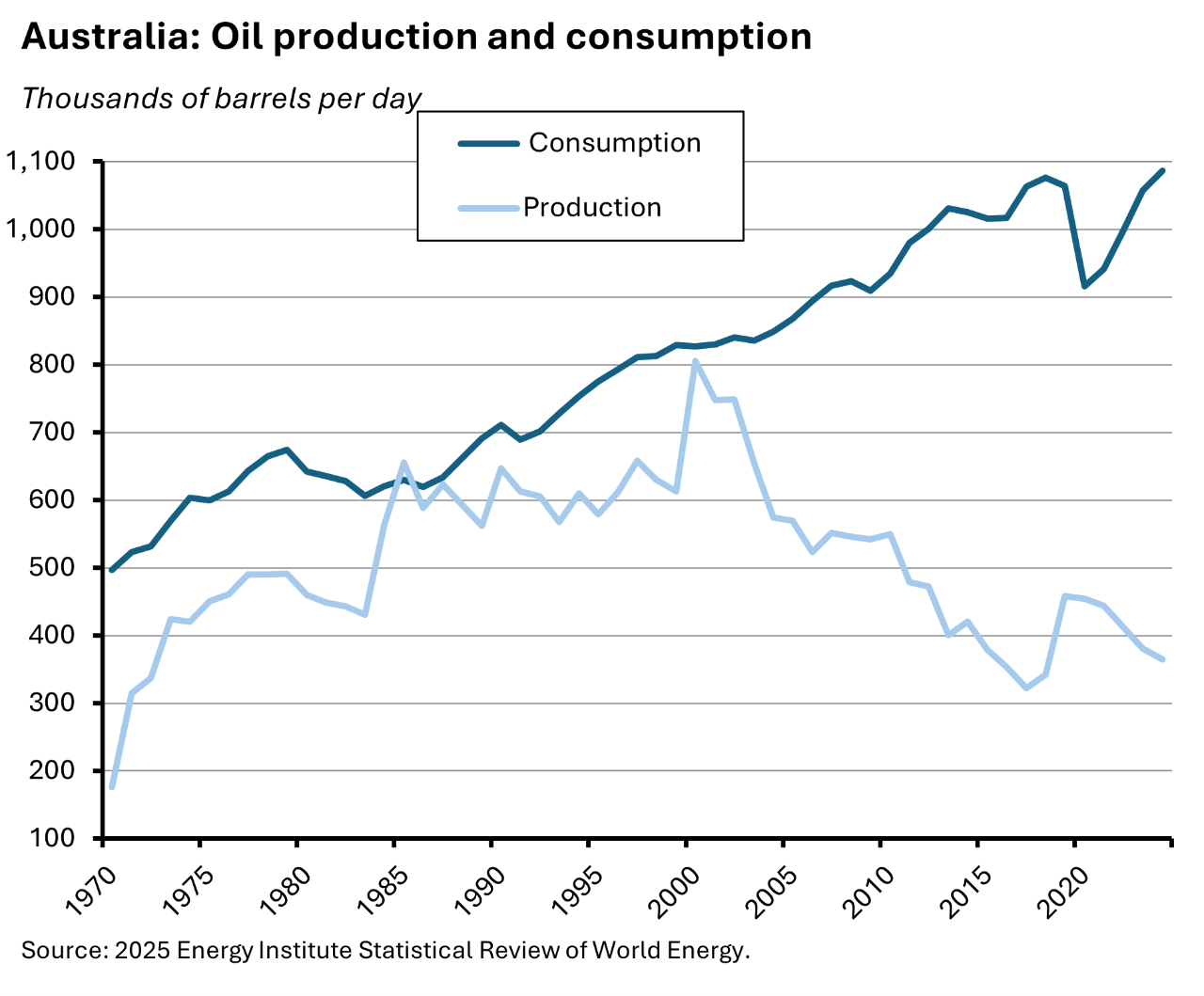
While Australia is more than self-sufficient in terms of coal and gas, however, the same is not true for oil and petroleum products. According to the Energy Institute, Australia has just 0.1 per cent of the world’s proved oil reserves while accounting for about 0.4 per cent of global production and 1.1 per cent of global consumption. (Note this does not consider the potential for Australian shale oil.)
Australian oil production has fallen further behind consumption over time, with the gap being met by imports. Most (about 97 per cent in 2022-23) of that remaining Australian oil production is exported. About 80 per cent of Australian oil production is located off the Northern coast of Western Australia and is sent mainly to East Asian refineries, partly reflecting geographical proximity and partly reflecting the type of oil produced – a mix of light sweet crude plus condensates associated with North West Shelf LNG projects, which is not well-suited to domestic refineries.
According to the draft Liquid Fuel Security Review, although they are not configured to do so, domestic refineries could process this Australian product in an emergency. But the Review estimated that even if all crude and condensate then produced was processed in Australia, this would still only account for about 30 per cent of our total consumption of liquid fuel.
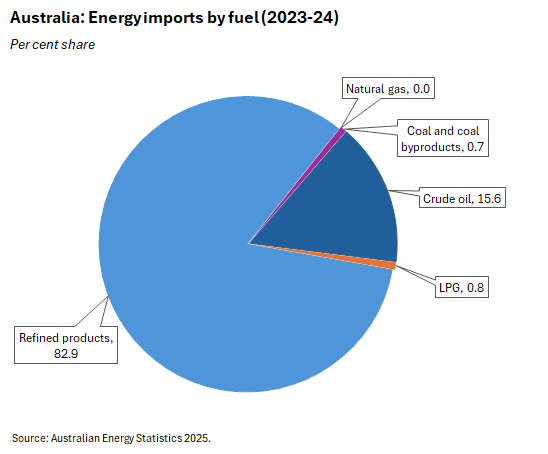
Australia’s energy imports are therefore dominated by a mix of crude oil and refined petroleum products. In both cases, imports now account for most of our domestic consumption. Despite Australia’s status as a major global energy exporter, this means we remain heavily dependent on this particular subset of energy imports.
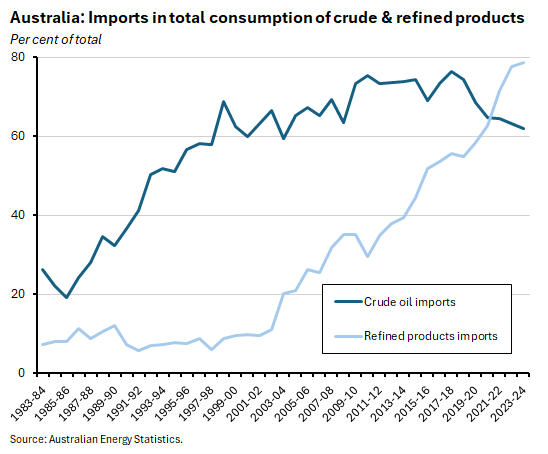
The balance between our imports of crude oil and of refined products (such as petrol, diesel and jet fuel) has evolved over time, with a marked increase in imports of refined products as a share of Australian domestic consumption in recent years. This shift reflects a significant decline in Australia’s domestic refinery capacity since the early 2000s. That same trend has also brought a more modest recent decline in the share of imports of crude in total domestic consumption.
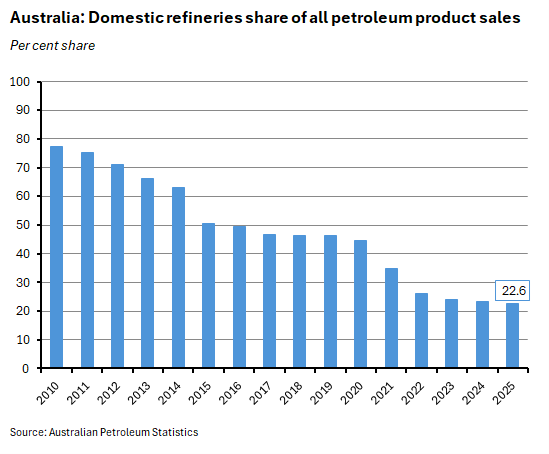
Back in 2002, there were still eight domestic refineries operating in Australia. Since then, six have closed: Port Stanvac in 2003, Clyde in 2012, Kurnell in 2014, Bulwer Island in 2015, and both Kwinana and Altona in 2021. Five of these were subsequently converted into import terminals (Port Stanvac the sole exception).
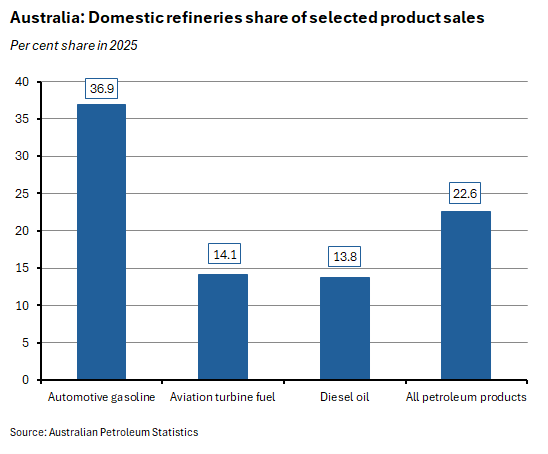
The story here is that smaller, ageing Australian refineries were unable to compete with larger, lower cost Asian operations. Their competitive position further deteriorated in the context of rising regional excess capacity in the aftermath of the pandemic, and the two refinery closures in 2021 left just two Australian facilities in operation: Ampol’s Lytton refinery in Brisbane and Viva Energy’s Geelong refinery in Victoria. As a result, the share of domestic refineries in Australia’s petroleum product sales has fallen steadily over time, dropping from more than 77 per cent in 2010 to less than 23 per cent by 2025.
By fuel type, as of last year the supply from domestic refineries accounted for less than 37 per cent of all petrol (automotive gasoline) sales in Australia and only around 14 per cent of sales of jet fuel (aviation turbine fuel) and diesel oil.
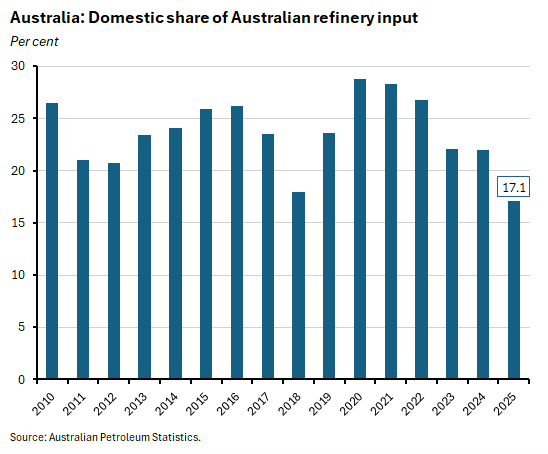
Moreover, our remaining domestic refining capability is largely reliant on imported crude oil and condensate. The share of domestic crude used by Australian refineries had fallen to just 17 per cent by last year.
Australia is therefore dependent on both imports of crude oil and imports of refined petroleum products.
The country source of that import trade varies by product. In 2025, for example, the majority of Australian petrol imports were sourced from Singapore (55 per cent), South Korea (22 per cent), India (11 per cent) and Malaysia (10 per cent). But while those four markets accounted for nearly all our petrol imports, their share of imports of diesel oil and aviation turbine fuel was lower. In the case of aviation fuel, for example, China was a particularly significant supplier last year, accounting for about 32 per cent of imports by volume – hence the angst around reports that Beijing was banning exports of refined products. South Korea was our largest supplier of diesel (accounting for about 29 per cent) and Malaysia was the largest source of imports of crude oil and other refinery feedstocks (with a share of around 39 per cent).
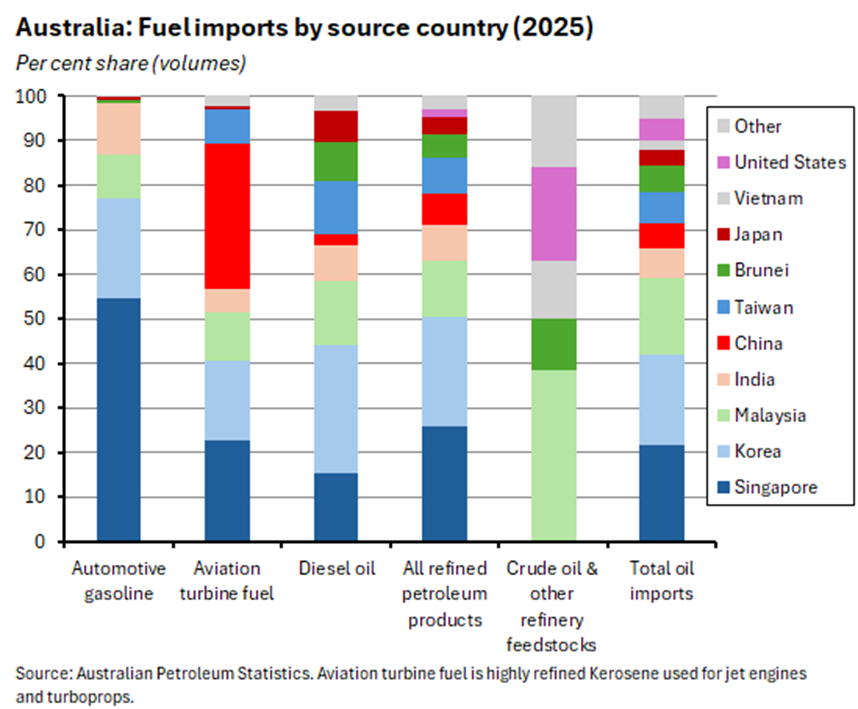
Australia’s relative reliance on Asian intermediaries for its oil needs means that – as assumed by some of those pre-war risk scenarios – our direct exposure to the Middle East appears to be limited.
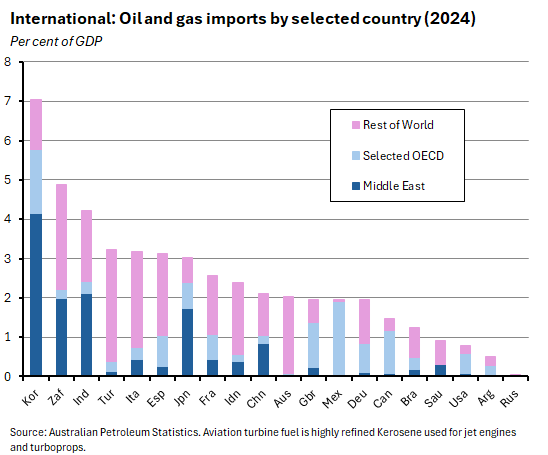
But shift the view a little, and most of our supply still originates in the Strait of Hormuz before flowing to East Asian refineries and then being shipped on to Australia. That leaves Australia’s fuel security ‘dependent on a chain of maritime chokepoints stretching from the Persian Gulf to the Indonesian archipelago’ including not just the Strait of Hormuz but also the straits of Malacca, Lombok and Sunda.
But what about gas?
Before examining the vulnerabilities created by the key role of liquid fuels in our transport and other industries, it is first worth considering the distinction between Australia’s energy security when it comes to oil and gas.
At first glance, the difference is obvious. As noted above, Australia is a net gas exporter and a net oil importer, which means that (1) at an aggregate level we ‘win’ from higher gas prices (our terms of trade improve) but lose from higher oil prices and (2) the risks to physical supply are very different.
That said, even as a net gas exporter, Australia remains exposed to shocks to the gas market via fluctuations in market prices. In the aftermath of the Russian invasion of Ukraine in 2022, for example, there were sharp increases in the international price of gas (as well as of thermal coal) which spilled over into the domestic Australian East Coast Gas Market (ECGM). Unhelpful domestic market conditions (including declines in the availability of coal-fired generation due to a mix of planned maintenance and forced outages which boosted gas-fired power generation, along with physical fuel supply and hydrological constraints at some thermal and hydro generators) meant that local markets found themselves forced to effectively compete at the margin with gas demand for LNG exports. As a result, wholesale spot prices in the National Electricity Market (NEM) and the ECGM soared to unprecedented average levels in the June quarter 2022, with average spot gas prices jumping by an eye-watering 246 per cent over the year.
Now consider current conditions. The conflict in the Persian Gulf has not only interrupted the transit of Qatari LNG exports through the Strait of Hormuz (about 20 per cent of the global market) but even more importantly seen significant damage to the massive Ras Laffan facility, triggering a temporary shutdown of LNG production which the Qataris say could take up to five years to fully repair, forcing QatarEnergy to declare force majeure on some contracts. That in turn has prompted a surge in LNG prices in Europe and Asia.
Yet, to date, the reaction of Australian gas prices has been remarkably muted. There has been no re-run of the Ukraine experience.
One explanation relates to differences in domestic demand and supply conditions compared to those prevailing during the Ukraine conflict. According to the latest Australian Energy Market Operator (AEMO)’s gas adequacy outlook, for example, gas adequacy in the ECGM has improved in the near-term due to a mix of more supply, less household and business consumption (due to more electrification) and less demand for gas-powered generation (due to the delayed retirement of the Eraring Power Station and more battery storage being connected to the market).
The market rules set by the Australian authorities have also changed since early 2022, with the introduction of the Gas Market Code including a price cap (or ‘reasonable pricing’) of $12/GJ which is intended to anchor wholesale contract negotiations between gas producers and buyers.
Yet another suggestion is that gas exporters have been on their ‘best behaviour’ as the government plans the introduction of a gas reservation scheme for the ECGM in 2027 and is reportedly also considering the case for a windfall profit tax.
While this situation could still change, for now the focus of the current energy crisis remains on liquid fuels, not gas.
The key role of liquid fuels in transport and beyond
The pattern of Australia’s energy consumption and energy trade means our import dependence is concentrated on the oil sector, where imports of petrol (or automotive gasoline), diesel oil, and jet fuel (or aviation turbine fuel) are particularly important.
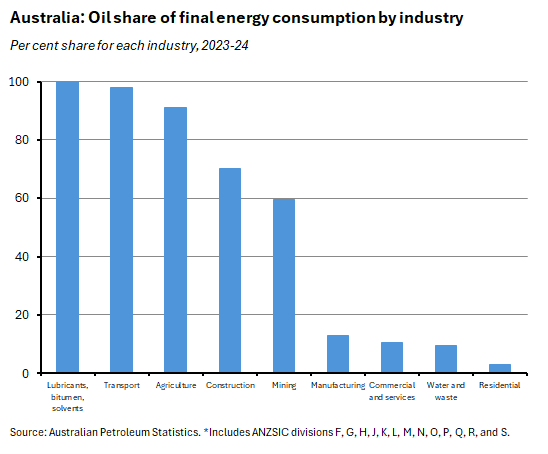
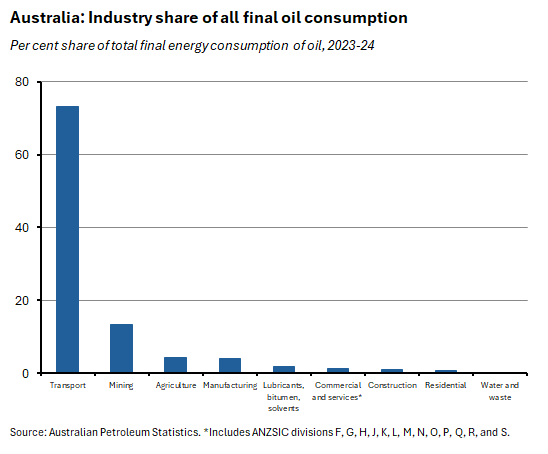
Where do the resultant vulnerabilities lie? By sector, oil plays a critical role in the transport, agriculture, construction and mining industries, with diesel in particular having an important role in key industries.
In terms of the relative size of domestic oil demand, the vast majority of oil consumption is accounted for by the transport sector, followed by mining and agriculture.
In the draft final report of the Liquid Fuel Security Review, the authors concluded that in a domestic fuel emergency, access to diesel would be of particular importance, given that it: is essential for emergency services and elements of the Australian defence force; provides the main source of electricity generation in remote communities and provides backup generation across critical services including hospitals, water and sanitation; powers the trucks, trains and shipping vessels that comprise Australia’s freight and logistics.
Last year, our volume of diesel consumption (33,508 million litres) was more than double our petrol consumption (15,798 million litres).
Australia’s pre-war energy security framework
So, how has Australia sought to manage this vulnerability?
In the period following the Liquid Fuel Security Review, the Australian government took several measures to boost Australia’s fuel security, many of them linked to the Fuel Security Act 2021. Those measures included:
- An Australian version of a domestic fuel reserve in the form of the Minimum Stockholding Obligation (MSO).
- A Fuel Security Services Payment (FSSP), intended to keep Australia’s two remaining oil refineries running.
The MSO began on 1 July 2023 and required regulated entities – which comprise Australian fuel importers and refineries – to report stock levels on a weekly basis, and to hold certain baseline stock levels. As of 2025-26, these stocks were set for gasoline at 24 days for refiners and 27 days for importers, for kerosene at 24 days for refiners and 27 days for importers, and for diesel at 20 days for refiners and 32 days for importers.
The FSSP for domestic refiners commenced on 1 July 2021, and pays refiners a production payment during loss-making periods, where the payment is based on the number of litres of FSSP fuels (petrol, diesel, and jet fuel). The original requirement was that the two supported refineries would continue operations until at least 30 June 2027 with an option to extend to 30 June 2030.
Other elements of Canberra’s fuel security policy framework included support to build additional storage capacity through the Boosting Australia’s Diesel Storage Program (BADSP) which operated over the three years to 2023-24, along with funding for the domestic supply of diesel exhaust fluid in the form of the 2022 Maintaining Our Supply of Diesel Exhaust Fluid (MOSDEF) grants program (later extended in 2025/26 to 2030), which provides funding to support the domestic manufacture of DEF or TGU. DEF (also known by the trade name ‘AdBlue’) is manufactured by blending technical grade urea (TGU) with deionised water. It is essential for the operation of modern diesel engines fitted with selected catalytic converter systems and is mostly consumed by Australia’s long-haul trucking fleet. The legislation also established a strategic stockpile of TGU.
Canberra also briefly established a national oil reserve stored in the United States, although this was later sold on the international market as part of the global response to the energy price shock triggered by the Russian invasion of Ukraine in 2022.
Measuring Australia’s stocks of liquid fuel
In gauging Australia’s fuel security, the level of available fuel stocks is a critical input. Australia measures and reports its fuel stocks using three different measures.
First, there is the MSO discussed above. This is a domestic fuel security stock measure which targets and reports on the volume of fuel the petroleum industry is required to hold in reserve. It covers gasoline (petrol), kerosene (jet fuel), and diesel. The MSO measure includes stocks of the relevant fuel held on land in Australia or in our domestic and coastal waters, plus stocks in pipelines and on water in Australia’s Exclusive Economic Zone plus stocks of crude oil and some other unfinished stocks held at refineries (and converted to equivalent refined product).
Compliance with the MSO is based on volumes of fuel held measured in megalitres (MLs), but these stocks can be converted in days equivalent, which measure how long stocks would last assuming a normal rate of consumption. As of 24 March this year, MSO stocks stood at 39 days for gasoline, 30 days for kerosene and 30 days for diesel.
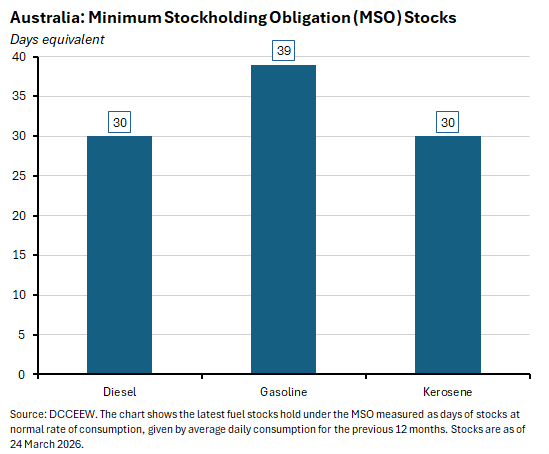
It is important to note the ‘normal’ in the construction of days equivalent, which makes this a backward-looking measure. Should consumption rates increase markedly going forward (for example due to precautionary stockpiling or ‘panic buying’), then the actual days cover for a given volume of fuel will prove to be lower.
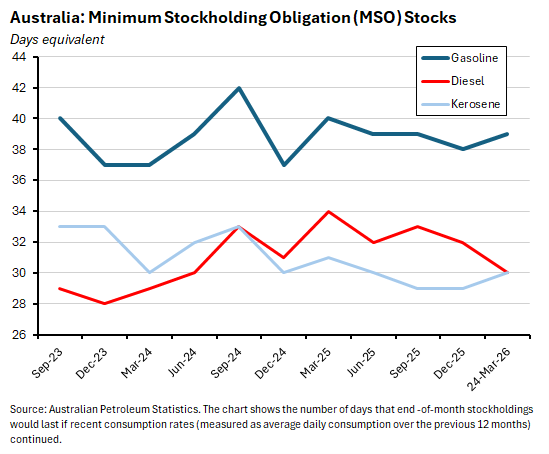
Our second measure of stocks is the IEA days measure, which is a gauge of import dependence. This measure is intended to capture Australia’s compliance with the IEA’s stockholding obligation, which requires members to hold oil stocks equivalent to 90 days of net imports (total oil imports less exports, not consumption). IEA days include crude oil, other refinery feedstocks and all refined products combined, reported as a single figure.
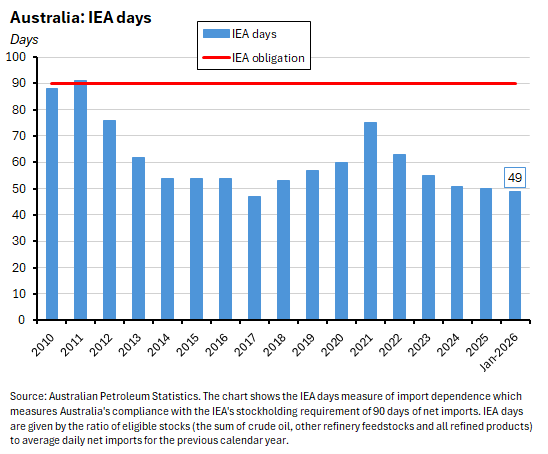
IEA days are calculated as total eligible stocks at the end of each month divided by average daily net imports for the previous calendar year. As of January 2026, Australia reported 49 IEA days of net import coverage, meaning that we are in breach of our IEA obligations (and have been since 2012).
The IEA measure only includes stocks held in Australia (on land and domestic and coastal waters). Including stocks onboard vessels at sea or held overseas but awaiting delivery to Australia would boost the total. In January 2026, for example, days import cover would be increased by 11 days if the former were included and a further three days if the latter were also included, giving import cover of 63 days instead of 49 days. Typically, in a given month, oil already onboard vessels at sea and headed for our market will add at least 10 more days of net import cover. But the reassurance provided by this flow will obviously be temporary in the case for example, of a shutdown in future shipping flows.
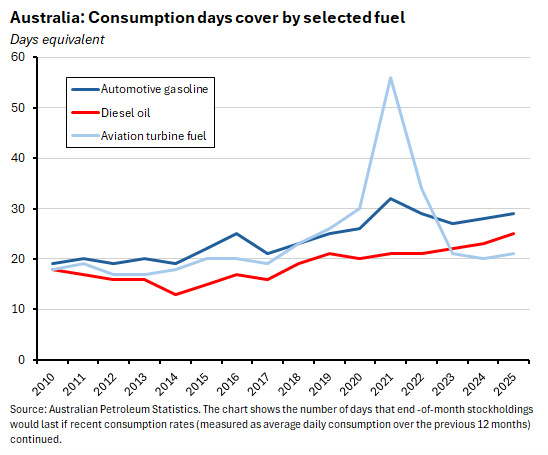
The third measure of Australia’s liquid fuel stocks is given by Consumption cover days, which measure how long stocks of refined products would last if all supply was cut off and demand remained at normal levels. This measure only includes stocks in Australia (on land and in domestic and coastal waters) held on the final day of each month. It therefore excludes some of the additional categories of stocks included in the MSO, making it a more conservative measure than the latter.
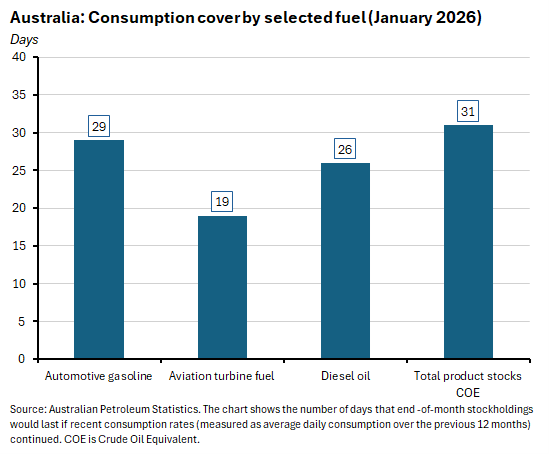
As of January this year, consumption cover was 29 days for automotive gasoline, 19 days for aviation turbine fuel, and 26 days for diesel oil.
New policy measures in response to the Gulf conflict
Since the onset of the conflict in the Middle East, Canberra has appointed a Fuel Supply Taskforce Coordinator and announced several measures intended to improve fuel security, including:
- A temporary 50 per cent reduction in the Australian fuel excise (equivalent to a reduction of 26.3 cents per litre) for three months starting from 1 April 2026, to provide price relief for Australian households.
- A temporary removal of the Australian Heavy Vehicle Road User Charge (RUC) for three months starting from 1 April 2026 and a pledge to defer the next scheduled increase in the RUC by six months. The current RUC is 32.4 cents per litre and applies to fuel (typically diesel) used by heavy vehicles such as buses, coaches and trucks on public roads.
- A temporary reduction of up to 20 per cent of the baseline MSO (equivalent to a release of up to 762 million litres) for petrol and diesel targeted at regional areas, to allow fuel companies to hold less in storage and thereby help ease local market pressures.
- A temporary easing of fuel standards allowed for higher sulphur levels in petrol, which the government estimates will boost new petrol supply by around 100 million litres a month.
- An update and amendment to the FSSP to make access to support easier, and an announcement that Australia’s two remaining refineries are now progressing plans to keep operating into the next decade.
- Support for ACCC authorisation to allow the fuel industry to cooperate in coordinating supply and removing bottlenecks to boost fuel supply to service stations.
- A temporary adjustment to diesel standards to lower the flashpoint for diesel, which the government says will give Australian refineries more flexibility in making diesel and will also broaden the markets from which Australia can source diesel to include those which allow for lower flashpoints.
- Tasking the ACCC with boosting fuel price monitoring and has promised to increase penalties for false or misleading conduct and cartel behaviour to ‘help consumers get a fair go at the petrol pump.’
The government has also announced a new National Fuel Security Plan based around four escalating levels of fuel stress and response:
- Level One: Fuel supply operates as normal and Australians can purchase fuel normally.
- Level Two: Fuel supply operates effectively but localised supply disruptions occur. Consumers should make voluntary choices to use less fuel and only buy what they need.
- Level Three: Ongoing supply disruptions will see the government provide ‘clear guidance’ and ‘practical measures’ to reduce fuel use to help secure supply for where it is needed.
- Level Four: Ongoing supply disruptions require direct government actions to make sure fuel is available for critical users, with a ‘nationally consistent framework to support the allocation of fuel, with clear conditions for when the measures can be relaxed.’
According to Canberra, Australia is currently at Level Two. At the time of writing (before the Prime Minister’s scheduled address on Wednesday 1 April), there was press speculation that fuel restrictions might start after Easter.
Implications and lessons learned (so far)
As we’ve noted repeatedly when writing about the likely macro implications of the war in the Persian Gulf, ultimately the consequences will depend on the still-uncertain breadth and duration of the conflict. Still, it is already possible to draw some early implications and lessons learned. Here are ten:
- First up, there is a decent case to be made that the current energy shock is an example of a Gray (or Grey) Rhino. Recall that while Black Swans are examples of high impact, unpredictable events, Grey Rhinos are high impact, high probability events that we are nevertheless often poorly prepared for. Some have argued that the COVID-19 pandemic was a Grey Rhino, for example, in that while the timing was unpredictable, there had been many warnings beforehand of the world’s growing vulnerability to a pandemic (although this is still contested, with plenty of descriptions of the pandemic as a Black Swan, despite the author of that concept, Nassim Nicholas Taleb, declaring that it was a White Swan in that it was ‘wholly predictable’). In the case of the current shock, and as discussed above, Australia’s vulnerability to a disruption of imports of liquid fuel has been well-understood for some time now. Likewise, the risks of a war in the Middle East were high (indeed, back in 2023 a major escalation of conflict in the region was used as an example of ‘an imminently charging rhino’) while the nature of the Strait of Hormuz as a key chokepoint was equally well-established.
- Tehran’s decision to use its effective ability to control the Strait, along with its ability to threaten and damage regional energy infrastructure is currently serving as a powerful example of the weaponisation of global economic chokepoints. According to Edward Fishman (author of Chokepoints), the most important geoeconomic story of last year was China’s April 2025 embargo on rare earths which utilised Beijing’s chokehold on exports to force the Trump administration to back down in its trade war. And the most important geoeconomic story of this year (so far) is Tehran’s use of the Strait as a chokepoint. For Fishman, then, a key takeaway is that today’s age of economic warfare has also become a multipolar one.
- A closely related point is that the Persian Gulf conflict is also the latest example of the return of the energy weapon – that is, of the growing willingness of countries to deploy energy as a tool of geoeconomic coercion.
- A world of weaponised chokepoints and threats to energy security will force a sequence of policy responses. For example, one possiblity is that for some countries, recent events will give a significant push to forging ahead with elements of the energy transition in the form of a shift to renewables and electrification (as seen already in the local jump in sales of EVs, for example). The leading justification for accelerating the energy transition could now shift away from environmental concerns to issues of national economic resilience and resource security. (That said, given China’s dominance of much of the renewable energy supply chain, to some extent a shift to more renewables would involve swapping one set of risks for a different set.) A desire to look at other demand-side responses to liquid fuel supply risks should also encourage renewed attention on fuel efficiency measures and related policies. Another possibility is that – given the at times erratic nature of the US attitude towards allies and to the status of the Strait – countries will have to rethink their assumptions about maritime security and the security of international trade more generally.
- This new geoeconomic environment also make Australia’s previous preferred strategy (and what used to be almost the automatic recommendation of institutions like the PC) – a reliance on our integration into well-functioning, efficient and interconnected global markets to deliver reliable and affordable imports to meet our needs – appear markedly more risky. That’s not to say that the benefits of international trade have suddenly evaporated. Far from it. But it does mean that alternative options – from stockpiling to securing domestic capacity – look relatively more attractive. Yet those kinds of options all come with costs attached. Stockpiles, for example, require not just the cost of purchase, but also ongoing storage, operation and maintenance expenditures. If those are official stockpiles, the cost falls on the government budget and ultimately on taxpayers. If they are required commercial ones (such as the MSO), the cost will likely be passed on to consumers. Likewise, payments to retain or build otherwise uncompetitive domestic capacity, such as refineries, also have to be funded. All of which adds to the growing fiscal burden of the modern version of the security state. And once policy starts to head in this direction, the case for intervention can quickly expand beyond fuel to consider the fragility of global supply chains more generally, from fertilisers to medical equipment, pharmaceuticals and more.
- A connected point applies to the business-level approach to managing supply chain risk. A world where chokepoints and energy supplies are increasingly wielded as geoeconomic weapons is not a world conducive to lean inventories, just-in-time production processes and lengthy international supply chains (see this piece on Australia’s retail sector, for example). But moving away from that business model also involves short-term adjustment costs and longer-term impacts on efficiency and perhaps productivity.
- Current events also tell us something important about the fragility of domestic supply chains. Issues around localised shortages, particularly in regional Australia, have already arisen, where disruption to diesel supplies is reported to have affected agricultural, freight and mining sectors, pointing to challenges around allocation and distribution. The Liquid Fuel Security Review had previously highlighted risks around disruption to local distribution networks, for example, noting that experience with localised supply shocks in the past had shown that it takes time for distribution networks to readjust, reflecting issues such as limited spare capacity in the nation’s trucking fleet.
- Another lesson from the current crisis relates to issues of data, judgement, and measurement when assessing resilience. One example highlighted above is the difference between apparent and real diversification. On some measures, pre-war Australia appeared to have a diversified set of oil and petroleum product suppliers and limited direct exposure to the Middle East. Yet a decent chunk of that supposed diversification turns out to have been illusory. A second example relates to the measurement of stock cover, where current experience is challenging assumptions about how we should treat stocks held on ships or stored overseas prior to shipment, for example, or the reliance on ‘normal’ consumption rates as a metric to convert stock volumes into estimated days of cover.
- Then there is the price and policy story. Economic analysis of the response to energy shocks tends to award a significant role to the price mechanism, with higher prices equilibrating demand and supply. In cases where a supply response to the incentives provided by higher prices is constrained, that adjustment has to take place primarily through demand destruction. Prices will also do some of the heavy lifting on the allocation of what supply is available. But the political cost of such an approach frequently renders it unattractive to governments. Petrol price shocks are regressive (lower income households spend a much higher share of their income on petrol than higher income households), for example, and with voters already suffering a cost-of-living squeeze, it was always going to be difficult for Canberra to choose not to respond to higher prices. The actual response has been a return to the 2022 playbook to deliver a cut to the fuel excise, regardless of the case made by economists (see this piece from the e61 institute) that this is a tool that comes with many shortcomings attached: it is poorly targeted in terms of helping the poorest households, it reduces incentives to otherwise cut back on fuel use at a time when there are concerns over supply, and it might not be fully passed on to consumers. This is another version of the modern security state in action.
- One last thought. A noteworthy feature of the current energy crisis has been the way in which scarring from the pandemic experience has influenced some of the responses. For example, the government’s reluctance to discuss the use of rationing (Level Four in the National Fuel Security Plan) has been attributed to a desire to avoid revisiting the kind of restrictions and mandates associated with Australia’s pandemic response. Likewise, some of the forceful and negative business response to the IEA’s recommendation for more WFH to reduce fuel demand seems to reflect a determination not to rerun the COVID-19 experience. It’s a useful reminder of how the past can shape our approach to the present.
Annex: The domestic supply chain and the price of petrol
Imports of crude oil and refined products typically enter Australia by ship as well as via domestic oil fields and our two remaining refineries. Fuel is then stored in terminals before being distributed across Australia. That distribution involves road transport as trucks deliver to industrial users and to retail stations; the piping of jet fuel to major airports; and the use of coastal shipping to supply regional ports.
Nearly all storage capacity in Australia is owned and maintained by commercial operators (except for some minor storage used by the Department of Defence) and is used to manage market fluctuations in demand (for example the surge associated with school holidays) and smooth out any gaps between the arrival of international shipments. The Review explains that since the start of the current century, operators had moved to holding lower volumes of commercial stocks measured as a share of demand, as they sought to reap cost efficiencies by keeping fuel moving through distribution networks rather than sitting in storage, with better information and communications technology and data management allowing for greater control over supply and thereby allowing for lower stock volumes while still managing commercial risk.
Who are those commercial operators? According to a useful overview of the market composition of Australia’s petroleum industry by the ACCC, in the case of petrol just four companies (Ampol, bp, ExxonMobil and Viva Energy) sit at the ‘supply’ end (imports and refinery production) of the supply chain, accounting for about 88 per cent of petrol in Australia. That market share has been relatively stable over time. In 2017-18, for example, the ACCC calculates that the same four major companies supplied around 89 per cent.
Downstream from the importers and refiners is the Wholesale sector, which sources petrol via direct imports, from refineries, and from other wholesalers before on-selling to other wholesalers and distributors, commercial customers, and retailers. Again, the same major four suppliers (Ampol, bp, Exxon Mobil and Viva Energy) account for the bulk of wholesale petrol sales by volume, equivalent to about 85 per cent of the total.
Finally, there is the Retail sector, which is relatively less concentrated. According to the ACCC, four major company brands (Ampol, bp, VivaEnergy/Shell, and Coles/Reddy Express) account for about 40 per cent of retail petrol sales volumes in Australia, while eight retail brands account for around 74 per cent of sales.
That petroleum supply chain tells us that changes in the total retail price of petrol (the price at the pump) will reflect the combined impact of changes in the international cost of refined petrol, changes in wholesale and retailers costs and margins (including changes in international shipping and domestic transport costs), and changes in taxes.
The relevant international price benchmark for refined petrol is given by the Singapore price of premium unleaded petrol with a 95 Research Octane Number (RON), known as Mogas 95. That price in turn is determined by the price of the crude oil (say the Brent oil price per barrel) and the refiner margin, where the latter will reflect the mix of products to be refined, refinery efficiency, and the impact of any refinery outages.
In addition, since international prices are typically quoted in US dollars, changes in the AUD-USD exchange rate will also influence the Australian dollar price. A stronger AUD will reduce the average Mogas 95 price in AUD terms, and vice versa.
According to ACCC price breakdowns, as of the December quarter last year, retail petrol prices mostly reflected the international price of petrol (about 42 per cent) and taxes (38 per cent), with the remaining 20 per cent reflecting wholesale and retail costs and margins.
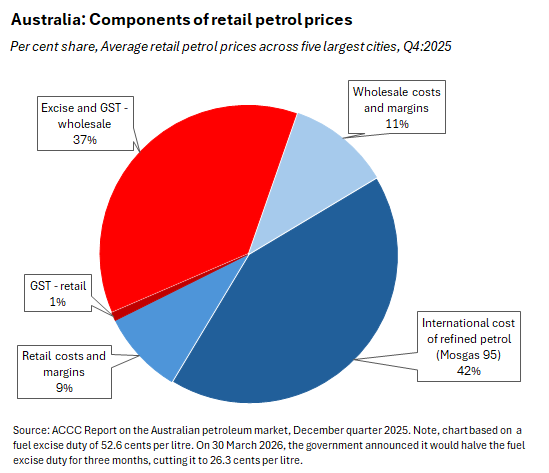
Taxes comprise an excise duty of 52.6 cents per litre for petrol (and for diesel) plus 10 per cent GST. The excise is collected at the point where the fuel leaves a designated storage depot and paid by the manufacturer or importer to the ATO, usually on a weekly basis. As part of the package of measures discussed above, the government has already announced that it will cut the fuel excise duty on petrol and diesel in half for three months, reducing it by 26.3 cents per litre.
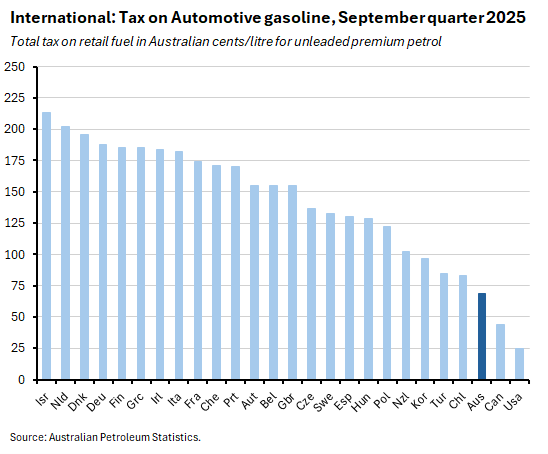
Relative to most of our OECD peers, the tax take on Australian petrol is relatively low, although note that the comparison is heavily influenced by high-taxing European economies.
The price story for diesel is broadly the same, except that the relevant international price is now the price of refined diesel, which is the price of Singapore Gasoil with 10 parts per million sulphur content (Gasoil 10ppm). Since both petrol and diesel are refined from crude oil, their prices tend to track each other over the long term, although they can diverge over short time periods.
According to the ACCC, the components of the retail price of diesel are little different from that of petrol, split between the international price (45 per cent), taxes (37 per cent) and other costs and margins (18 per cent).
Finally, note that the RUC is set independently of the fuel excise rate but is collected through the excise included in the price of fuel rather than by directly charging heavy vehicle operators. The RUC is equal to the amount of the fuel excise that is not refunded to the business through Fuel Tax Credits, which refund the fuel excise to eligible business users.
Latest news
Already a member?
Login to view this content