

 This product has already been purchased.

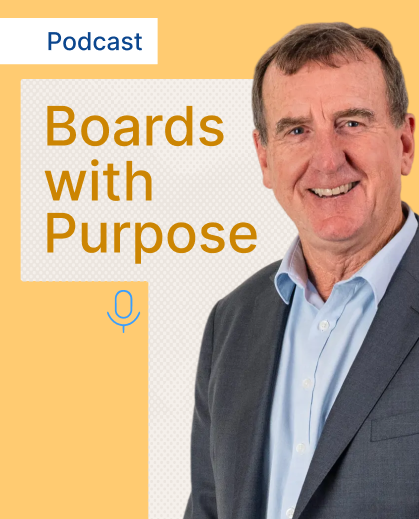
From business builder to investor, CEO to climate policy contributor, for Tim Reed, leadership never stands still.
After more than a decade as CEO of MYOB, and as former President of the Business Council of Australia, Tim shares insights on how to drive growth through disruption. In this episode, he discusses the realities of CEO succession, offering lessons on why different leadership stages require different leaders.
Along with this, Tim brings us a grounded view of how boards should approach AI, productivity and decarbonisation, emphasising that getting the basics right, such as strategy, people and execution, still matters in today’s fast-changing world.
Key takeaways:
The CEO to board transition – knowing when to step back, shift mindset and find renewed energy
Customer-centric leadership – stay close to what customers think and see
AI in practice – enhance thinking and productivity without replacing judgement
AI risk and opportunity – adopting AI to strengthen governance, security and competitive advantage
Productivity and national competitiveness – the role of business, policy and investment
Decarbonisation and board oversight – measure impact, navigate trade-offs and commit to credible path to net zero in 2050
Sitting down with Tim
Conversation soundbites
AI, decarbonisation, productivity are big, high-pressure topics. Tim Reed cuts through the noise with a grounded view on how boards can act now while keeping strategy, people and execution at the forefront.
1. Leadership Lessons from a Decade at MYOB
Where leadership effectiveness comes from and the importance of setting a long-term vision
2. CEO Succession a Board's Most Important Decision 00:03:36
How succession planning works best and what boards need to know
3. Knowing When to Leave — From CEO to Investor 00:06:33
Reinventing yourself, switching to learning mode and building new capabilities
4. Private Equity — How Potential Creates Value 00:09:09
Aligning board and management on a clear 3-year plan in the first 90 days
5. The Rise of Private Money & Market Regulation 00:11:46
How funding options can strengthen the economy and the need for fit-for-purpose regulation
6. AI — Transformation, Hype & the Board's Role 00:14:20
Pairing AI with robotics. Embracing AI to strengthen security, governance and risked-based guardrails
7. Productivity — Australia's Challenge & the Policy Levers 00:20:21
Productivity is value per worker. Why Australia needs stronger investment settings as resource-led gains decline.
8. The Business Council of Australia 00:26:32
Leading through covid, climate and unfinished business
9. Decarbonisation & the Director's Role in the Energy Transition 00:33:00
What makes the decarbonisation process successful?
10. The GWS Giants 00:34:58
Innovations in sport, a focus on athletes’ health, safety and wellbeing and governance under the spotlight
BENNETT MASON
Our guest this time is Tim Reed, the President of the GWS Giants and a director with Transurban. Tim's also a partner with private equity firm Potentia Capital and a member of the Climate Change Authority. Tim was previously the President of the Business Council of Australia, or BCA, and spent more than a decade as the chief executive of software company MYOB. Tim, thanks so much for joining us.
TIM REED
It's great to be here.
BENNETT MASON
Tim, I mentioned MYOB a moment ago. You were in the top job there for over ten years, and you led the company through an extraordinary period of growth and transformation. What did you learn about leadership over that period of time with MYOB?
TIM REED
Yeah, it's a great question. And first all, let me just say it's an absolute privilege to have been given the opportunity to do that role and to lead that business through that time. I think back to when I first joined the business, and two of the three founders of the business were still there. And I was running the Australian operations of the business, which was about 80% of the revenue in the company. But I never thought that the opportunity to be CEO would actually come up because Craig, who was one of the founders and who was the CEO before me, had been doing it for 20 odd years. He was only five years older than me, and I thought he'd do it for the next 20 years. And so, when the opportunity came up, I remember actually being quite taken aback and saying to Craig, “But that's your job.” And the conversations flowed from there. I was fortunate in that he and the board put confidence and faith in me before I think I actually really understood exactly what it was to be a CEO. And I don't know that anyone's 100% prepared when that first opportunity comes along, but I certainly wasn't. What I learnt about leadership through that time was the importance of setting a long-term vision for the business. The critical nature of ensuring that the foundations of the business are strong so that the culture is what is needed to be able to deliver on the strategy, that it's genuine, that it's lived, that it's in the business every day. And that takes time. But if you invest in those things, you see accelerated performance going forward from there. The absolute critical nature of a clear strategy with metrics that people can look to help direct their activities each day and direct their success. And ultimately, a really close gauge on customers and having direct hearing mechanisms, direct listening mechanisms on what customers are thinking, what they're seeing in the market. That sounds really basic when I put it that way. But I think we all learn and then re learn and then re learn in different scenarios and different situations. Ultimately the biggest decisions you make are people that you employ. The systems around them are super important. But really coming down to making those key decisions around the right people in the right role, at the right point in time.
BENNETT MASON
Appointing a chief executive is one of the key roles that a board member plays. When you're on board thinking about succession planning, do you reflect on that time at MYOB and what you learnt in the job?
TIM REED
I do. And what I particularly reflect on is the need for different leaders at different moments in time. And a leader who's been very successful in a business for a period of time isn't necessarily the template for the right person to take the business from here to where it needs to go. The environment changes. The strengths of that leader have probably become embedded in the organisation, and no one's good at everything. And so that means there are probably some areas where there's been less focus, less attention, or less strong in the business than what might need to be going forward. And so, I do reflect and I reflect on the specific circumstances of how well the founders have built the business. And I was blessed to take on a business that had a lot of those fundamentals really well embedded. Yet the difference that was then needed to take MYOB to the next level.
BENNETT MASON
MYOB has been a remarkable Australian success story. It's one of the darlings of our tech sector. Is there anything, though, from your time at MYOB that you're particularly proud of?
TIM REED
Oh look, when I became CEO, I think the business was traded on the ASX at about a $500 million market cap. When I left, that was north of 2.5 billion in the last transaction we did with KKR. We created a culture that gave thousands of people the opportunity to come to work and, I believe, be their best self every day. It was an environment that invested in people, believed in people, and had a growth mindset. There were half a million customers who every day, we helped make their business life easier. And that was a driving force for us, to take away some of the mundane things, to take a bank reconciliation that used to take 20 minutes down to two minutes by integrating an online accounting system with, with the online banking. All of those sorts of things give me great pride. So, I don't think there was a moment. It wasn't a corporate transaction or something like that. I think it was just the continued delivery of value to customers, creating a safe, nurturing and growth-based workplace. Yeah. Those are the things that I reflect back on with, with sort of most pride.
BENNETT MASON
You had this long and successful time as a chief executive. How did you know when it was the right moment to stop being a CEO and move on to board roles and, and private equity? And I guess, was there anything that surprised you about that transition?
TIM REED
So, there's two parts to that decision, I think. One, that it's time to leave the role you're in. And then two, whether you want to go into another CEO role. And I would have been young enough to have done that or move on to something else. And on the first, I think, it is hard when you're in a role to get the perspective that actually it's probably time to move on. Not for everyone, but it can be hard. And I was there for a long time. I just knew in myself there were little signs there. I remember we were doing a three-year strategic plan, and it was going to be the fourth one. Well, it was the fourth one that I was doing as CEO. And just reflecting on the way I went about that compared to previous times we'd gone through it. And I don't think anyone around me would have said I was anything less than 100% engaged in that process and in the business at that time. But I just knew myself, the feeling of excitement that was there the previous times around, it felt a bit different to me. So, I knew it was time for me to move on. The decision whether to be a CEO again or to move into private equity. And Potentia invests in largely B2B, SaaS businesses, which is what I'd spent 20 years, in operating roles both at MYOB and previously. I just immediately became excited about the opportunity to take the skills, the knowledge that I had and use it in a different frame. And it is quite different being an investor to being an operator, being a board member to being a CEO. And I've always enjoyed putting myself in environments where I'm the least knowledgeable in the room and in many senses, as an investor, I had to learn a completely new skill set. Not that the skills that I had were irrelevant. In fact, they were relatively unique and I think highly valued in the conversations that we had at Potentia. But it was a new mindset and a new skill set for me, and that I embraced, and I could feel that new energy coming back to me.
BENNETT MASON
Let's keep talking about Potentia. Some of our listeners might not be hugely familiar with the role of private equity. Can you explain what actually happens when Potentia takes a stake in a company? What changes, what occurs in those first 90 days, and how do you really help management grow and drive value?
TIM REED
So of course, it depends on what the business is and what is there at the starting point. But in the first 90 days, we will be trying to ensure that there's a really clear three-year strategy that has been agreed between the board and the management team. And we do a lot of diligence work before making any investment, but frequently that is outside-in. And then when you get inside the business, you learn something different. It's a very complimentary process though, because that outside-in information is often information that people inside the business have never seen. So, we will do a lot of customer interviews before we invest in a business. We'll often do industry surveys. We'll go out to industry experts and get their views and opinions. And to have that data, when you're inside a business from somebody who's been outside is an incredible resource. It's a gift as a CEO, to be able to have someone come in and actually share with you another lens and another view on your business. So, this first 90 days will largely be around: “Is the plan really clear? Have we got an agreed strategy? Here were our hypotheses over what could be achieved over the next three years from the outside? But what do you see on the inside? Where do you think they're right? Where do you think they're wrong?” To get to an agreed strategy and three-year financial plan. There's also a genuine question: do we have the right people in the right roles to be able to then achieve that plan? And we talk openly with management teams before we invest about what their personal desires are and whether they want to be with the business right through our ownership period. And we'd start out just by saying it's likely to be five years. Or is there a transition that they want at some point in time? Because the alignment between the board and the business from a strategy perspective is important, but the alignment between the directors and the individuals and executives is also an important element. And so, 90 days, if we got all of that done in 90 days, we'd be off to a really good start.
BENNETT MASON
I'll ask you one final question about private money. There's been a lot of words said, and a lot of words written about the remarkable rise of private money. There's private equity, private credit, super funds. Some market observers are concerned about that. They think maybe we don't have the right regulation in place. Some folks have also expressed concern that we don't have more companies listed. We don't have more companies on the public markets. Do you have a view on that at all? Do you think that the rise of private money is just going to keep going? And do you have any concerns about it?
TIM REED
So, I think firstly, markets work these things out. And so, it will be a stronger economy and a richer tapestry and a more diverse set of businesses if there are more ownership options out there and more financing and funding options out there. So, I think it's great that we don't have a one-size-fits-all, and there's only one solution and only one path. When you look at private equity in Australia, it's still reasonably significantly under penetrated compared to what it is in the northern hemisphere. So, I think that that trend in our country is likely to continue. I don't have a concern about it. Again, I think given a business at a point in time, public or private, there can be pros and cons, but I don't think one's fundamentally right and one's fundamentally wrong. Do I have a concern about the regulation of private companies? Look, regulators continue to put their focus where they see risk. And as these categories grow, I think everyone in them can and should expect that there will be more regulatory oversight. That's nothing to be concerned about. The needs of investors are different in private markets than they are in public. And so, I'd be concerned if regulators were saying, “How do we just take what we've got here and move it over here?” I haven't heard any regulator say that, by the way. I'm not speculating that they will take that. But so long as regulation is fit for purpose, then I don't have concerns.
BENNETT MASON
Let's shift to AI. You spent decades in the tech sector as an executive, board member and also as an investor in private equity. The rise of AI over the last 12 months has been extraordinary. What do you think is truly transformational when it comes to AI and what can be maybe dismissed as just hype?
TIM REED
So, I think there will be a few moments of truly transformational progress. I think the real ones will come when there's a combination of AI and robotics. And the biggest one that is out there for everyone to start seeing is a self-driving car. But equally, there will be lots and lots of tasks that the combination of a machine that can learn and improve and a robotic piece of equipment will be able to address. And I think that will be fantastic, particularly in a country like ours, which is wealthy, has an ageing population and frankly, is looking for drivers of productivity so that a smaller and smaller part of the population working can support improved living standards for all citizens.
BENNETT MASON
Something that a lot of directors have said to me about AI is that they're concerned about the challenge of, on one hand, you want your organisations to seize the opportunities that come from AI. You don't want to miss out, you don't want to fall behind. But on the other hand, you also want to have sufficient guardrails in place to ensure that your organisation is using AI effectively and safely. Do you have a view on that? How do you get that balance right.
TIM REED
So, you've got to put the fundamentals in place. You've got to make sure that the data and the infrastructure and everything is secure. You need to put in place policies as to the way in which there is going to be oversight as to how AI is being used, whether decisions are being made, at what level, etc. So, I think there is need for boards to put those in place. But I think a lot of the early use cases are actually just going to be things that humans don't get to or don't do particularly well. So, a lot of it is going to be the mundane. And let me give you an example. At Transurban, one of the things that AI can help with is the identification of number plates when there's not a clear reading of a beeper. Of course, we need privacy in there because number plates are identifiable objects. And so, as a board and as a company, we've got to make sure all of that is in there. But it's not a dangerous use case to get more accurate identification of the number plate because we're already doing it. It's just a process that AI allows us to take to a higher level of accuracy.
BENNETT MASON
What about you yourself, Tim? What are you using AI for in the boardroom and outside? What mundane uses do you have? And what about the not so mundane?
TIM REED
So, I would use it multiple times a day, just to do quick research. And I mean, Google has now embedded Gemini into, ahead of any search result, it gives you an AI summary. So, I absolutely use it there. I use it when I'm trying to help structure my thoughts, and therefore I'll put my thoughts in and use it to help me summarise those, to concatenate, just to sharpen up what I'm doing. Where I'm starting to get to is helping it prompt me for what else I should be asking, what else I should be looking at, and help me take that next step. And it's good because it's just like brainstorming. I don't use it in that sense to tell me what to do, but I can ask it a question. Is there anything else I should think about when, whatever the task is that I'm on at that moment in time.
BENNETT MASON
What do you think are some of the potential blind spots that boards have when it comes to these emerging and potentially transformational technologies like AI?
TIM REED
The careful line for a board to walk is to ensure that all of the risk processes, the governance processes that are existing, are robust enough to be able to guide the company's progress in a new area. And whether that’s AI or whatever else that might have been. If we wound back the clock, I'm sure the same things we’d be talking about connectivity to the internet at work and so on. So, I think it's just about making sure you get that balance because you absolutely want your organisation to be embracing AI and using it to competitive advantage. But you've got to make sure that the parameters are there, that the risk that is being taken is understood, is quantified, and that that activity is being assessed on a risk basis.
BENNETT MASON
You mentioned that AI would be an important driver of productivity as a nation. We talked a lot about productivity over the last 12 months. This brings us to a public policy area. What do you think boards can do at their own organisations to help drive productivity?
TIM REED
The good mechanism there is, it's probably quite a natural driver for the private sector to drive productivity. I'd like to see the public sector embrace it equally. But if we think of productivity as just the value created by a unit of labour, call it an hour of work, then businesses are always looking for efficiency in how they do that. Whether it's the cafe that I was at this morning where you now scan a QR code to place an order so that no one's time is needed to receive that order. Someone still has to make the coffee and bring it to you. But if there were three actions, labour is now only involved in two of those three. That will have increased productivity of that cafe. So, companies are constantly looking for that and they need to. They need to for competitive reasons. But they also just need to fulfil their promise to their customers because every business I've been involved with has more ideas as to great things they could do to enhance the value proposition to their customer than what can possibly be resourced and funded in a finite time period. And that's healthy. Like you want that in your businesses. You want continual tension there and pressure about what's the next thing, what's the next thing, how do we just deliver it faster? How do we deliver more accurately? How do we deliver it in a safer environment and etc. So, I think businesses are set up to do that. Yes, this is a new, if you like, set of tools that can be used. And we've got to learn those, and we've got to have all precautions and risk-based gates and stuff that we've spoken about previously. What I would love to see is public sector doing it as well. And see the public sector productivity be driven through this. And there are industries where it's more difficult. Care industries, I think, for example. There is an element of humanity that comes through in care and I think always will. And I think it's just a critical element of what the services that's delivered. But that doesn't mean that there's not a ton of stuff, paperwork that nurses are doing, which takes away from their front-line care work that AI can't play a role in.
BENNETT MASON
As I said, the nation has talked a lot about productivity. We had a national summit. There are many views, many policy ideas on how productivity growth can be improved. Do you have a view? Are there any, not quick fixes, but are there changes that could be done now that would really have an impact?
TIM REED
Yes, there are. But let's just frame the problem a little bit. In the post-World War Two period, Australian productivity was a real success and mirrored largely US productivity growth. If you look in the last 4 or 5 years, that hasn't occurred. US productivity has continued to go up. And ours has not. Ric Deverell at Macquarie Bank did some really interesting research on this stripping, out the contribution of different sectors. And he explains that largely the drop in productivity is from the lowering of the amount of coal that we are extracting from the ground. And productivity in oil and gas is extraordinarily high, in mining these high. In market sector businesses, market exposed businesses and then in non-market sectors, both of those are much lower. But the majority of the economy sits in the third of those, the market based, market facing business sectors and productivity in those have continued to grow. So, across our retailers, across our banks, across entertainment, hospitality, productivity has continued to go at its current rate. Now, I don't think extracting more fossil fuel is the answer to Australia's productivity. Some people might. I don't. I think the world needs to decarbonise and I think we'll be in a much, much worse place if we don't decarbonise and don't do it rapidly. But as a country that has created a lot of wealth through the extraction of hydrocarbons, that places a real challenge on productivity in our nation. So now more than ever, we need to be thinking about every lever that can be pulled to drive productivity. Because we are in this backdrop of what has created a lot of wealth for us to date, won't be the thing that creates it going forward. So, what do we need to do? That means we need to create an environment where investment and private sector investment is encouraged and rewarded. And I don't think when you look internationally at the tax settings in our country, that they are competitive in that degree. So, I think that needs to occur. And there was some discussion at the Productivity Roundtable on that. But I don't think there's been anything substantive that has come out of it that the government has committed to. Investment doesn't just take place because of tax settings though, regulatory settings and particularly project approvals are incredibly important as well.
BENNETT MASON
Productivity was one of the many issues you talked about when you were President of the Business Council of Australia or the BCA. You were there through a fairly extraordinary time through the Covid period. What do you think were some of the biggest achievements from the BCA during your time there? And now that you're out of that position, is there any unfinished business?
TIM REED
Great questions. So firstly, it was a privilege to be there and a privilege to have that role in our community through that time period. And I do look back at, frankly, the uncertainty that businesses were facing, the daily calls that we had with members to update them on regulations as Covid regulations were coming sort of thick and fast.
There was a moment in time where some of the shutdowns would have meant that the East Coast supermarkets would have been short of their supply chains. And I think had electricity gone out, had food not been available, these things are places that you don't really want to see how a society and community reacts when you get there. We all saw it in relation to toilet paper, but that's different than food and power and so on. So, behind the scenes, we did an enormous amount of work on behalf of members, as they could see these red flags coming to get to governments and to express the consequences and the amount of leeway that we had. and to give them credit, all of the governments, and it was predominantly state governments. The state governments took our calls, responded, and we avoided the worst outcomes there. And so that is something that I look back on now and think to be there at that point in time and for our community to come through the way we did and to have played a small role in that is something that I'm particularly proud of.
TIM REED
I would also cite the progress that we made on aligning both major parties and the business community around the challenge of decarbonisation. During that time, both the Coalition, the Labor Party and the business community, through the BCA, embraced Net Zero 2050. There was then a process through the 2030 target. And I think there was an ambitious target that Minister Bowen put out there. But put out there with the support of the BCA. And I think aligning the business community with the government on the objective of decarbonisation. We don't agree on every single policy. But at the headline, I think getting that alignment is critically important to Australia's future.
BENNETT MASON
How did you first become interested and involved with decarbonisation and climate change?
TIM REED
So, one of the things I learnt in the role at the BCA is you don't set the agenda right. You might influence it. But frankly, even the Prime Minister doesn't fully set the agenda. He has to respond to different things every day. So, I went in with a real view on skills, believing that as high, labour cost/wealthy society, that the thing that would enable us to continue to drive productivity and drive prosperity for all Australians was making sure that people had the right skills to do the jobs that were highly valued and highly paid. And so, my ambition was to spend a lot of time on the way in which immigration and skills worked and labour supply. I got in there and within the first week there was an early bushfire at the start of what became a horrendous bushfire season. And so, we spent a lot of time helping members and local communities respond to that. We were then hit by Covid. And through this, one of the main political decisions that had to be made was around decarbonisation. I didn't know a lot about it, so I just spent a lot of time reading and understanding, and there's an enormous amount of disinformation that is out there. There's enormous amount of people who just have a lack of knowledge but have an emotional perspective one way or another. And I found the best way to cut through that was actually just to listen and to learn and to read and research. And then I stood back and realised that actually, this was an enormous opportunity, that there were people who were well down the path on the skills agenda and making significant progress. But this was actually something that our community really needed. And so, I became quite passionate about it. And obviously to this day, as a member of the Climate Change Authority, I remain deeply involved.
BENNETT MASON
The BCA and the business community are now broadly in support of decarbonisation. And as you said, they don't agree with the government on everything, but the business community also supports the push towards net zero. Do you think Australian companies are moving fast enough from the climate transition and decarbonisation?
TIM REED
So, I don't think you can bucket everyone together. There are some that are moving very quickly and there are others where I think more progress could be made. I think collectively, I thought the BCA’s recent paper on the 2035 target was a very thoughtful one, which didn't come out and say, “We think the target should be X.” It came out and said, “Our current trajectory will get us to this point. If we want to have more ambition, here are the things that we need to do. And here’s likely the cost of doing them. And if we want even further ambition, then there would be more cost. And here are another range of actions that would need to be taken.” And I think that's a thoughtful way to do it because there are tradeoffs. And I think the idea that we can decarbonise without there being tradeoffs, everybody has now moved past that. And it's a matter of how much, how important is this to us and how much are we willing to invest and how much are we willing to accept some of those tradeoffs/support those where there's a negative consequence from those tradeoffs?
BENNETT MASON
What's the role of the board in this, at big companies, but also SMEs, not-for-profits? How can directors help to really drive action when it comes to the energy transition and decarbonisation?
TIM REED
Well, I think firstly is just really getting a deep understanding of your carbon footprint. Where are our emissions and where is the science, where's the technology to be able to address them, what's happening to cost curves, etc.? I mean, a lot of companies have started to decarbonise by effectively buying green electricity. And it's a great way to start and a relatively easy way to start. And for many companies, most of their carbon footprint will be in transport and electricity. And those things there are solutions that are out there. Absolutely, there are green vehicles. If there's a fleet of vehicles that a company has, you can offset air travel, and you can purchase clean electricity. So, it's not a bad start there. There are then businesses that have far more complexity in them. And there are businesses where the chemical processes involved in that business, they aren't scientific, or at least scalable, affordable scientific solutions to removing that carbon. And I think there will be some of those that are still around in 2050.
TIM REED
And that is where I think the business community and the government really need to think and understand about what the offsetting will be, because it is net zero. It's not zero emissions. And I think directors can really be pushing down that path. What do we categorise? How much is the science there? And we can afford it today. Where is the science but the cost curve means it's not currently a good investment, but it could be in time. Where is it where we've got emissions that are going to be really, really hard to abate, that the science just isn't there. And what are our thoughts therefore around credible offsetting?
BENNETT MASON
Tim, you remember the climate change authority. You're an ASX director. You were a president of the BCA. But I couldn't let you go without asking about one of your other roles as president of the mighty GWS Giants. How did you become a Giants fan and why did you want to be the president?
TIM REED
So, I love footy. I grew up playing footy and loving AFL, so it probably started there. I live in Sydney and was raising a family in Sydney, and I wanted my kids to have that same passion for footy so that it was something that we could enjoy as a family, as I did with my brother and sister, growing up. And so, about the time that they were of the age to start watching footy, we went and watched the Giants and fell in love with the club and became family members, and it was just a very organic process from there. I didn't expect that I would be on the board. I didn't expect that I'd be club president. But the board became aware and Tony Shepherd, who was my predecessor and chair, became aware that I was a Giants fan and a Giants member and asked me whether I'd be interested in getting a bit more involved in the club. And then further from there asked me if I'd be interested in joining the board. And of course, I was delighted to be able to have that opportunity to take footy to Western Sydney. The club is a phenomenal club, with great culture and it's living, working and sharing an enormous amount with a large community in Australia that can receive and really benefit from what the club’s got to give. The decision then to be chair when Tony stepped down, the board went through a process, and I was fortunate enough to be given the opportunity.
BENNETT MASON
Are there certain innovations in sport and in the AFL that really excite you over the next five years, whether it's media, membership, partnerships?
TIM REED
Yeah. So, I think there's a few. The first I'd say is just health, safety and wellbeing. And the AFL is putting an enormous amount into concussion and into really trying to understand the causes and how they adapt to the game to make it a safer game. And I think for every director, it starts there, right? I mean, safety, safety, safety, we all have to make sure that we're doing everything we can to ensure safe workplaces. And that goes for the AFL as well. I do think that the way in which social media and sport are engaging is a really interesting one. And at the Giants, we've done a lot with our social media team and they are, in my mind, league leading, in terms of the way in which they take our brand, take our players, take our assets and take them to new audiences.
But I do think that's something that we're just in the infancy of and we'll see continue to grow.
BENNETT MASON
Tim, you've had some high-profile roles. As we said, you've been the president of the BCA. You've been chief executive of a major company. The scrutiny that comes with sport, though, is different. You're not just on the front page. You'll be on the back page as well. How have you found that experience?
TIM REED
These are frankly quite small organisations that have enormous amounts of community interest and therefore little things really get picked up and very immediately. But the process is the same. We take in a group of young women and young men every year into our club. They're 18. I mean, we've all been 18. We weren't fully formed. We weren't perfect. But these people are under extraordinary amounts of scrutiny and so for a club to try and put their arms around these people and create a safe environment where they can grow, develop themselves, but also make the most of the opportunity in front of them, but protect them from it, is tricky. And it's a fine line, but it's all the same things. It starts with education. It starts with making sure that people are available to them. Starts with making sure that the skills that they need are there in the club so that they can draw on those resources as and when they might need to. It does mean putting some guardrails around them at times. It means hoping that the senior players that you have are the role models that will set those younger players up for success. And it is all of those things. And I think as a director, because they are smaller organisations, but the spotlight is much brighter. It is actually doing all of the basic things but doing them absolutely thoroughly and authentically.
BENNETT MASON
Tim, we've covered a lot of ground, but we'll have to leave things there. Thanks so much for talking with us.
TIM REED
Great to be with you today.
Explore more conversations
Already a member?
Login to view this content