

 This product has already been purchased.

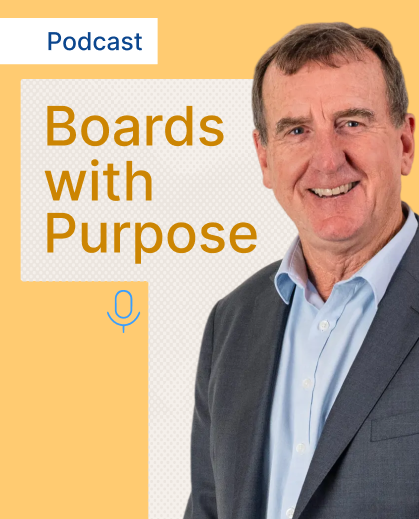
Skipp Williamson has spent decades working with organisations on one of the most persistent challenges in business: execution. As founder of Partners in Performance, she has seen first-hand how even the most compelling strategies can unravel when delivery falls short.
In this conversation, Skipp explores why execution risk is often underestimated at board level, and how major projects can drift off course despite appearing on track. She explains the difference between the “pageantry” of project management and the realities of delivery, and why traditional reporting often obscures more than it reveals.
The discussion examines how boards can strengthen oversight without crossing into management, including what to look for in critical projects and how to identify early warning signs. Skipp also shares practical insights on capability, accountability and the importance of leading indicators, alongside lessons from large-scale transformations, AI programs and decarbonisation efforts.
Key takeaways:
- The illusion of control — how reporting and dashboards can mask emerging risks in major projects.
- Project failure dynamics — why initiatives drift off course long before problems are visible.
- Board oversight in practice — probing assumptions, testing readiness and knowing where to focus.
- Leading versus lagging indicators — shifting from retrospective reporting to forward-looking insight.
- Transformation at scale — aligning strategy, execution and accountability across complex organisations.
- AI and execution discipline — applying lessons from past transformations to new technology investments.
- Decarbonisation as delivery challenge — turning ambition into achievable action.
Sitting down with Skipp
Conversation soundbites:
Board-approved strategy. Plans mobilise. Dashboards turn green. But where and when do things start to go wrong?
Skipp Williamson, founder of Partners in Performance has spent decades working at the intersection of strategy, delivery and execution. In this compelling conversation, she explores why so many projects appear to be on track, only break down later, and how leaders can spot the warning signs earlier.
00:00 – Introducing Skipp Williamson and Partners in Performance
01:53 – Why projects unravel before they begin
07:30 – Four questions boards should ask before approving major projects
11:02 – Oversight in practice: verifying without micromanaging
17:42 – Early warning signs in the first 90 days of execution
20:21 – What successful projects do differently and how boards can intervene early
23:47 – Maintaining pace and momentum through transformation
26:23 – AI programs: why success depends less on technology than people
28:31 – Governing AI while still capturing value
34:03 – Decarbonisation challenges and why execution matters more than ambition
BENNETT MASON
Hello, and welcome to Boardroom Confidential, a podcast from the Australian Institute of Company Directors. I'm Bennett Mason, and thanks very much for listening. In each episode, we have candid conversations with some of Australia's top directors, experts and leaders. We'll be delving into many of the key issues that boards are grappling with. I'm pleased to say our guest this time is Skip Williamson, the founder and senior managing director of Partners in Performance. Skip. Thanks so much for joining us on the podcast.
SKIPP WILLIAMSON
Thanks for having me.
BENNETT MASON
Let's start with an easy question, I hope. Tell us more about Partners in Performance. What do you do and how do you help boards in their organisations perform better?
SKIPP WILLIAMSON
Partners in Performance has been around for 26 years. And as in our name, we've really focussed on what we think the traditional consulting space has not given enough attention to, which is performance or execution. A great strategy, poorly executed, you’d be better not to stop executing. And so that has been our focus over that time. Global company, delivering with our clients about 10 billion of EBIT improvement a year and about 10 billion of capital improvement. In the Australian context, we span across pretty much all industries. And so, we bring this unusual blend to our clients of from the strategy down to what you might call the shop floor. What else can I tell you? We were acquired by Accenture just over a year ago, which we, of course, regard as a reverse takeover. We wanted their AI and their technology, because we could see that just becoming so embedded in everything that our clients should be doing.
BENNETT MASON
We're going to talk a lot about technology and AI today, but you’re here mostly today to talk about execution risk. You said that you and Partners in Performance help organisations with executing. So, tell us more about execution risk. What is it and why does it matter to directors?
SKIPP WILLIAMSON
The most typical thing that you see, and we can talk about why, is that major projects can quite often come in at twice the cost and time that was planned. And those are ones with large capital spend, which you could think of as technology projects or major capital builds in the construction space. But a project doesn't necessarily have to have a major budget to be strategically vital. And I would say for many companies, at any point in time, a board probably has somewhere between one and four that have a significant impact on the outcomes of that company that they should be aware of. So, you can have risks to overrun on cost and time. Usually the even more important thing is, “Did it work?” Because an ERP that doesn't actually deliver the savings or was ever in the business cases, that's usually the bigger problem than the cost overrun. It may not feel like that at the time. So, I think those are the risks and associated with it, if the project is significant enough that the organisation actually gets distracted from the BAU, which they also have to deliver. So, there's a few different ways these things can go wrong. And when they do, it can be quite spectacular.
BENNETT MASON
Let's go into a few of the details now. Where do you most often see that disconnect between what a board approves and then what the organisation can actually deliver?
SKIPP WILLIAMSON
Can I roll back a few steps before approval? And you had sort of mentioned AI. But worryingly, we seem to as humans repeat the same mistakes over and over again. I think there's a few things that occur coming up to approval that can really derail projects. In the AI space, I would say 70% of what I'm seeing is that the organisation hasn't stepped back and said, “What's our roadmap?” And really thought about where they were going to focus, typically based on the value, like how much will this deliver us and also what we might call ease. But it's really what's good to go today because this space is moving so quickly that the projects may not be ready to implement now, but in a year's time they will be. So, firstly, we're seeing in that AI space in particular, a huge amount of money being spent without stepping back and saying, “where should we spend it?” In other words, “what should we prioritise on?” So that's kind of one thing that we're seeing particularly starkly in AI. Although it should be lessons that were the same from technology OT and so on. The second area that we see significant problems prior to approval is whether people were brought along on the journey. Because people don't object to change, they object to being changed. And so many of the projects, whether it's in the AI space, any area, business improvement, whatever it is, most things depend on people actually making these projects occur quickly. And then making them last. And so, far too often we see people going into rooms, huddling for however many weeks or months, producing this magnificent idea, but not actually taking users along on the journey. And the correlation between that and an epic fail is really high. And so, I think there's a few things that go wrong before it gets too board. And so, if I were a board member, I'd be wanting to firstly check that it was prioritised value, ease, whatever you want to call that term. And secondly, who are the stakeholders that need to make this work and that need to sustain this in the long term? And are their fingerprints all over this? Because if they are not, I would have concerns about the success of the project.
BENNETT MASON
It can be difficult for board members. They're obviously not there walking the shop floor every day. They're not management. So how can directors really get a sense if the organisation is ready for this big project, this big change, this big transformation? It could be, “Are the people ready? Is the culture right? Does the organisation have the skills and the capability?” How can directors really get a sense of the organisations ready to go?
SKIPP WILLIAMSON
So, I think there are, there are sort of 4 or 5 things, questions that I'd be asking about. And we have four letters that we try and remember all four. So, the first one is people and capability. Far too often I see projects that are vital for the company where people are having a development experience. I don't think that is one of the kinds of ones that should be on the board’s top list. I would want these projects run by people who have done something similar before. I think there's a time and place for people to learn project management skills or skills in whatever that area is. I don't think it's on the vital ones, at least not in the critical roles. So, I would be wanting as a board member to know that some of the pivotal roles on a particular project, people have done this before. And then the second thing around people is the thing that I talked about before, we call it alignment and ownership, which is are the key people who have to make execution a success and then have to sustain whatever this is. Have they got their fingerprints on it? Without that, I would envisage a world of hurt and reasons why things don't work and can't work, or that they’re switched off. And the world is already cluttered with AI projects that have been switched off by the users. So that's the first one, we broadly call that people. The second thing I would be checking for as a board member is single point accountability. So, if I ask a question around the critical path, if I ask a question around the key risks and so on, that there is somebody accountable for that risk or for the critical path, or whatever the sort of question is who's clearly accountable and actually can speak to it. Signs where that's not the case is where a consultant is speaking for them.
BENNETT MASON
Not that you would ever argue against consultants.
SKIPP WILLIAMSON
So that would be the kind of second thing. Projects go awry when there's not crystal-clear accountability on who is delivering what. Third one is resources. Just have you got enough? And then the fourth one is what we would call specificity, which is exactly what will be done by when. And we can talk about that, if you think about when a board member is actually going potentially on-site or talking to the project, there is a massive difference between what we call the pageantry of project management. There's dashboards and it’s green and red. And the reality of, does this team actually know how to manage a project for success and specificity around specific people know what they're doing by when is a very clear sign on whether people know what's going on.
BENNETT MASON
Okay. Let's say the board has approved the project. We're moving forward. The board's then got to provide oversight. So, what does effective oversight look like when that project is underway?
SKIPP WILLIAMSON
So, it's such a great question and I notice a huge difference around the world in terms of culturally how different countries have a view on the role of the board. And this is the kind of famous discussion that came up in the 90s around whether a board's role is only governance or whether there is what we would call “trust but verify”. So, we're firmly in the “trust but verify” camp, I guess because we've seen so many projects really turn into catastrophes for board members. If I think about my clients in the US, for example. I don't see the same conversation around, “Oh, but surely that's micromanagement.” So, thoughts - I don't think there's a lot of projects that a board should be engaging with at any point in time. Somewhere between one and four, and I suspect less than four. And then secondly, I do think there needs to be enough of what we might call porpoising. To go in and just check whether the key ingredients are there. As a board representing the various stakeholders, shareholders and the longevity of the company, it is actually important to work out early whether these projects are on track and whether they're still tracking.
BENNETT MASON
You talked about how boards need to be wary of maybe micromanaging or intervening too much. What does that look like?
SKIPP WILLIAMSON
I actually think boards micromanaging is a negligible problem in Australia. In general, I worry, particularly for the larger organisations, that boards aren't doing enough verifying. But true micromanagement, where it's too much, is where the board is so engaged on, what-who-when, and where is the critical path and other things that are important that, effectively management is being pushed down a layer and then their people are being pushed down a layer. I don't think I've seen that in Australia very much.
BENNETT MASON
You talked a bit earlier about metrics and reporting. What sort of metrics should boards insist on to ensure that a project or a strategy is on track, and are there leading indicators that that boards really need to have for these massive projects?
SKIPP WILLIAMSON
So, there are different types of projects. Let me take a classic construction one, because I think it's one that people across industries can understand. Most people have seen a house being built. Too often projects are managed by what I would call accounting metrics, which is what happened eight weeks ago. Now AI will make eight weeks, six weeks, four weeks, two weeks. But it's still a story about what happened. But most projects, unlike operations, we don't repeat. So, what happened eight weeks ago, there’s nothing you can do about that. You might have a conversation with contractors about variances, but basically the damage is done. And far too often we see project management looking at history with not nearly enough looking at the future. If you think about projects, most projects are signed off with a P50, a most likely cost and time of this project. And most of the reporting I see is focussed only on one half of that, which is what went wrong. What happened over the last eight weeks? What went wrong? For a project to come in on time and budget, by definition, you've got to attack. You have to attack what we would call a critical path. The “what's going to keep this project on time?” And so good leading indicators, I am going to answer the question, are focussed not just on what happened and what was the cost and the time implications, but far more on: in 180 days, is everything ready for this? What could derail this one? So that's time. And time is the most important thing because it drives cost and it also drives “Will this thing deliver the savings?” or whatever. And then there's a second sort of stream which is around risks. So, you've got leading indicators around time, cost as a consequence Usually. You’ve got leading indicators around risk. the number of projects that have risk registers and that's the end of it. As opposed to risk registers, and we're actively managing those risks and knocking them off and preventing them. So that's the sort of second one, is leading indicators around what we actually doing to mitigate and prevent the risks. And then the third one, are leading indicators around the ingredients or what we would call the wiring for good project management in place, which comes back to: have I got people who know what they're doing? Is there clear accountability? Do we have the resources and the specificity, which are the things I'd check if I were a board member going on.
BENNETT MASON
Are there particular early indicators or early warning signs, maybe in those initial 90 days, 120 days that boards should be looking for?
SKIPP WILLIAMSON
Look, I think the most likely ones that will come forward is that what is occurring is the pageantry of project management, but that is the risk that results in these projects that cost twice as much and take too long, which is we have pretty dashboards , they’re green, amber and red. Actually, the green are watermelons. So, they're green on the outside and it's rotten inside. And so, I think those leading indicators are ones we actually do need to drill down a bit to test for. I'm happy to talk about what the test is, but that's where I see things going wrong.
BENNETT MASON
So, what is the test?
SKIPP WILLIAMSON
Yeah, I think there's a few. So, I will sort of stick with this. Have I got people that are capable? Do I have a single point accountability? Have I got the resources and specificity? So, if I were going and talking with a project team. So, the first thing is some incredibly high proportion of people are scared to talk to a board member because they're scared they're going to get clobbered afterwards.
BENNETT MASON
I talked to quite a few of them. They're not that scary. They're quite nice when you get to know them.
SKIPP WILLIAMSON
Actually, I think it's more that the message then comes down, “Why did you talk to the board member?” We want to keep our complete chaos from the board, which is not how I see the relationship should be. So, the first thing is the board member has to establish trust, and create that environment where people are even prepared to talk with them.
So, that's the sort of first thing. But what I'm really listening to when I go and talk to a project and try and understand what is going on is I'm really looking for who's accountable for this. I'm looking for that single point accountability that says for this particular piece of work, this is the person. And they can tell me about it in a way that is clear to me they understand what's going on, with enough specificity around what is being done, what has to be done, or what is being done to remediate that. It would give me, as a board member or somebody that's been asked to do an independent review, comfort that actually the organisation knows what they're doing and that's disturbingly rare. So, we talk about the pageantry, which is the artefacts. We're having meetings, we're having project meetings and things are being coloured. But if the actions are not specific and measurable, if there's more than one name in the “who” and there's not a specific date, it it's all over.
BENNETT MASON
We talked a bit about when projects go wrong. What about when they go right? Can you share some examples with us of transformations and major projects that have succeeded? What made them successful and different to failures?
SKIPP WILLIAMSON
So, I think there are kind of a couple of things. So, we stick to the same things, like capable people and single point accountability. But in terms of how it manifests, I think there's this culture of transparency. So, it's not about having watermelons and pretending everything is okay. It is outcome focussed. And the outcome is we want this project to come in on time and budget, not that we survive another board meeting. And so, where you have projects that are clearly laying out these are the problems, this is what we're doing about it. “We're comfortable in these two. These two, we actually aren't.” Those cultures where projects are being transparent and talking to themselves and to the board and reaching out, trying to find suppliers or anybody that can help with the real problem, are the ones that have will come in far better. And that's actually relatively rare. So that's a culture that allows problems and transparency on that to be on the table. And that's a culture where we're all problem solving for an outcome. As I said, relatively rare.
BENNETT MASON
What about a project that is starting to go off the rails? How can the board help get that back heading in the direction? What can the board do?
SKIPP WILLIAMSON
It's an interesting problem, isn't it? Because racing around and changing people early project or mid projects is quite a big call because you can lose the thread of why decisions were made and so on. So, often it may just be that there are disciplines that are missing, so if you're not seeing the leading indicators being tracked and managed, if you're not getting the clarity of accountability, specificity, that stuff you can put in relatively rapidly and coach people on it. These are eminently trainable skills. The great news for all of us is this does not require heroic leadership or some incredible brain. They’re things that we can all do. So, I think that kind of coaching and putting in some of the basics or what we might call the wiring to support projects, I think is the most powerful because changing out team members looking for a better hero is quite risky, because you lose history. Sometimes you have to. But it might just be and I think often times it is, getting the rhythms, getting the disciplines, getting the basics in place will make a huge difference.
BENNETT MASON
Pace can be really important with these projects, these transformations. Where have you seen boards go too slow and maybe strangle momentum? And where have you seen boards that move too fast? And maybe the organisation missed out on some critical tasks?
SKIPP WILLIAMSON
And where do they do really well? Because I got one at the moment where it's a significant transformation. It's the whole back-office, offshoring, AI, redesign the processes, where I think the board's doing a great job of saying this time before you actually push the starter gun, it’s where you get to set yourself up well. Come back to us on compelling, that you've actually got people in the pivotal roles that have done this before and how are you going to manage things. So, there are some great things I think, that boards do around key risk, how are we going to manage it? Look, I'm not sure I see boards that much stifling projects once they're in execution. I do sometimes get very surprised around projects that go round and round in circles for three or four years. Often, I think, in the past, if you're uncertain around a decision, we've had, what, 20 years that have been relatively stable. I'm not convinced the next ten years are going to be that stable. And historically the logic was if we're not sure, let's wait and see if things change in the next year. I see in a variety of areas, AI, power, electricity, where continuing to do the same as before is actually betting the business. So, I think it's separating out what are we waiting for, and what's the logic? That needs to be really transparent.
BENNETT MASON
We've mentioned AI a few times. Let's drill down on that a bit. Many boards, many organisations very focussed on AI now. They're doing AI projects, AI transformations, looking to embed AI in their business. How are these AI projects different to other transformations that organisations have done and how are they the same?
SKIPP WILLIAMSON
In many ways, I think they're more similar than people think. You absolutely have to start with where's the money? Which might not be a saving today. That might be strategically “We’re either in this game, yes or no.” But you have to start with that prioritisation around money and do-ability. And we talked about this before. This is disturbingly a mistake that I would say 70, 75% of clients are making, which is they're picking up exciting use cases rather than use cases that will make a difference. And that just clutters the organisation. I think they're similar to operating technology type projects and IT projects in the past. Which is, people think this is all about the tech. The tech’s known. The stuff works. This is not largely a tech problem. It is a people problem. The classic thing of we need to take people on the journey. If people don't see their fingerprints on this, it will fail and execution almost certainly fail afterwards to be sustained. There's no point in doing it if it's not going to last. So that that to me is the type of error that we've seen for the last ten years on digital and operating technology projects. I'm not sure there's much that's unique. Any new wave comes with people waving jazz hands and not having done it before. There's all those usual things of, please show me that you've done this before, but that's just normal due diligence.
BENNETT MASON
Something we've been talking about with a lot of directors is that balance with AI. On one hand, you've got boards who want to ensure that organisations have the right guardrails. They’ve got risk management protocols in place, but at the same time, boards want their organisations to seize the opportunities that come with AI. Do you have a view on how directors can balance those two sides?
SKIPP WILLIAMSON
Yeah, it's an interesting thing. And I had a great quote given to me by a C-suite executive, which is, “Well, we have great governance, but not execution.” So, the first thing is, there are different types of AI, which have different risks. And I'm not sure in the conversations I'm hearing that we are making that distinction. So, the machine-learning type of AI, which is kind of like Excel and regression on steroids, doesn't typically have an ethical risk. And yet I'm seeing all AI being lumped together as “we need to have our ethical policy” and so on. Whereas actually some of the gen AI does, but not all. So, I think the sort of starting point is that prioritised roadmap and clarity around what the risks are that's embedded and which ones you select. The counter to the roadmap is, I have absolutely no problem, and we've done it in our organisations, giving everybody in the organisation a license to corporate ChatGPT or Microsoft 365. But that's a bit like what we were doing 20 years ago when organisations were saving 0.1 of an FTE all over the place. Really good for people getting comfortable. And getting a sense of it, but it's actually not going to move the dial. So certainly, don't get distracted by that if you're trying to get things moving. I regard it as a hygiene factor. Do it. Then have this prioritised roadmap and then drill down on the two or three things that you think are your highest priority in terms of what the risks are. Because if it's machine learning, it probably doesn't have an ethical risk. So, I think that's where I'd be engaging as a board. I'd also be aware of, “You have to fix all your data before you can start”, which I've seen delay clients. I would start by: “What are those highest value cases for us?” Because, yes, if you're in a more digital business, financial services, maybe the retail arms of utilities, a lot of your value is going to come from an end-to-end process, and therefore you need the end-to-end data to be fixed. An important question for board. On the other hand, if this is an asset-intensive business, manufacturing, oil and gas, some of the capital projects, you can get huge amounts of value for the organisation from just one or two use cases that don't need all the data cleaned. So again, it’s come back to your roadmap. What are the risks, what needs to be done and select on that basis. Rather than we're going to do governance for a year.
BENNETT MASON
What are the signs or signals that those use cases are actually there? How does a board know that this new AI transformation, this new AI program is actually going to change how the business operates? And it's not just a new tech stack?
SKIPP WILLIAMSON
I'm not sure there are many industries where AI won't make a fundamental shift, from what I've seen. We've done road maps across a huge number of industries. My starting point as a board would be where is the roadmap? So, have we prioritised, have we prioritised on value and what was the process for doing that? Because so often what I see is: “Anybody got ideas? Is anybody playing with stuff now? Right, let's collect that. The board wants something. So, let's get on and implement these things.” So, the first thing I'd be focussed on is did you start with: “where is the money?” And a little bit of a test to make sure they really started with “where is the money?” rather than collecting the ideas that were on the table. So, I think that's kind of the first test to check what was the process. Because sadly, I'm not seeing a lot of that. And then really testing, sanity checking is that where the big pools of value are. And you're testing for customer experience that will lead to revenue, not customer experience for customer experience. But can I see that linked strategically to that? You're looking for big reductions in time and simplification, headcount, revenue, it’s throughput. Just the basic economic levers You're looking at.
BENNETT MASON
I wanted to shift from I to another area where you and partners in performance do a lot of work, and that's, decarbonisation. A lot of organisations are finding that their decarbonisation programs are a lot harder than maybe they first anticipated. Why do you think that is? And do you think decarbonisation programs are particularly prone to execution failure?
SKIPP WILLIAMSON
No, I don't think so. Lots of questions. No, I don't think there's anything particularly special about the execution issues around decarb. And let's stick to Australia, because Australia is a lucky country in terms of meeting its decarb targets because it's got a fossil driven grid, which means the first half of most companies’ roadmaps is just getting clean electricity. That is lucky, because if you sit in some other countries that have got hydro power or whatever, they've got to do all the really hard stuff that technically is not ready. So, I think what we're seeing in terms of what's really causing problems is a few things. And I don't know how much you want to go into it. Firstly, I think boards think that in terms of electricity, and that's what the game is for most companies in Australia, if they're uncertain, the lowest risk thing is to keep buying power off the grid. That is the highest risk thing. Their power prices have already gone up 30% in the last few years because of that decision. And over the next five years, five or six years with data centers coming in, they will expect their power price to double. If you're reasonably energy intensive, therefore, the “keep doing the same as what we've always done because we're not certain” is the highest risk decision for boards to make. So, the first thing I think is extrapolating from the past and thinking, let's be slow followers. The slow followers will end up with power prices that are more than double those of the players that get on. So that's the first thing. Second thing, again, not going back to the economic fundamentals. If you're in Australia with a grubby grid that's fossil fuel driven. If you and the first half of your roadmap, that's prioritised on value and technology ready to go now, that first half of decarbonising through the change in power is economic. 20% reduction in costs from today compared with where power will be in five or six years, 60% cheaper. Okay, so it is wildly economic. So, if boards are seeing roadmaps and they're failing at the “Hang on, this isn’t economic.” Wrong roadmap. They've either not started from the drivers of the economics, or they've chosen the wrong levers. So that would be the second sort of thing. If it's not economic, wrong roadmap. And then the third one, and I don't want to get into the political realm, is there's the tragedy of the commons in Australia is that the technology is available, it's economic, and so many projects are stuck in the planning phase, looking for permission, environmental permission, stakeholder permission. And so on. I'm not saying it's an easy problem. And I'm sure more authoritarian countries are moving much faster, and that's just the tension of being in a democratic environment.
BENNETT MASON
Let's try to look at some of the positive examples. What are the hallmarks of organisations that are genuinely delivering on their decarbonisation programs? What are they getting right?
SKIPP WILLIAMSON
So, I think there's a few things. Firstly, clarity on value drivers, like where's the money and what's possible. The second thing, and I see this across so many areas, making sure they're bringing in experts. Too often with projects, construction, IT, whatever, there is this learning journey and development curve for our people. And that's part of it. These projects are very appealing to engineers. And I'm one, so I'm allowed to kind of have a little bit of a dig here, but you don't want to learn the stuff from first principles. We've had organisations spending two years studying the strength of wind at various points around their sites. When wind is number nine, typically on the ranking of the KPIs that make the most difference. The engineers will eventually work that out. But the opportunity cost is huge. So, bringing in specialists and of course the test is how do you figure that out? To match the technical skills with “Where's the money?” And if you are talking energy transition, the commercial experience to be able to bring the finance to it, that's kind of the key thing. Too often, and it's not an Australian thing, it's a people thing, we get excited about the journey and learning it ourselves, rather than bringing in the people that know what they're doing.
BENNETT MASON
Skipp, we’re nearly out of time, but I'll ask you one final question. If you could give directors and boards one piece of advice to shut that execution gap, what would it be?
SKIPP WILLIAMSON
I'm only allowed one.
BENNETT MASON
You can sneak in a second or third.
SKIPP WILLIAMSON
I think for me, it comes down to people, pivotal roles, have the experience, look for the wiring associated with the project to make sure people really are focussed on delivering the outcomes. So not the pageantry, but single point accountability. One person, one action, all the way down, and that transparent culture that is bringing to the surface, future problems, that's future focussed on future problems rather than let's keep this all under the covers and hope we get through the next board meeting, the next review, whatever it is.
BENNETT MASON
Skipp, we're out of time. But thanks so much. You've had some great insights.
SKIPP WILLIAMSON
Thank you.
Explore more conversations
Already a member?
Login to view this content