

 This product has already been purchased.


- There are three things boards can do to improve the gender balance in their organisation, including driving a cultural change that strips away unconscious bias.
- Boards need the courage to choose people who are unlike their typical director in style, gender and approach.
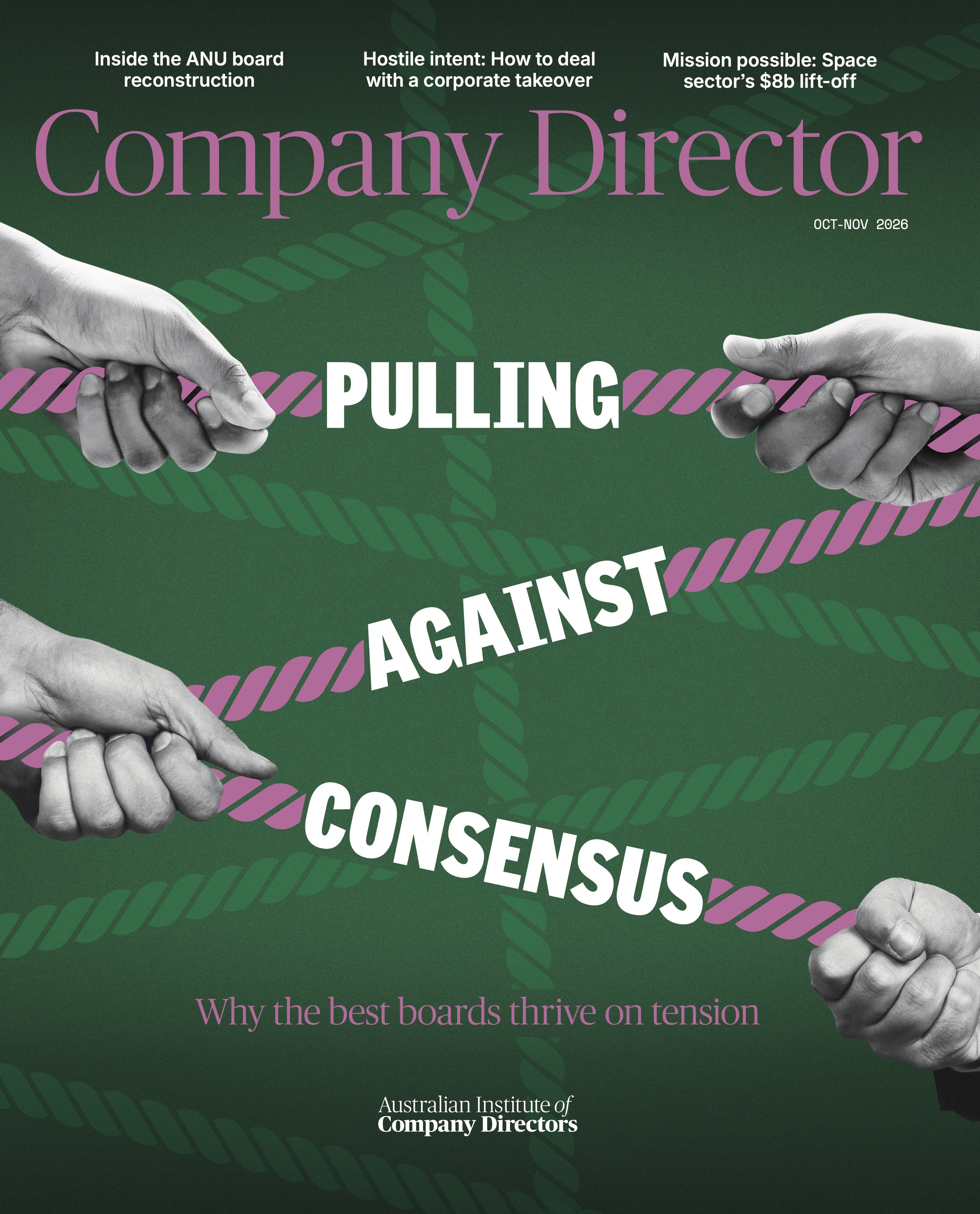
- The real pressure in the boardroom comes when you have divergent views that seem unresolvable.
Mandatory quotas can inadvertently erode ambition. That’s the conviction of Dr Vanessa Guthrie AO, who relies on “hard work” over quotas. After helping drive female board representation at IGO to 57%, she lays out three actionable steps for boards seeking to replicate that success.
With nearly four decades of leadership across the resources sector, Guthrie brings an exceptionally deep technical and strategic perspective to corporate governance. A qualified geologist with a PhD, her qualifications span environment, law and business management, fuelling a career recognised globally by International Women in Mining and honoured with an Officer of the Order of Australia.
She currently holds board directorships at major listed entities Santos, Orica and Lynas Rare Earths, alongside roles as Chancellor of Curtin University and deputy chair of Cricket Australia.
In the third installment of our series, Guthrie shares insights on upping female representation in the mining and resources sector – and reveals where the real pressure in the boardroom comes from when the stakes are high.
Under your leadership, IGO has 57% female board representation in the mining and resources sector. How was this achieved?
Firstly, through hard work!
I believe that what gets measured gets done, and we had a clear focus on the value that a diverse workforce brings. We also set some targets – not quotas – to actually drive the business to achieve a more diverse mix in the workforce, including in leadership roles.
Why not quotas?
This is a personal view of mine, but I think targets drive people to have an ambition, whereas quotas take that ambition away. A quota means you’ve just got to achieve a certain number, and when you hit that number, that’s enough. It takes the control, drive and ambition away from the person to not just achieve a target, but to keep stretching, whereas a quota is more like “I’ll just fill my bucket, and when it’s full, it’s full”.
In mining and resources, female representation is never usually very high. How did you create change in a traditionally male-dominated sector?
While it’s traditionally male-dominated, the percentage of women in the workforce in the mining industry has actually changed quite dramatically in the past 10 years. The perception that there aren’t that many women in mining is probably now somewhat misplaced.
The challenge in the mining industry, as in many industries, is that there are more women employed in what you might call the “safe havens” – the roles traditionally held by women, like HR, accounting and finance, rather than in operations. The challenge in the industry now is to focus on shifting the diversity of the workforce out in operations.
What is your advice to boards seeking to improve the gender balance at their organisation?
There are three things you can do. The first is changing policies and procedures within companies. This includes flexible work practices, such as extended parental leave, which apply equally to men as they do to women, and encouraging men to take it.
The second thing is a structural shift – that is shifting work practices themselves. For example, providing childcare in the workplace when it’s in an office environment is a significant shift for both men and women. Another thing is accepting that to be a leader or a superintendent in the field, you don’t have to be on 24/7. You can actually job share, for example, as is the case at BHP.
The third thing, which is the most difficult, is a cultural change where there isn’t an unconscious bias. It’s important to remove the unconscious bias that says, “It won’t be a job for a woman in the field because she’ll want to go and have children”, or, “She has children at home, so she won’t want to do that job”. That is rarely stated about women. This cultural shift has to happen to be truly successful.
What is your advice to other boards with low female representation?
Look critically at the diversity of your board, not just the female representation on it, including the diversity of style in boards in the boardroom. It’s easy to recruit a certain type – we all feel comfortable with somebody who is like us. Be alert to this and have the courage to choose people who aren’t like you in style, gender, approach or how they go about problem solving.
What’s one question directors should be more willing to ask at the board table?
It’s an inward one. The question we should all have the courage to ask is: Am I bringing biased assumptions to the table? Am I truly being curious, open-minded and thoughtful about my presence here? Or am I bringing a bias and an opinion? Am I not truly testing the assumptions?
It’s a question you can ask of others at the table, too.
Where does the real pressure in the boardroom come from when stakes are high?
The real pressure in the boardroom comes when you have divergent views that are seemingly unresolvable. That’s when the stakes are high and it often bubbles to the surface. I’ve had very few experiences in my board career where we haven’t been able to resolve divergent views. You have to just continually work at it and try to understand what it would take to come together to form a consistent view.
What that takes is a compromise on everyone’s part. If you obstinately hold out on a particular position without accommodating others’ views, things can get fractious.
Coming to a collective agreement takes everyone being open to shifting their position just a little bit to achieve the best outcome for the company. Even with very divergent views in the boardroom, when everybody is motivated by that, the outcomes can be very powerful.
Latest news
Already a member?
Login to view this content