

 This product has already been purchased.


Overview
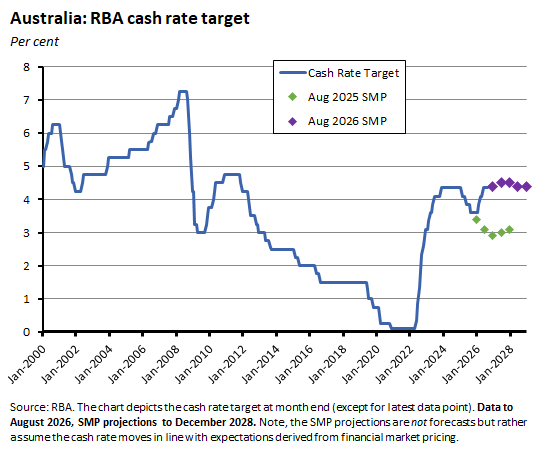
- The Monetary Policy Board (MPB) voted unanimously this week to leave the cash rate target unchanged at 4.35%. Their decision had been widely expected.
- As with the June MPB decision to leave rates unchanged, this week’s announcement was accompanied by a dose of hawkish rhetoric, warning that a further rate hike remained possible.
- Under the RBA’s central case forecast, as presented in the August 2026 Statement on Monetary Policy, headline and underlying inflation are expected return to the top of the inflation target band by mid-2027, and be in the lower half of the band by mid-2028. This is based on the technical assumption of no meaningful change in the cash rate target over the forecast period.
As widely expected after June’s below-forecast inflation numbers, the RBA’s Monetary Policy Board (MPB) voted this week to leave the cash rate target unchanged at 4.35%. The vote was unanimous and marked a second straight hold by Australia’s central bank. After having earlier delivered three consecutive rate hikes at the February, March, and May MPB meetings this year, the RBA remains willing to give that previous tightening more time to work its way through the economy.
In our assessment of the MPB’s previous, June 2026, decision to leave its policy stance unchanged, we described it as a ‘hawkish hold’ to capture Governor Bullock’s emphasis that inflation remained too high and her pledge that the RBA remained ready to hike rates further if necessary. We also wrote back then that the MPB had shifted into a ‘watch and wait’ mode that would likely last longer than the June decision. As it continues to do.
This week’s MPB meeting broadly delivered more of the same, once again pairing the announced hold with rhetoric that was, if anything, a little more hawkish. The accompanying statement warned that:
‘The Board will continue to do what it considers necessary to bring inflation sustainably back to target, including increasing the cash rate target further if upside risks materialise.’
And in her post-meeting press conference, the Governor first told her audience:
‘… I think the message today is that in waiting, the Board isn’t ruling out that there might be a need for further interest rate rises if we look like we’re off a path which takes us with inflation remaining above the target for much longer than in the forecasts. So we’re not ruling that out, but we’re saying we want to get a bit more information to confirm whether or not we still seem to be on that path.’
And then later on and in response to a direct question about why the MPB had not voted to hike rates this week, she said:
‘…we’ve already raised [rates] three times and we will go again if we need to. And I think personally that it’s quite possible we might need to go, but we’ll wait and see what the data tells.’
Overall, there are two key points to make.
- If the economy does track the RBA’s base case, then it is likely that no further rate increases will be needed. As discussed below, the RBA’s central forecast has headline and underlying inflation back at the top of the 2-3% target band by the middle of next year, and returned to the lower half of the band by mid-2028, all based on the technical assumption of (effectively) no further rate increases.
- But the central bank is very mindful of the various risks to that outlook. And in its view, those risks still skew more towards higher inflation than they do to faster disinflation. Given that environment, Martin Place does not want markets or households to get ahead of themselves and start anticipating an impending return to easier policy. This is particularly the case when households’ short-term inflation expectations remain elevated.
As a result, the RBA is combining ‘wait and see’ with a mix of expectations management and sensible hedging against persistently high uncertainty around the economic outlook.
More on the RBA’s thinking below, including a review of the new economic forecasts included in the August 2026 Statement on Monetary Policy. There is also a quick review of the week’s other data releases plus some suggestions for further reading and listening.
The RBA on how we got here
The MPB’s unanimous vote this week to hold the cash rate target steady at 4.35% partly reflects its assessment of current economic conditions, and partly its expectations as to where inflation and activity will go from here.
Starting with the former, the RBA’s view as set out in the August 2026 Statement on Monetary Policy is that although inflation has fallen faster than it expected, the economy is still characterised by capacity pressures overall. That is, the output gap remains positive albeit smaller than it was at the start of the year. That persistent imbalance between aggregate demand and supply, together with the pass-through of higher costs from the war in the Persian Gulf, has kept Australia’s inflation rate uncomfortably above target. It also helps explain the absence of any discussion of a rate cut at the latest MPB.
In more detail:
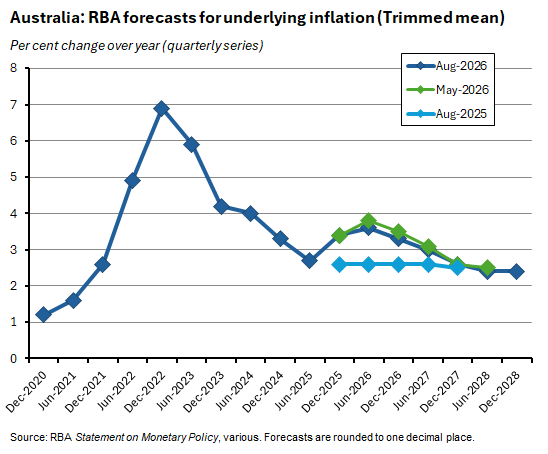
- While the May 2026 SMP had projected annual CPI inflation to be 4.8% in the June quarter 2026, the actual outcome was materially weaker, at 3.9% for the June quarter and 3.8% for the month of June itself. That was mainly because retail prices for automotive fuel fell more quickly and to lower levels than had been anticipated in May. Underlying inflation in the June quarter was also softer than predicted in the May SMP, although this time the forecasting miss was more modest. Instead of the RBA’s anticipated 3.8%, the trimmed mean printed at 3.6% year-on-year. Still, both measures of inflation remained well above the top of the inflation target band.
- Pass-through from cost pressures related to the war in the Persian Gulf has been present but limited. The RBA estimates that conflict-related cost effects (excluding the direct effect of retail fuel prices) contributed a little over 0.1 percentage points to underlying inflation in the June quarter. Pressures on non-labour costs highlighted by the SMP include sharp increases in the price of some building materials which contributed to higher new dwellings inflation; marked rises in the price of some fertilisers which added to grocery price inflation; and a general rise in the price of goods transport, which has seen the hospitality sector, for example, telling Martin Place that many upstream firms were raising or passing on fuel surcharges.
- The central bank judges that overall demand in the economy has moved closer to supply, but that an output gap persists. These ongoing capacity pressures are particularly visible in market services inflation.
- Households’ short-term inflation expectations remain elevated although long-term expectations measures are still mostly consistent with inflation returning to target.
- The May SMP’s projections for a slowdown in economic activity in the first half of this year have played out largely as expected, with the March quarter GDP growth rate (0.3% over the quarter and 2.5% over the year) broadly in line with the RBA’s forecasts. Despite a sequence of very weak consumer sentiment readings, household consumption has held up reasonably well. Business investment has been strong, propelled higher by AI-related data centre capex (although any lift to GDP was offset by the large imports of machinery and equipment required).
- Conditions in Australia’s housing market have eased by more than the RBA expected earlier this year, with the central bank pointing to its own three rate increases, the broader economic environment, and the tax changes announced in Budget 2026 as drivers of the change. But the RBA Governor was quite clear in her post-MPB press conference that housing ‘really isn’t the main game here for us at the moment’ while adding later that ‘the housing market wasn’t a constraint’ on the level of the policy rate.
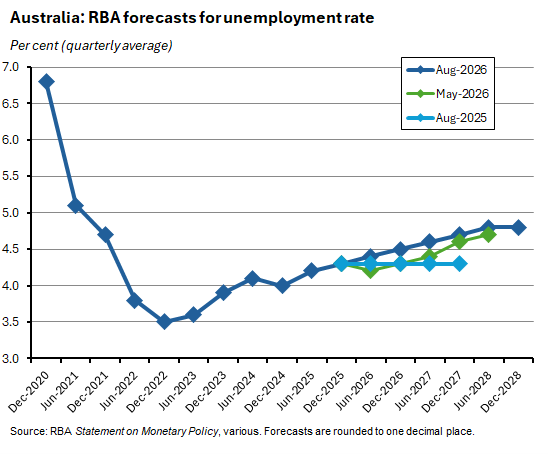
- Likewise, the RBA reckons that ‘labour market conditions have eased by a little more than expected.’ In the May SMP, the unemployment rate had been projected to rise gradually to 4.2% in the June quarter 2026 before reaching 4.3% in the December quarter of this year. Instead, the actual rate was already at 4.4% by the June quarter. Even so, ‘labour market conditions are still assessed to remain a little tighter than full employment.’
- Against this backdrop, Martin Place judges that current financial conditions are ‘somewhat restrictive.’
The RBA’s new forecasts
While that explains where we are, current decisions on monetary policy settings depend heavily on where we are going, given that the full impact of a change in the policy rate will only be felt in one to two years’ time. The RBA’s latest best guess (central forecast) is set out in the updated projections included in the August SMP.
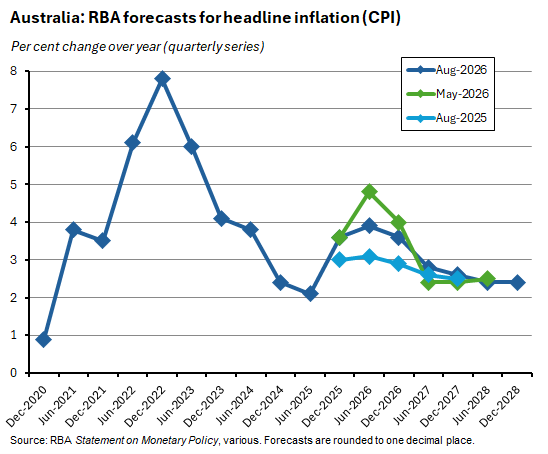
According to the new SMP, slower growth and higher unemployment will work to close the output gap and bring inflation back to target. Headline inflation is now forecast to slow to 3.6% in the December quarter of this year before easing to 2.8% by the June quarter next year, and to return to 2.4% (just below the middle of the target band) by the June quarter 2028. Underlying inflation is projected to follow a similar trajectory, easing to 3.3% by the final quarter of this year, and then falling to 3% by the June quarter 2027 before returning to the lower half of the target band by mid-2028.
Australia’s real GDP growth this year is expected to be 1.9%, unchanged from the May SMP. Real GDP growth next year is projected to run at a sluggish 1.5% (albeit revised up slightly from 1.3% in the May SMP) before picking up to 1.7% in 2028. Since Australia’s potential growth rate is thought to be around 2%, that means three consecutive calendar years of below-potential growth. In fact, in the new SMP the RBA has nudged up its estimates of potential annual output growth to a little over 2%. But that increase is due to an upward revision to population. Forecast medium-term annual productivity growth remains at 0.7%. That combination means real GDP per capita growth has been revised down for this year.
That forecast for subdued real GDP growth translates into an increase in projected joblessness. The August SMP forecasts the unemployment rate to rise to 4.5% in the December quarter of this year, to climb again to 4.7% by the December quarter 2027, and to edge up once more, to 4.8% in the December quarter 2028. That represents a slightly higher trajectory than in the May SMP, which only had the unemployment rate reaching 4.7% by the June quarter 2028.
Importantly, all these forecasts are based on the technical assumption that the cash rate will move in line with financial market expectations as of early August. That implies little change through to the end of 2028, with the rate increasing by around 10bp over the course of the rest of this year before falling to around 4.4% by the end of the forecast period. That trajectory for the cash rate is around 25bp lower than the one that underpinned the May 2026 forecasts.
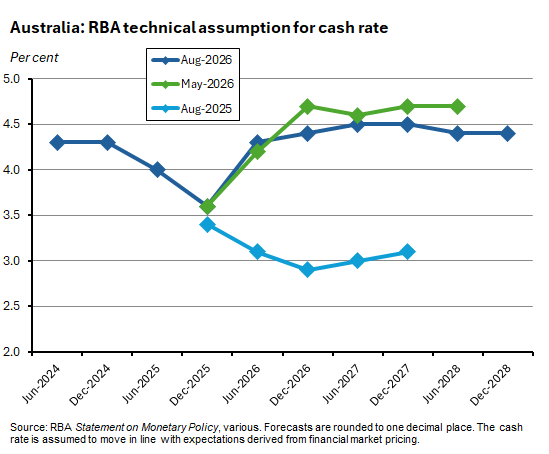
Another important assumption underpinning the August SMP is that oil prices will follow current market pricing. That means prices are assumed to gradually retreat from their current levels, falling from US$81.20/b in the December quarter of this year to US$71.30/b by the December quarter 2028.
Three key judgements and three key risks
As usual, the SMP sets out the key judgements underpinning its forecasts along with the key risks to that outlook. There are three of each.
The key judgements are:
- The conflict in the Middle East will gradually de-escalate over the second half of this year, allowing for the gradual decline in oil prices noted above. At the same time, broader geopolitical tensions will remain elevated.
- The assumed trajectory of the cash rate will deliver financial conditions that are restrictive enough to close the output gap and generate a gradual increase in unemployment.
- The pass-through of fuel and other war-related costs will continue to push up inflation until around mid-2027 but this effect will wane thereafter, contributing to declining inflation over the latter part of the forecast period.
The key risks are:
- Global and domestic inflation could be more persistent and/or higher than expected, for example if the conflict in the Middle East escalates, if energy market disruption increases, if there is more cost pass-through than the RBA anticipates, or if the global AI investment boom proves more inflationary than predicted.
- Economic activity could be weaker than expected, for example if an escalation in the Middle East conflict takes a greater toll on global activity, or if house prices fall by more than anticipated and/or if the impact on activity of a given fall in house prices proves larger than estimated.
- The RBA could have misjudged future productivity growth and the amount of spare capacity in the economy. Actual productivity growth – non-farm labour productivity rose by just 0.1% over the year in the March quarter – is still well below the RBA’s downgraded medium-term estimate of 0.7%, for example. And the ‘true’ level of labour market tightness remains another important source of uncertainty.
Importantly, the RBA’s overarching judgement in the August SMP is that the risks to inflation remain skewed to the upside, from the threat of renewed escalation in the Persian Gulf to the possibility of stronger-than-expected spending on AI and data centres and the risk of more persistent domestic capacity pressures. Hence this week’s hawkish rhetoric accompanying the vote to leave policy on hold.
Other Australian data points to note
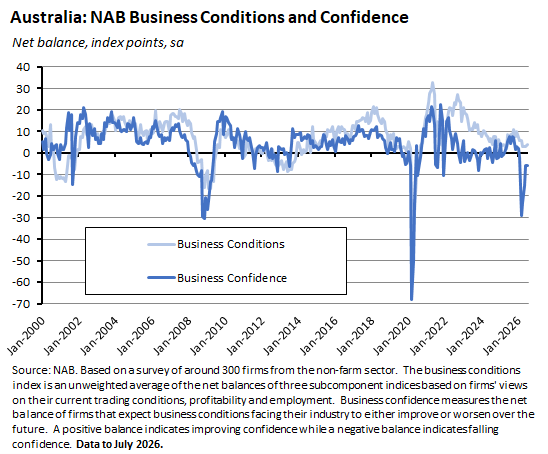
According to the July 2026 NAB Business Survey, business confidence fell one point over the month to -6 index points, ending a sequence of three consecutive monthly increases. In contrast, business conditions improved by one point, rising to +4 index points, but remaining below their long-run average (+7 points). The NAB survey reported that capacity utilisation rose 0.9 percentage points in July, climbing to 83%, with four out of eight surveyed industries reporting trend utilisation running above the corresponding average, but less than the six industries reporting the same at the start of this year. Purchase cost growth rose 0.2 percentage points to 2.3% (quarterly rate), labour cost growth rose 0.5 percentage points to 2.2%, and final product price inflation nearly doubled, rising at 1.1%. While NAB noted that purchase cost growth is still well below its March 2026 peak triggered by the onset of the Middle East crisis, labour cost growth has now climbed to its highest level since January 2025. And purchase and product price growth are both running at or above pre-conflict rates.
The ABS said that average weekly ordinary time earnings for full-time adults rose by 3.7% over the year to May 2026 (seasonally adjusted basis). According to the Bureau, that was the lowest rate of annual increase since November 2022. Full-time adult average weekly total earnings rose 3.5% over the same period. And all employees average weekly total earnings (original basis) grew 2.4%.
Further reading and listening
- The RBA’s Christopher Kent on the restrictive stance of monetary policy.
- Also from Australia’s central bank, the latest RBA Chart Pack on the Australian economy and financial markets.
- In the AFR, Richard Holden is unhappy about the RBA’s approach to monetary policy.
- Also from the AFR, making the case that this housing downturn is different to the rest.
- The e61 institute offers some thoughts on taxing robots in a context where AI could exacerbate income inequality while shifting the tax base offshore.
- On Australian workers’ changing expected and preferred retirement age.
- From the Lowy Institute, Graham Fletcher reviews the state of the Australia-China relationship.
- A new BIS Bulletin analyses energy shocks and inflation, noting that the recent shock ‘ranks among the most significant since the 1990s’.
- The IEA’s August 2026 Oil Market Report estimates that the global oil balance will now show a deficit of 1.8mb/d in the September quarter of this year, more than double the estimate in its July 2026 report. The IEA warns that: ‘Although the market is projected to return to surplus towards the end of this year, risks remain substantial and the urgency of reopening the Strait has increased, as previously available inventory buffers are rapidly depleting.’ Related, the IEA’s latest update on EVs reports that global sales surged in the June quarter, despite a challenging backdrop for the global car market.
- RAND considers the potential of China’s strategic petroleum reserve as a geoeconomic tool.
- UNCTAD’s latest global trade update says that the first half of this year saw ‘a strong but increasingly uneven expansion of international trade.’ Higher prices due to the Middle East conflict drove much of the growth, along with leading roles for technology-intensive products - critical minerals, semiconductors, batteries, ICT products and EVs.
- A Peterson Institute report on China, global supply chains and the limits of US decoupling.
- Related, the WSJ considers China’s new export engine – a ‘factory for factories.’
- And an Economist briefing on China’s AI drive and its implications for the world’s largest workforce.
- Torsten Slok says that, to date, the AI capex boom is only showing up in sellers’ margins, not buyers’.
- According to Chokepoints and the new geography of power, there are now six categories of chokepoints – that is, the concentrated points of passage or dependency through which wider systems must move, and where disruption can produce effects well beyond the immediate location or sector – that are now central features of international power: Geographic (such as the Strait of Hormuz), Infrastructure (for example, electricity grids), Manufacturing (for example Taiwan’s advanced semiconductor production), Digital (such as subsea cables), Financial (such as SWIFT) and Climate and Water.
- On the global scramble for critical minerals.
- The FT’s Weekend Essay reckons Philip K Dick saw our future. Related, an FT Big Read on America’s new oligarchy.
- A roundup of economics book reviews from the IMF.
- Why making generalisations can be useful.
- The ABC’s Insiders/Politics Now podcast talks to the former Director General of the Australian Signals Directorate about how the US-China AI race could influence Australian national security.
- The Conversations with Tyler podcast with Daron Acemoglu on liberalism and automation, and the educated elite.
- The Sinica podcast chats with Evan Osnos about the future, made in China.
Latest news
Already a member?
Login to view this content