

 This product has already been purchased.


Overview
- Australia's unemployment rate rose to 4.9% in October. That was up from 4.7% in September this year and above the market consensus forecast. It was also the highest unemployment rate since October 2021.
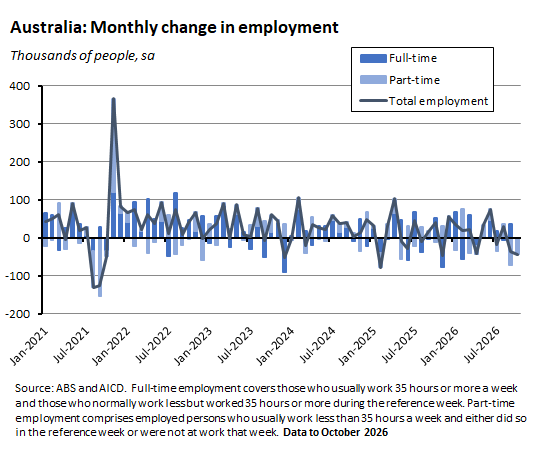
- In further signs of labour market easing: employment slumped by 43,500 vs a consensus forecast for a 25,000 increase; monthly hours worked in all jobs slipped by 0.2%; and the employment-to-population ratio fell 0.3ppt to 63.3%. The participation rate was down, too.
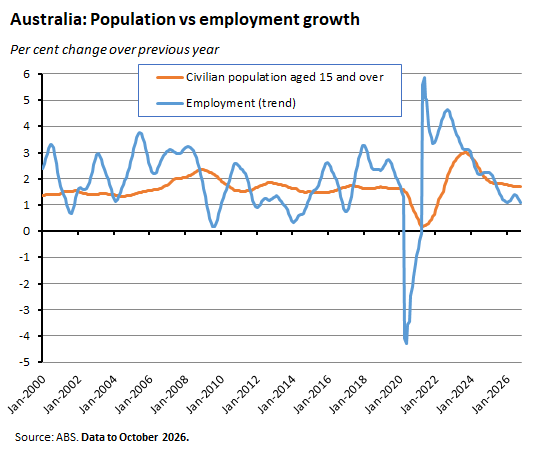
- The RBA has been concerned that the labour market has been 'a little tight'. This week's labour force numbers should help assuage such worries, with the unemployment rate now above the central bank's (upwardly revised) estimate of the NAIRU and trend employment growth running below working-age population growth. If anything, another surprisingly weak outcome instead provides more support to the argument that the labour market is (again) softening faster than the RBA has projected.
- The latest wage data will have been less comforting for Martin Place. The WPI rose 1.1% over the September quarter, growing at its fastest quarterly pace since the December quarter 2023, while headline annual wage growth was 3.5%. Some of this strength reflects the FWC's 4.75% award increase. But individual arrangements also saw stronger wage growth last quarter. Despite the pickup in nominal wage growth, however, real wages still went backwards for a fourth consecutive time.
- Overall, the labour market data are consistent with the current market assessment that rates will remain on hold at the upcoming December 2026 MPB meeting.
- This week's release of the MPB Minutes provided more detail on the split 6-3 vote for a November rate hike. The majority were focused on upside inflation risks, a prolonged period of above-target inflation, and uncertainty as to the restrictiveness of policy settings. The minority were more concerned by downside risks to activity, including the possibility of a 'materially sharper downturn.'
- The MPB's voting record shows the hawks in the ascendancy. Four of the 12 meetings with published voting records to date have involved dissenting votes. Of those, only the March 2026 rate hike (5-4) was tight.
This week delivered an update on labour market conditions in Australia with new monthly numbers on employment and unemployment and new quarterly data on wages. The updates were particularly interesting for two reasons.
First, they arrived in a context where the RBA has delivered five rate hikes this year, motivated in part by concerns around the inflationary impact of domestic capacity constraints as well as by fears that a sustained period of high inflation is starting to feed into inflation expectations, and from there into future wage demands (as well as into firms’ pricing decisions). A labour market that the central bank recently judged to be ‘a little tight’ is central to this narrative.
Second, they also arrived against a backdrop of recent announcements of large job losses across major Australian employers. From this perspective, the big story is not the old tale of labour market tightness, but rather one of rising retrenchments and apprehensions that some combination of AI, automation, and cost reduction measures is inexorably squeezing employment prospects even as the RBA is actively targeting a looser labour market.
So, what did we learn? Elements of both stories were visible in the data, suggesting that while the RBA still has some lingering grounds for concern on the inflation front, the balance of risks in the labour market is shifting. That in turn indicates that markets are correct to anticipate rates remaining on hold at next month’s Monetary Policy Board (MPB) meeting.
Start with the first story. Here, this week’s labour force numbers offered some reassurance, albeit at the cost of higher joblessness. The unemployment rate has now risen to 4.9% and stands at a five-year high that also exceeds the RBA’s new estimate of the Non-Accelerating Inflation Rate of Unemployment (NAIRU). At the same time, employment has fallen, the employment-to-population ratio has declined, and trend growth in employment has slowed. All of which suggests that the labour market is once more loosening at a faster rate than implied by the central bank’s forecasts (which recently pencilled in a 4.9% rate for the December quarter of next year).
On the other hand, the September quarter Wage Price Index (WPI) numbers were less comforting for Martin Place. The quarterly increase in the WPI was the highest since the December quarter 2023, headline wage growth rose to 3.5%, and private sector wage growth ticked up to 3.4%. Some of this was expected in the aftermath of the Fair Work Commission’s (FWC) decision to increase modern award wages by 4.75% effective from 1 July this year. But signs of wage pressure extended beyond awards and enterprise agreements to individual arrangements, offering at least some validation for the RBA’s worry that higher inflation is being reflected in higher wage outcomes.
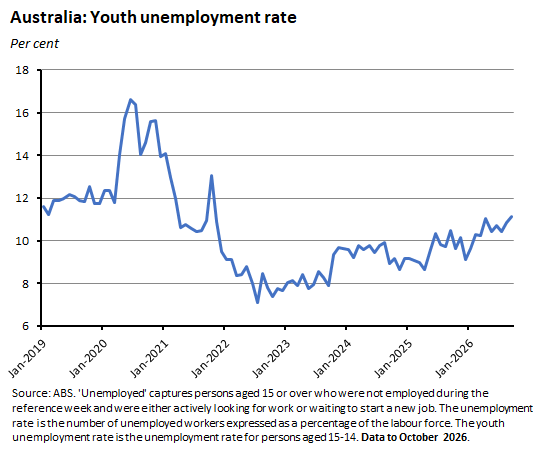
What of the second story? Along with that increase in the headline unemployment rate there was also a 0.2ppt increase in the youth unemployment rate to 11.3%, another five-year high. In addition, backward-looking retrenchment data (original basis) show the number of retrenchments rising from around 50,500 in July to about 57,800 in August and 65,700 in September, for a quarterly total of around 174,000. That is markedly higher than the average quarterly rate of 123,000 retrenchments last year.
We dig into the labour force and WPI releases in more detail below. We also review the Minutes of the November 2026 MPB meeting, examining the story they tell about the 6-3 split in the Board vote for this month’s rate increase. And we provide a short history of past MPB split decisions.
Meanwhile, on the international front, this week also sees two historic meetings. Presidents Trump, Xi, and Putin are scheduled to hold a trilateral meeting in Shenzhen on the sidelines of the APEC summit. Some have dubbed the gathering Yalta 2.0 and detected echoes of an earlier effort at setting the terms of the global order, although there is plenty of scepticism, too.
Second, COP31 is already well underway in Antalya and now entering its final stretch, having kicked off on 9 November. This too is an historic meeting, marking as it does the first ‘Overshoot COP’ – that is, the first UN climate summit held after the official view has shifted to accept that the world will almost certainly exceed the Paris Agreement’s target of limiting global warming to 1.5°C above pre-industrial levels. The UN Environment Programme (UNEP) recently warned that even under an optimistic scenario based on the full implementation of all current national climate plans plus meeting additional net-zero targets, the expected peak temperature rise would still reach 1.8°C. According to the UNEP, the risks and impacts of this overshoot include faster sea-level rise, more extreme heat and wildfires, and major changes to the cryosphere (ice sheets, sea ice, glaciers, permafrost and snow). Recently the OECD cautioned that extreme weather events were already increasingly impacting ecosystems and economic activity across many of the world’s regions.
The unemployment rate rose to 4.9% in October
According to the October 2026 Labour Force release, Australia’s unemployment rate rose to a seasonally adjusted 4.9% last month, up from 4.7% in September, as the number of unemployed people increased by 17,800. October’s result came in above the consensus forecast for another 4.7% print and took the rate up to its highest level since October 2021. The unemployment rate also increased on a trend basis, rising to 4.8% from 4.7%.
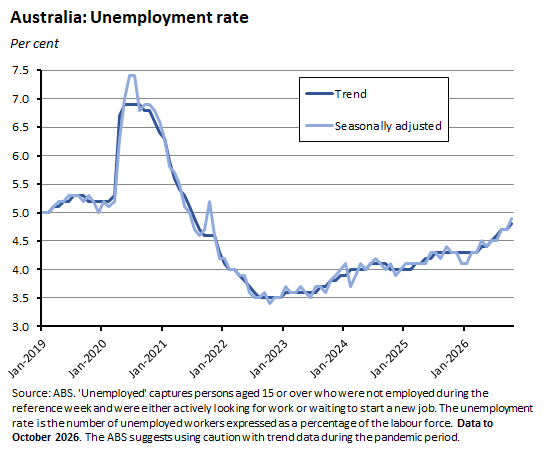
The ABS noted that, as was the case in September, there was a higher proportion of people remaining unemployed than usual for October in the post-COVID era.
The Bureau also highlighted an increase in the youth unemployment rate to 11.3% in October, which likewise saw that measure return to its highest level since October 2021. There has been an increased focus this year on the impact of AI and automation on youth unemployment rates and the availability of entry-level positions, although note that outsized increases in youth joblessness relative to the overall position have been a feature of labour market data for some time.
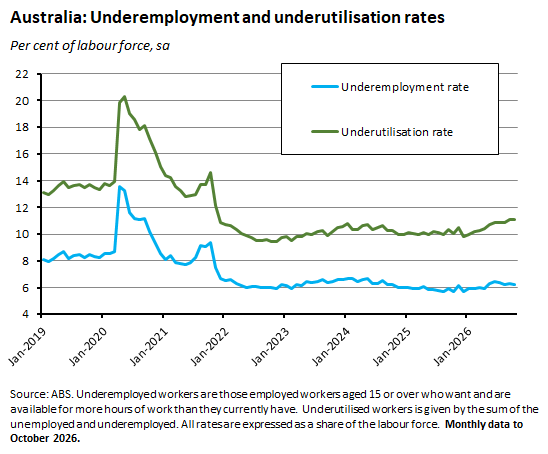
In contrast to October’s rise in the unemployment rate, the underemployment rate fell 0.1ppt last month, easing to 6.2%. As a result, the overall underutilisation rate was unchanged from September at 11.1%.
Employment fell by 43,500 people in October, with full-time employment down by 2,900 and part-time employment slumping by 40,600. Again, this was a weaker outcome than the market had anticipated, with the consensus forecast having expected a 25,000 gain. The number of hours worked in all jobs also fell over the month, sliding by 0.2% (4 million hours).
The participation rate fell 0.2ppt to 66.6% (the lowest rate since November last year) while the employment-to-population ratio dropped by 0.3ppt to 63.3% (the lowest reading since January 2022).
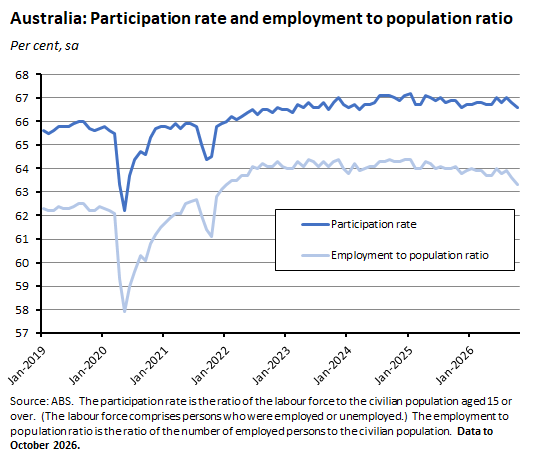
As discussed earlier, these weaker-than-expected labour market numbers arrived against the backdrop of an RBA that has been signalling it thinks the labour market remains ‘a little tight,’ including in the November 2026 Statement on Monetary Policy (SMP).
Granted, the SMP did acknowledge that labour market conditions had already eased by more than Martin Place had expected in recent months. The RBA’s previous SMP had projected the unemployment rate to average 4.4% over the September quarter vs the actual 4.6% outcome. But November’s SMP went on to suggest that this miss was accounted for by ‘stronger-than-expected labour force participation rather than weaker-than-expected employment.’ According to the Statement, the RBA also judged that most of the labour market indicators it monitors remained ‘close to or slightly tighter than their estimated trend levels’ while the average of the RBA’s own model-based estimates of the NAIRU had increased to more than 5%, pointing to more capacity pressures than indicated by labour market data alone. (Note that the SMP reports that, after considering a broader set of labour market indicators than the model results alone, the RBA now assesses the NAIRU to be around 4.75%.)
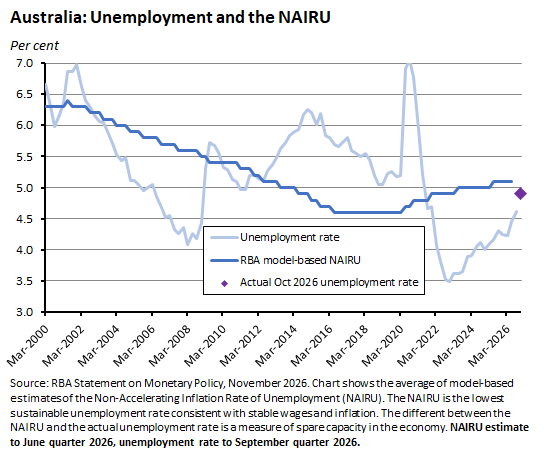
Combining this analysis with the presence of strong underlying inflation and strong growth in labour costs in the economy leads the SMP to conclude that ‘we continue to assess that the labour market is a little tight, despite recent easing in a number of indicators.’
In this context, the October labour market results should offer Martin Place some reassurance. The unemployment rate has now risen to be a little above the central bank’s new estimate of the NAIRU and moved closer to the pure model-based one. At the same time, the trend rate of employment growth has continued to slow and is now running below the rate of growth of the working-age population.
Wage growth picked up in the September quarter
The ABS said that Australia’s Wage Price Index (WPI) rose 1.1% (seasonally adjusted) over the September quarter 2026 to be up 3.5% over the year. That was the strongest quarterly wage growth since the December quarter 2023 and the highest annual rate since the December quarter last year. It was also a stronger outcome than the market had expected, with the consensus forecast anticipating 1% quarterly and 3.4% annual growth outcomes.
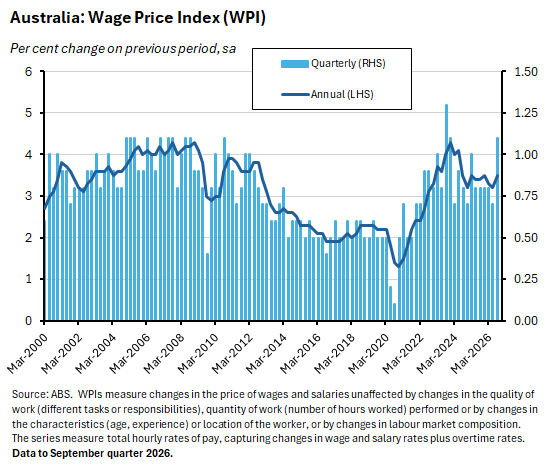
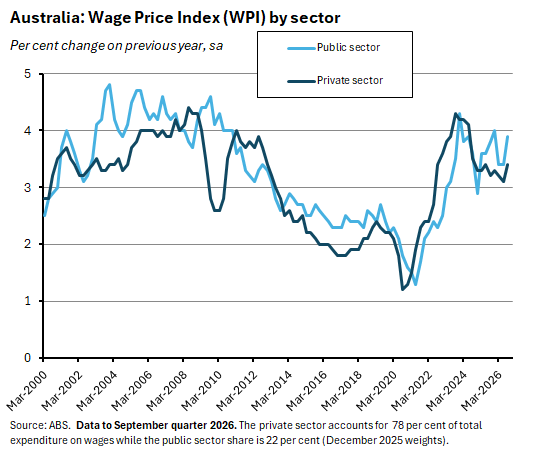
Private sector wages rose 1% over the quarter and 3.4% over the year while public sector wage growth was 1.3% quarter-on-quarter and 3.9% year-on-year. Private sector wages accounted for 80% of total wage growth in the September quarter, with the public sector accounting for the remaining 20%. Annual public sector wage growth has now outpaced gains in the private sector for seven consecutive quarters.
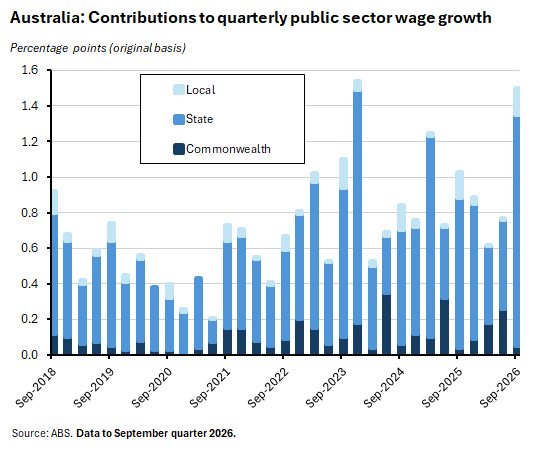
According to the Bureau, the main driver of public sector wage growth in the September quarter was pay rises for state government front-line workers (such as nurses, midwives and police officers) covered by enterprise agreements. On an original basis, overall public sector wages rose 1.5% over the quarter, with state governments accounting for most (about 1.3ppt) of that increase.
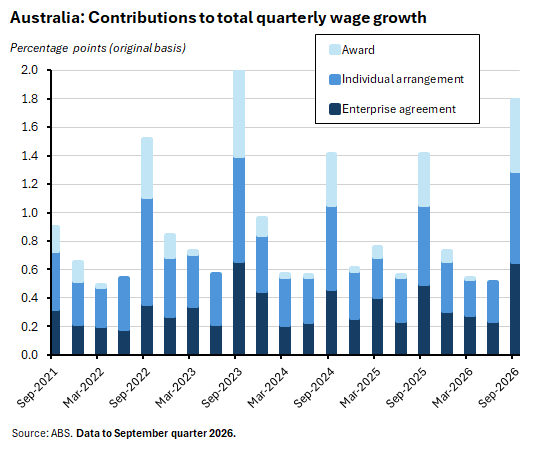
The ABS said that wage setting decisions made by the FWC, including this year’s Annual Wage Review increase of 4.75% to modern awards (up from 2025’s 3.5% increase), were a key driver of private sector wage growth over the quarter.
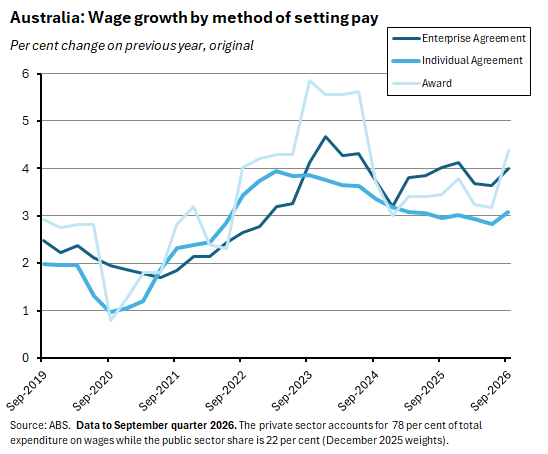
While the rate of annual wage growth picked up the most for awards (rising from 3.2% in the June quarter to 4.4% in the September quarter) followed by enterprise agreements (up from 3.6% to 4%), it is notable that there was a modest increase in wage growth for individual arrangements, too (from 2.8% to 3.1%).
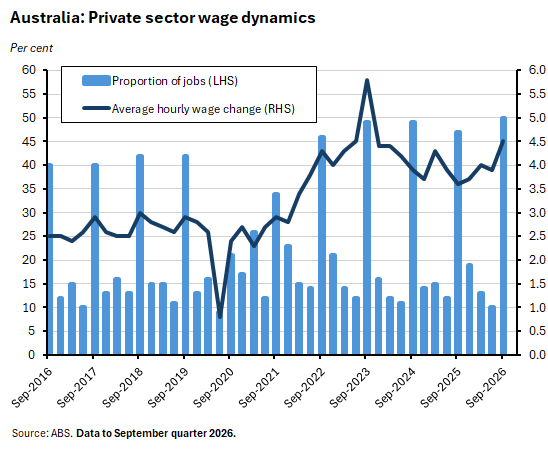
Some 50% of jobs in the private sector received a wage increase this quarter, with the average hourly wage change reaching 4.5%, marking its highest rate since the September quarter 2023.
By industry, the fastest rate of annual wage growth was in Health care and social assistance (4.9%) followed by Mining (4.2%).
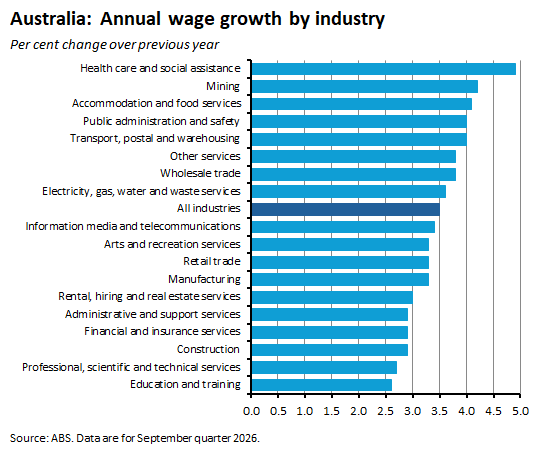
Health care and social assistance (both private and public) was also the largest industry driver of wage growth over the quarter, contributing around 26% of the total, or more than twice the share of the next most important industry (Professional, scientific and technical services).
Finally, with annual wage growth running at 3.5% in the September quarter and annual inflation at 4% (on a seasonally adjusted basis), real wages went backwards for a fourth consecutive quarter.
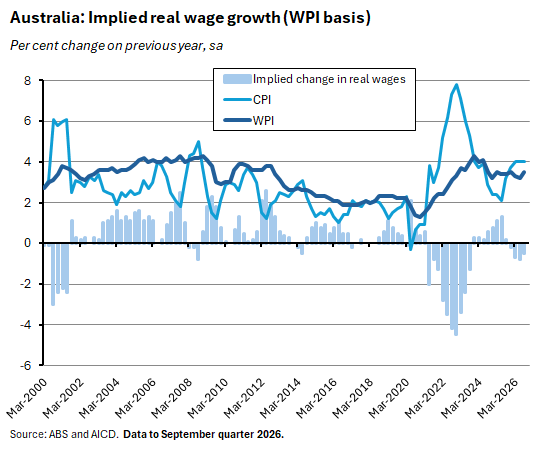
While the latest employment and unemployment numbers pointed to further loosening in the labour market, the September quarter wage numbers offered less comfort to Martin Place.
The RBA’s review of labour market conditions in the November 2026 SMP notes that wage growth had remained stable in the June quarter, with the headline rate of annual increase in the WPI running at 3.2%, private sector wage growth slightly below that at 3.1%, and wage growth for workers on individual arrangements (which the RBA thinks tend to be the most responsive to current labour market conditions) growing at a little less than 3%. At the time, the SMP reckoned that these numbers were ‘consistent with our assessment that labour market conditions are a little tight.’
The September results have all come in stronger than their June predecessors, at 3.5%, 3.4% and 3.1%, respectively. That 3.5% headline rate is also above the RBA’s projected 3.4% WPI growth for the December quarter this year.
Granted, the SMP did caution that wage growth was likely to have picked up in the September quarter, in part due to the FWC’s ruling on award wages. In addition, the RBA’s liaison contacts had also told the central bank that wage growth had ‘increased notably since July’ including in firms not reliant on awards, as workers’ wage claims responded to higher inflation in an effort to protect real wages. So the new WPI numbers won’t have come as a big surprise. Rather, they offer some support for the RBA’s views on the persistence of a degree of labour market tightness through the preceding quarter.
The RBA Minutes’ guide to this month’s split vote by the MPB
On 3 November, the MPB voted to increase the cash rate target by 25bp to 4.85%. Six of the nine members voted in favour of an increase while three members voted to leave the cash rate target unchanged at 4.6%. This week’s release of the Minutes of the November MPB Meeting offers some insight into the debate behind that split vote. Broadly, while the majority in favour of a hike were focused on the dangers of prolonging the time that inflation remained above target, the minority placed a greater weight on downside risks to activity.
The (losing) case for a November hold
According to the Minutes, the case for a wait-and-see approach was ‘founded on a view that, while further tightening in monetary policy might still be required, there was no need to make that judgement immediately and the prevailing downside risks made it prudent to wait for more evidence before deciding.’ The Minutes set out three arguments in support of this position:
Case for a hold #1: The full effects of the 100bp of tightening introduced before the November meeting were still working their way through the economy and were not yet apparent in the data. Long and variable policy lags meant that their full impact was uncertain.
Case for a hold #2: The downside risks to the growth outlook could be larger than the majority believed. Supporting arguments here included the greater-than-expected 0.5ppt increase in the unemployment rate over the previous six months, the possibility that the still-unfolding housing market downturn would reduce activity by more than the average historical response, and the potential for sentiment toward data centre construction to prove more fragile than expected.
Case for a hold #3: The risks to inflation could be more balanced than assessed by RBA staff. Potential supporting evidence here included signs of a slowdown in the monthly pace of inflation in market services over the September quarter, the relative stability of wage (WPI) growth in the June quarter, and the contestability of the evidence on higher inflation expectations.
Summing up this case, the Minutes say:
‘A minority of members determined…that the case to leave the cash rate target unchanged at this meeting was the stronger one…They also placed somewhat less weight than the other members on the upside risks to inflation and somewhat more weight on the downside risks to economic growth. These members expressed their concern that the economy might be near the point of entering a materially sharper downturn and pointed to the costs in terms of unemployment.’
The (winning) case for a November hike
The case for a rate hike was also founded on three arguments: ‘concerns about the further deterioration in the outlook for inflation, continued upside risks to the inflation forecast and an assessment that financial conditions may not be as restrictive as that backdrop required.’ Taking those in order:
Case for a hike #1: Recent information (as seen both in the strong September quarter 2026 inflation numbers and the new and higher RBA inflation projections in the November SMP) could be signalling a more inflationary environment than previously assessed. Supporting evidence for this thesis included: high rates of price increases for market services, persistently strong growth in unit labour costs, and consistent messaging from the RBA’s liaison program regarding broad-based cost pressures. Together, these could indicate a relatively larger role for domestic capacity pressures in driving inflation and an environment in which higher capacity pressures might allow firms to pass on a larger share of cost pressures arising from higher oil prices or other global developments.
Case for a hike #2: The risks to the inflation forecast could remain skewed to the upside. Potential sources of upside risk included persistently higher oil prices, evidence of persistently higher price pressures beyond oil prices across other countries implying higher import prices for Australia, and the threat of stubbornly higher inflation expectations.
Case for a hike #3: Financial conditions might not be sufficiently restrictive. This could be the case if some of the previous monetary policy tightening had merely served to remove a degree of policy accommodation or if the neutral rate of interest had increased over the past year (a higher neutral rate would imply that for a given policy rate, the level of restrictiveness would now be lower than previously).
Summing up the winning arguments, the Minutes state:
‘…most members determined that the case to increase the cash rate target at this meeting was the stronger one…they judged the risks of unintentionally leaving monetary policy insufficiently restrictive (potentially allowing medium- to long-term inflation expectations to rise) currently to outweigh the probability associated with unintentionally setting monetary policy too tight (potentially leading to a faster or greater easing in labour market capacity pressures)…these members cited the length of time inflation had been – and was projected to remain – above target and the likelihood of even higher near-term headline inflation outcomes.’
A short history of MPB split votes
The new MPB was established in March 2025, with the first policy decision arriving with the April 2025 meeting (which left the cash rate target unchanged at 4.1%). For the April and May meetings last year, the RBA did not report the direction of voting. But starting with the July 2025 MPB meeting, the post-meeting statement began to include an unattributed record of votes cast.
Including that July 2025 meeting, there have now been 12 MPB meetings where we have a record of the votes. In eight of those meetings, the vote was unanimous, leaving four meetings in which there were dissenting votes:
July 2025. Six of the MPB’s nine members voted in favour of leaving the cash rate target unchanged at 3.85% while three members voted in support of a rate cut. At the next meeting in August 2025, the Board voted unanimously in favour of a 25bp rate cut.
March 2026. Five members voted to increase the cash rate target by 25bp to 4.1% while four members voted to leave the cash rate unchanged.
May 2026. At the following meeting, eight members voted to increase the cash rate target by 25bp to 4.35%. One dissenter voted in favour of leaving it unchanged. At the next meeting, in June 2026, the Board voted unanimously in favour of a hold.
November 2026. Six MPB members voted to increase the cash rate target by 25bp to 4.85% while three voted in favour of leaving policy on hold.
That short history suggests that – so far, anyway – the pattern is for the hawks on the MPB to outnumber the doves, with only the vote for the March 2026 rate hike ending up as a particularly close call.
Other Australian data points to note
The ABS has released new State Accounts for the 2025-26 financial year. According to the Bureau, gross state product (GSP) rose in all states and territories last year, with real growth ranging from a high of 3.2% in the Northern Territory to a low of 1.7% in Victoria. That compares to real GDP growth in 2025-26 of 2.3% for the Australian economy overall.
Further reading and listening:
Treasurer Jim Chalmers’ keynote address to the ASIC Annual Forum: Cutting red tape and compliance costs to boost productivity. According to the Treasurer, December’s MYEFO will include ‘a substantial savings package’ while the government will seek to keep making progress on productivity.
Related, has the Treasurer really made $180 billion in budget savings? It depends.
In her panel at the same ASIC event, RBA Governor Michele Bullock told her audience that the risks to inflation are still skewed to the upside and include (1) the possibility that oil prices remain elevated, (2) that the AI/data centre boom adds further to existing capacity pressures, and (3) that inflation expectations ratchet up.
From the AFR, a monetary case against further rate hikes.
According to the IEA’s November 2026 Oil Market Report, the oil market is ‘showing tentative signs of rebalancing, with global oil supplies surpassing demand for the first time since the outbreak of the war in Iran.’ Exports from the Gulf have recovered much faster than global oil demand, after global oil supplies surged by 2.3mb/d to 105.4mb/d in October this year. Observed oil inventories rose by 1.7mb/d in October, marking the first increase since June this year while oil on water has risen to its highest level since January. The IEA reckons that Gulf oil exports are running 26% below pre-war levels. Output has increased by 5.3mb/d since August and as a result, the year-on-year decline in output has shrunk from an average of 8mb/d over March-September to around 2.9mb/d as of last month.
The WSJ on the month that rocked the AI trade and rewired Wall Street and the end of the ‘no-brainer’ era and its ‘one big trade.’
The OECD’s International Migration Outlook 2026 reports that permanent migration across member countries fell for a second consecutive year in 2025, dropping by 1.6%. Even so, migration levels remained historically high, at 12% above 2019 levels.
Related, this FT Big Read considers the great migration slowdown and its impact on advanced economies.
Some US work on data centres and local labour markets covering the 2000 to 2024 period finds negligible long-term impacts on labour demand and only a short-term impact on construction employment. The authors also find no evidence that data centres act as anchors for high-tech employment clusters.
Interesting Bank Underground post on AI, accountability and the economics of evidence: ‘Where the relevant information is accessible, a wider range of people can produce professionally presented analysis and submit it to decisionmakers. Responsibility for decisions, however, remains concentrated and changes more slowly. Analysis may therefore proliferate faster than those accountable for decisions can assess it. The comparative advantage of institutions may increasingly lie in deciding what evidence to trust and act on, rather than in producing more analysis.’
The Economist magazine asks, can the AI boom make enough money to sustain itself?
Also from the Economist, are the boom times over for boomers?
The FT’s Martin Wolf suggests the best economics books of 2026.
Models of Football Capitalism.
The Odd Lots podcast analyses the impossible trilemma that hangs over the Nvidia crisis.
Stephanomics asks Jason Furman about what happens when AI replaces the economists.
And the EconTalk podcast in conversation with Tyler Cowen regarding the wisdom of Montaigne.
Latest news
Already a member?
Login to view this content