

 This product has already been purchased.


Overview
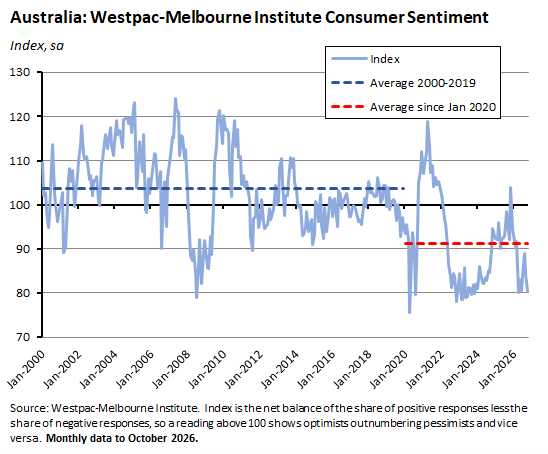
- The Westpac-Melbourne Institute Consumer Sentiment Index fell 4.7% over the month in October this year, delivering one of the 40 worst outcomes in the history of the series.
- Sentiment among the subgroup of those polled after last week’s RBA rate hike was even weaker, slumping to levels last seen during the depths of the early 1990s recession.
- Despite a sequence of very weak consumer confidence readings across this year and earlier, actual consumer spending has proved more resilient. So far.
- Even as consumers are telling pollsters they feel terrible, the RBA’s latest Financial Stability Review sounds relatively sanguine about the financial position of most Australian households.
- New AICD-sponsored research from Mandala partners reckons that efforts to reduce the regulatory burden could make a significant contribution to boosting Australia’s waning dynamism, thereby lifting productivity growth and living standards.
This week’s consumer confidence data – monthly numbers from Westpac-Melbourne Institute and weekly ones from ANZ-Roy Morgan – paint a deeply pessimistic picture. Sentiment has slumped to recession-like levels. There are plenty of potential drivers for this fall, from high inflation to falling home values. But the key trigger appears to have been last week’s RBA rate hike. Below, we dig into the latest sentiment readings, consider what they might imply for the future path of consumption, and take a look at the RBA’s recent assessment of household financial resilience.
This week also brought the release of new AICD-commissioned research on productivity, dynamism and regulation in the Australian economy. We provide a brief overview below, along with a short roundup of other data releases plus the regular selection of further reading and listening.
Consumer sentiment has slumped after last week’s RBA rate hike
The Westpac-Melbourne Institute Consumer Sentiment Index fell 4.7% to a reading of 80.4 in October 2026. That reading was one of the 40 worst outcomes in the history of the monthly series, which goes back to the early 1970s. And with April and June’s results this year also falling into this unhappy category, plus another eight similarly dour readings recorded in 2022-23, Westpac economists reckon that we are now in the midst of ‘the worst period of recurring extremely weak sentiment since the disastrous recession in the early 1990s.’
Blame higher inflation and higher interest rates
Why are consumers feeling so gloomy? All five subindices fell over the month in October, with particularly sharp drops for ‘family finances vs a year ago’ (down 8%) and ‘family finances next 12 months’ (down 6.4%) along with a steep fall in ‘time to buy a major household item’ (down 7.1%). All five are also in pessimistic territory and well below their long-run averages. That detail is consistent with the story that consumers are worried about elevated living costs and rising interest rates.
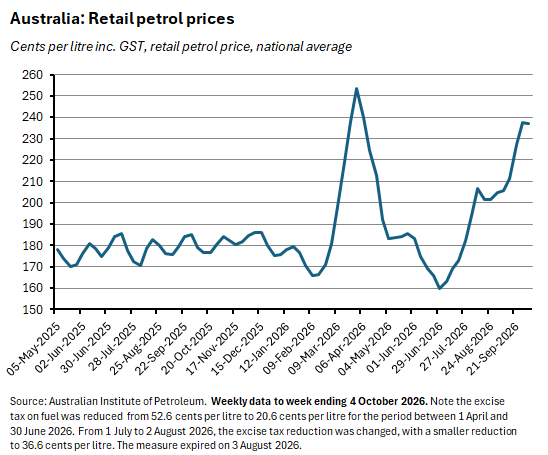
As we noted in last week’s review of the August inflation numbers, the ongoing war in the Middle East has driven fuel prices back up to levels close to the highs reached in March and April this year.
The immediate trigger for consumer grief, however, appears to be last week’s 25bp increase in the RBA’s cash rate target, which pushed the policy rate up to its highest level in 15 years. That view is supported by the difference in reported sentiment before and after the rate hike. So, while the level of sentiment amongst the 60% of the sample surveyed before the rate decision was announced was recorded at 86.9, sentiment in the remaining 40% surveyed after the decision slumped to a reading of just 67.2. Westpac described the latter as ‘an alarmingly weak read that, for complete surveys, has only been registered during the depths of the early 1990s recession.’ Furthermore, the near 20-point drop in the level of sentiment between the two subsamples is the largest since the survey started tracking daily responses in 2019.
Consumers are also worried that there are additional rate increases to come. According to the Westpac-Melbourne Institute Mortgage Rate Expectations Index, amongst those surveyed after the RBA rate hike, just over 80% expected mortgage rates to rise further over the next 12 months, up from 63% expecting the same in the previous month’s survey.
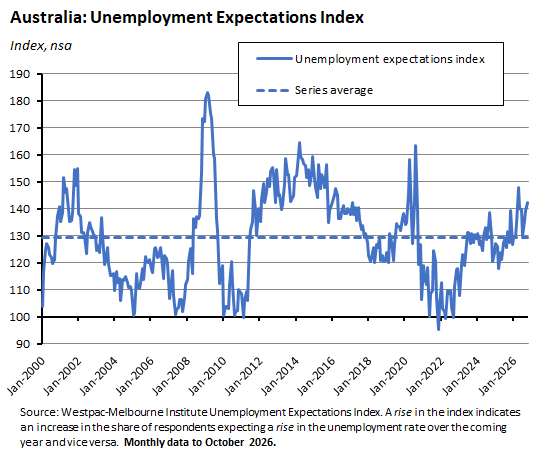
To add to their list of woes, consumers are becoming somewhat more concerned about job security. The Westpac-Melbourne Institute Unemployment Expectations Index rose 1.9% to 142.1 this month, indicating that more respondents expect unemployment to rise over the year ahead.

Additional evidence of souring sentiment
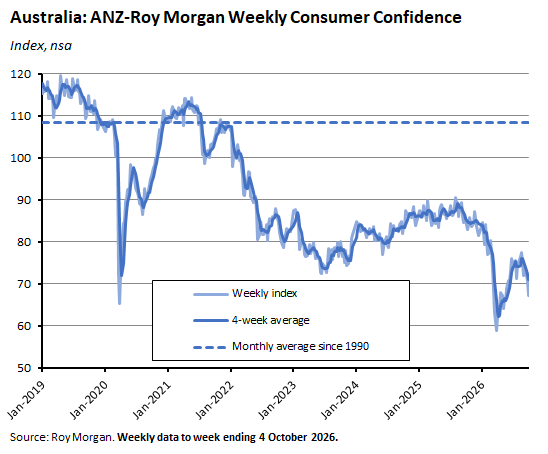
It is not just the Westpac-Melbourne Institute survey sending a negative signal about sentiment. The weekly ANZ-Roy Morgan Confidence Index also slumped following the RBA’s latest rate hike. The index fell 3.4 points to 67.1 for the week ending 4 October 2026 and recorded the 10th lowest result since the survey series began in 1973.
What are the implications for consumer spending?
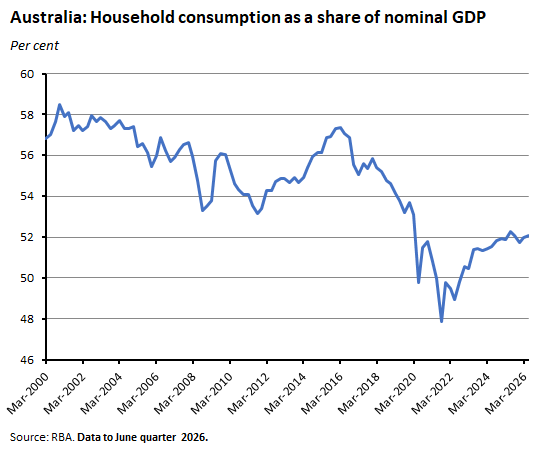
Household consumption accounts for the largest share of demand in the economy, comprising around 52% of nominal GDP. At a time when the RBA wants to see slower growth in demand to bring it closer into line with the economy’s supply capacity and thereby return inflation to target, a downshift in household spending will be part of the story.
In that context, an important puzzle is that indicators of consumer sentiment have been looking much weaker than actual consumer spending, with the former at recession-like levels and the latter more resilient. In fact, the latest (August 2026) RBA Statement on Monetary Policy (SMP) has already highlighted this discrepancy. The SMP noted that recent data had suggested only a gradual easing in underlying momentum in household consumption despite a run of very weak sentiment readings. It attributed this gap between sentiment and spending to the presence of ‘solid’ household fundamentals, where the latter included still-growing household incomes and relatively healthy household balance sheets. The Statement’s discussion on household spending also noted that:
‘…past analysis has found limited evidence that consumer sentiment is an independent driver of household consumption (over and above fundamental drivers such as household income and wealth, which remain consistent with modest growth in consumption).’
Although in a later section on risks to the outlook, the SMP did acknowledge that:
‘…consumer sentiment remains very low and this could weigh on household consumption at some point.’
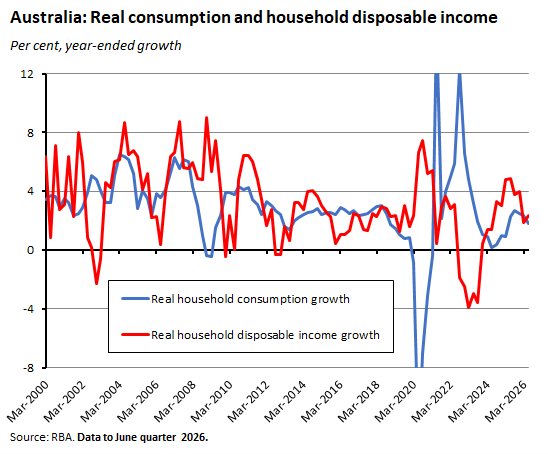
The June quarter 2026 national accounts, released after the August SMP, did report a slowdown in real annual household consumption growth, from 2.4% in the March quarter of this year to 1.8% in the June quarter. The latter was the softest result since the March quarter 2025. (Readers may recall that household consumption growth in the June quarter was supported by rapid growth in the purchase of motor vehicles due to record sales of electric and hybrid vehicles over the quarter). At the same time, although growth in real household disposable income had nudged up to 2.3% from 1.9% over the same period, it also remained below the 3%-5% range recorded between the September quarter 2024 and the December quarter 2025.
Assuming that financial markets and the Westpac-Melbourne Institute survey respondents are correct and further monetary policy tightening is incoming, there will be additional downward pressure on sentiment. Combine that with the drag from higher fuel prices (including the removal of temporary excise relief) and more time for the pass-through from previous rate hikes to do its work, and household consumption should continue to slow further from here, working to pull down growth and inflation.
How resilient are household finances?
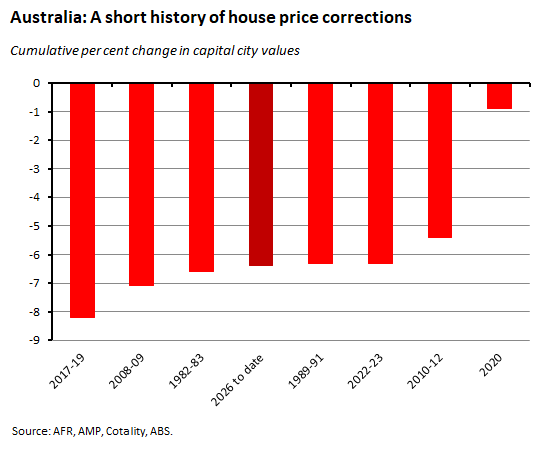
The pressure on household finances is not just coming from higher inflation and higher interest rates. Falling house prices are also part of the picture, placing pressure on the household balance sheets of homeowners. Is the RBA’s battle to defeat inflation going to come at the cost of rising financial distress for Australian households? Some positive news here is that, according to recent assessments, those pressures remain manageable for most households.
According to the October 2026 RBA Financial Stability Review (FSR) analysis of the resilience of Australian households, for example, and despite an increase in cost pressures since the start of this year, ‘the financial position of most households remains strong.’ So, although higher inflation and higher interest rates mean that real household disposable income per capita fell slightly over the first half of this year, it nevertheless remained higher on average than it was in 2023 and 2024. Moreover, while financial pressures have increased for borrowers including mortgage holders, the RBA’s view is that most borrowers continue to have sufficient income to meet their scheduled mortgage repayments and essential expenses.
According to the Review, the estimated share of variable-rate owner-occupier borrowers experiencing a cash flow shortfall – that is, in a situation where their income is insufficient to cover scheduled mortgage repayments plus essential expenses – did increase a little over the first half of this year. But the share of such borrowers remained relatively low at around 2 per cent. Moreover, most borrowers suffering a cash flow shortfall were still judged to have enough savings to enable them to cover their cash flow shortfall for at least six months, assuming they adjusted their consumption down to ‘essential levels.’
Likewise, the FSR reports that the current level of arrears remains low despite a recent pick-up, with the share of housing loans more than three months behind on repayments still around pre-pandemic levels. And while arrears rates for riskier borrowers (including borrowers with high loan-to-value ratios or high loan-to-income ratios) are higher than for other borrowers, those rates have not increased significantly since the start of this year. At the same time, arrears rates for first home buyers remain low, too.
The FSR also reckons that most Australian borrowers continue to benefit from large liquidity buffers that can help them weather adverse shocks to income or expenses. It estimates that the median borrower would be able to cover more than a year of scheduled mortgage payments at current interest rates. It also notes that there has yet to be any significant increase in the share of borrowers persistently drawing down on those buffers.
In addition, and despite the ongoing fall in house prices, most borrowers also retain large equity buffers, with less than 1% estimated to have negative equity (that is, to owe more on their loan than the value of their property). The Review reckons that in a scenario involving a large uniform fall in house prices of 20% from current levels, only around 5% of mortgages would fall into negative equity. Indeed, even in a scenario involving an adverse economic shock that saw the unemployment rate rise to 6.3%, inflation jump to 7%, and the cash rate climb to 5.6%, the share of mortgagors at higher risk of defaulting on their loans would only rise to around 5%. True, the FSR estimates that around two-thirds of these borrowers have insufficient income to cover their expenses. But it also reckons they still retain sufficient buffers to service their debts and meet essential expenses for at least six months. Indeed, even if house prices fell by a further 20 per cent, the Review judges that the number of households falling into negative equity would still be limited.
The Stagnant Nation: Dynamism, productivity, and the regulatory burden
One way to cheer up households in the medium term would be to boost productivity growth. This would lift the economy’s speed limit, making the RBA’s life easier, and delivering a boost to living standards.
This week the AICD released The Stagnant Nation: Lifting Australia's Dynamism, a new research report prepared for the AICD by Mandala Partners. The new research builds on Mandala’s 2025 analysis of the size of Australia’s regulatory burden. That previous report found the cost of complying with federal regulation had risen from $65 billion (4.2% of GDP) in 2013 to almost $160 billion (5.8% of GDP) in 2024. This time, the focus is on the implications of a decline in Australia’s economic dynamism across five key dimensions since the mid-2000s: labour mobility, technology adoption and innovation, business entries and exits, industry concentration, and investment and capital expansion. Mandala estimates that reversing this decline in dynamism could boost productivity growth and lift Australia’s GDP by at least $101 billion a year over the next decade.
The new report also finds that regulation has played a significant role in driving the decline in Australian dynamism over the past two decades. Mandala estimates that by reducing the regulatory burden and returning it to late-2000s levels, Australia could boost GDP by at least $20 billion per year (about 0.7% of GDP) over the next ten years. That is, it could effectively reverse around 20% of the economic drag from lower dynamism.
Specific policy recommendations to lower the regulatory burden and promote a more dynamic economy include establishing a joint industry-public sector taskforce to review regulation, expanding the National Competition Policy and National Productivity Fund to better encourage state-level reforms, extending Automatic Mutual Recognition to all occupations, and removing Group 3 entities from the climate reporting regime.
Other Australian data points to note
ANZ-Indeed Job Ads rose 2% over the month in September (seasonally adjusted) to be up 12.9% over the year. The series is 24.4% above its pre-pandemic (2010-19) average.
The ABS said that the total number of dwelling commencements rose 7% to 52,201 dwellings in the June quarter 2026 (seasonally adjusted). That saw commencements up 14.4% over the same quarter last year. Within that total, commencements for new private sector houses were up 11.6% quarter-on-quarter and 20.7% year-on-year, at 31,707. Housing commencements are running at their highest rate since the December quarter 2021. Commencements for new private sector other residential were down 0.1% over the quarter and up 4.6% over the year, at 19,126.
Further reading and listening
- A submission from the Grattan Institute on building a better Safeguard Mechanism to help deliver on Australia’s emissions-reduction targets.
- On Western Australia’s GST deal.
- On the plan for publicly owned supermarkets.
- IMF Managing Director Kristalina Georgieva’s recent speech on navigating the crosscurrents of a changing world economy.
- Also from the IMF, early releases of the analytical chapters from next week’s World Economic Outlook. Chapter 2 examines lessons from cost-of-living crises while Chapter 3 considers spillovers from corporate income taxation. And a chapter in the new IMF Fiscal Monitor looks at taxing better to boost growth. Key findings from the latter chapter include that poor tax designs impose sizable economic costs (typical corporate income taxes increase the cost of capital by 15% to 20% on average, discouraging investment, while poorly designed taxes on employment income weaken incentives to enter the workforce), that reforms that reduce tax distortions can materially strengthen growth (by boosting investment and employment rates), and that better implementation of taxes can deliver gains (better administration can increase compliance while lower compliance burdens can free up resources and reduce productivity gaps).
- An FT Big Read on how the bond market turned on France.
- Also from the FT, China, America, and the new Great Game.
- The Economist magazine reckons that the era of speedball capitalism has dawned.
- The McKinsey Global Institute’s new report analyses energy security beyond the Strait of Hormuz crisis.
- The WSJ peers inside Scott Bessent’s Treasury.
- The NY Fed asks, how quickly do tariffs pass through into consumer prices?
- A new BIS Bulletin examines circular relationships among AI firms.
- Still no sign of AI in US productivity data.
- The FT’s Unhedged podcast wonders if there is only one trade in markets right now.
- The Power and Consequences podcast asks, how much trouble is Europe in?
- Adam Tooze has some thoughts on Francis Fukuyama’s new memoir.
- The Ezra Klein Show talks to another worried (former) OpenAI insider.
- Following on from its recent series on an ageing society, the Past Present Future podcast kicks off a new series on the history of transhumanism, starting with its origins.
Latest news
Already a member?
Login to view this content