

 This product has already been purchased.


As ANU faced financial and leadership turbulence, Dr Larry Marshall FAICD had to unite a fractured council as interim chancellor. He shares governance lessons learned during a period of profound institutional upheaval.
For the Australian National University (ANU), the need to evolve arrived rapidly, following almost two years of turmoil. ANU's first female vice-chancellor, Professor Genevieve Bell, took office at the beginning of 2024.
There followed a cost-cutting and restructure program known as Renew ANU, which sparked ongoing protests from staff and students. After a bruising federal Senate inquiry and a no-confidence vote from academic college deans, Bell resigned in September 2025. Then chancellor Julie Bishop resigned in May, citing "unprecedented and coordinated interference" and regulatory overreach by the Tertiary Education Quality and Standards Agency (TEQSA).
Dr Larry Marshall FAICD, former CSIRO CEO and serial tech entrepreneur, had been appointed to the ANU Council in 2023, then elected pro-chancellor and finally interim chancellor in the wake of Bishop's resignation.
"I chaired a council meeting on the Thursday night while Julie [Bishop] was away, and overnight she sent an email to tell us she'd resigned," says Marshall. "We [council members] woke up to that chaos and the whole day was triage, because we wanted the people of ANU to hear about it from us first, rather than the media. That crisis disrupted everything, but it brought us together in a way that may not have happened without it."
After the turmoil, Marshall knew one of his priorities would be to help renew the council (several other resignations followed Bishop's) and establish an orderly process for appointing his successor. "Council members come and go, but the institution must always come first," he says.
In August, former public service commissioner and economist Dr Gordon de Brouwer AO PSM was announced as the new ANU chancellor.
"My mission at ANU has always been to make myself redundant," says Marshall. "We designed an open, rigorous process to find the best person to lead ANU into its next chapter, and I'm delighted we've found exactly that in Gordon. Council's most important job is to leave the institution better for the next council than we found it."
The challenge of change
The description "hallowed halls" sums up the vibe of many universities that have been resting comfortably on their laurels for a long time. The tech revolution shattered that august position. "The role of universities is changing globally," says Marshall. "Most of Australia's institutions have tended to evolve slowly over decades, but the way technology is changing means we need to evolve over years, maybe faster."
He adds that in recent years, ANU relied on almost $500m of non-core earnings, such as investments, to bridge the gap between the cost of running the university and the income from its core activities. Marshall says that is turning around. "We're investing in a new strategy, in Al and in new capabilities to be able to flourish. We were staring down the barrel of a $200m deficit, and we've landed on about a $30m deficit. That means we have the capacity to invest in a new strategy, so we can grow from that."
The "ANU by 2030" strategy was launched in August, aiming to repair reputational damage, stabilise the institution, restore trust and embed a culture of care. To achieve this, Marshall had to urgently unite what was left of the council. "We started doing council meetings from about four in the afternoon and going through to nine or 10 at night, bringing pizza into the chancellery, wearing T-shirts not suits, and making it more of a working session," he says. It paid off.
"That really worked with the elected council members who were left. They felt like they were empowered to do things and it helped break down the 'us and them' history."
Marshall says "a bunch of little things" helped to knit them together as a team. "At the end of the session, everyone would help clean up, rather than leaving it to our admin people."
Out went an 80-year-old gavel traditionally used to restore order. Instead, a toy koala wearing a mitre board, a classic grad gift, became the centrepiece. "It was a reminder that we're here for the students and the nation. Good governance is never about personalities, it's about protecting the institution long after today's personalities have moved on."
A path to renewal
"At first, I thought we would need to rush to replace the experience we had lost," says Marshall. "Then I realised we already had the right talent in the room. We simply had to empower those very smart people to deliver."
Everyone stepped up to fill the vacuum, which extended beyond the council boardroom. "The chancellor used to have an office and a staff and we lost all of that, but it turned out to be a blessing. I like to write board papers and love risk matrices because they help me make decisions," says Marshall.
"I found a couple of other council members who also like to write, so we wrote a lot of papers together, particularly around governance renewal. That got other council members invested and they started sharing some of those tasks. After a while, the council was all working collaboratively on the board papers necessary for us to renew the council. We've reconstituted the subcommittees - we'd lost all the chairs for them - and rewritten a lot of the governance documents."
Marshall knew some of his moves risked "crossing over into the management lane", but in the circumstances, it was necessary.
"They just didn't have the operational bandwidth. We'd lost our board secretary, our general counsel, and we had a lot of rebuilding to do."
He collaborated closely with the regulatory body. "I told TEQSA we wanted to change the process by which ANU recruited council members, including the chancellor. They were hugely supportive and gave me a lot of insights."
The old tap-on-the-shoulder recruitment style has been replaced with advertising for council roles, a clear skills matrix and a series of interviews. "All the things a good ASX company would do."
Marshall says Prof Rebekah Brown, the deputy vice-chancellor appointed as interim vice-chancellor after Bell's departure, brought important operational and university experience to the role.
"When Rebekah stepped in as vice-chancellor, she put herself out there to take the blame, which took a lot of heat out of the situation. Rebekah knew we had to change and she has approached it in a very people-centric way. We've all been working on a new strategy designed to restore ANU's long-term financial sustainability and invest in its future."
Governing in disruption: Five takeaways
By Dr Larry Marshall
1. Governance matters most when the governance itself is disrupted. In those moments, you can't solve everything at once. The board's first job is to create clarity - what must we protect, what must change and where do we need to go?
2. The institution doesn't belong to today's board. Today's board belongs to the institution and the chair belongs to everyone. Directors, chairs and CEOs come and go. When leadership changes, don't focus only on what you've lost, look for the strengths you still have around you and empower them. The institution and its purpose must endure.
3. Management has to win today; the board has to help the organisation win tomorrow.The more complex the organisation and itsstakeholders, the harder it is for management to lift its gaze from immediate demands. One of the board's greatest contributions is to help management see around corners, asking what might disrupt the organisation next and whether we're preparing early enough.
4. Strong balance sheets buy you time, but only if you act before you have no choice. Boards naturally focus on the risks of change. But Australian institutions that once evolved over decades are now being disrupted in years, sometimes months, by exponential technologies like Al.
5. The first disruption is rarely the real upheaval. Management naturally focuses on the immediate impact on the business. The board must look beyond that. For example, with Al, universities naturally worry about students using it to do their assignments instead of learning. But that's just the first disruption. The real one is what happens when Al becomes the best tutor a student has ever had - and challenges the traditional role of the university itself.
Unleashing a competitive advantage
By setting aside ego and focusing on institutional survival, the current ANU council (Brown is an ex-officio member) has prepared the ground for a new era while at last operating as a unified team.
When the turmoil was at its height, The Saturday Paper had scoop after scoop based on inside leaks, presumably from council members. Perhaps it was because the remaining council members were flat-out fixing the mess, but "the leaks just stopped", says Marshall.
"We'd tried various technology solutions to prevent leaks, but I realised the real question was what could we do differently to stop the need to leak."
Future-proofing the institution and putting its purpose sharply in focus has been central to the mission.
"What does a university need to do to become indispensable in a world where Al does a lot of the dissemination and management of knowledge? We've all been working on a new strategy to take ANU back to its core purpose, and that's brought everyone onto the same page: How will Al redefine what a university does and, as the national university, how can we help Australia navigate that and the other disruptions happening around the world?"
Marshall sees a thriving ANU as intrinsic to Australia's future prosperity. "If the past century was about digging stuff up and selling it globally, the next century is about the power of our brains, our creativity, to create new knowledge. Natural resources run out, but brainpower, human ingenuity, compounds when you invest in it."
There are "green shoots", he says, that ANU is "sneaking up again" in university rankings. The QS World University Rankings, released in June, put ANU at 29th globally, three places higher than the previous survey.
"Id give Rebekah a plug for that, because as a seven-time CEO, I know how consuming running a business is," says Marshall.
"A university is so much more complex, with so many different elements you don't have in a regular business. When the management team is consumed dealing with that, it's even more important for the council to help them see around corners. While they're winning today, the board is anticipating coming disruptions, so we also win tomorrow."
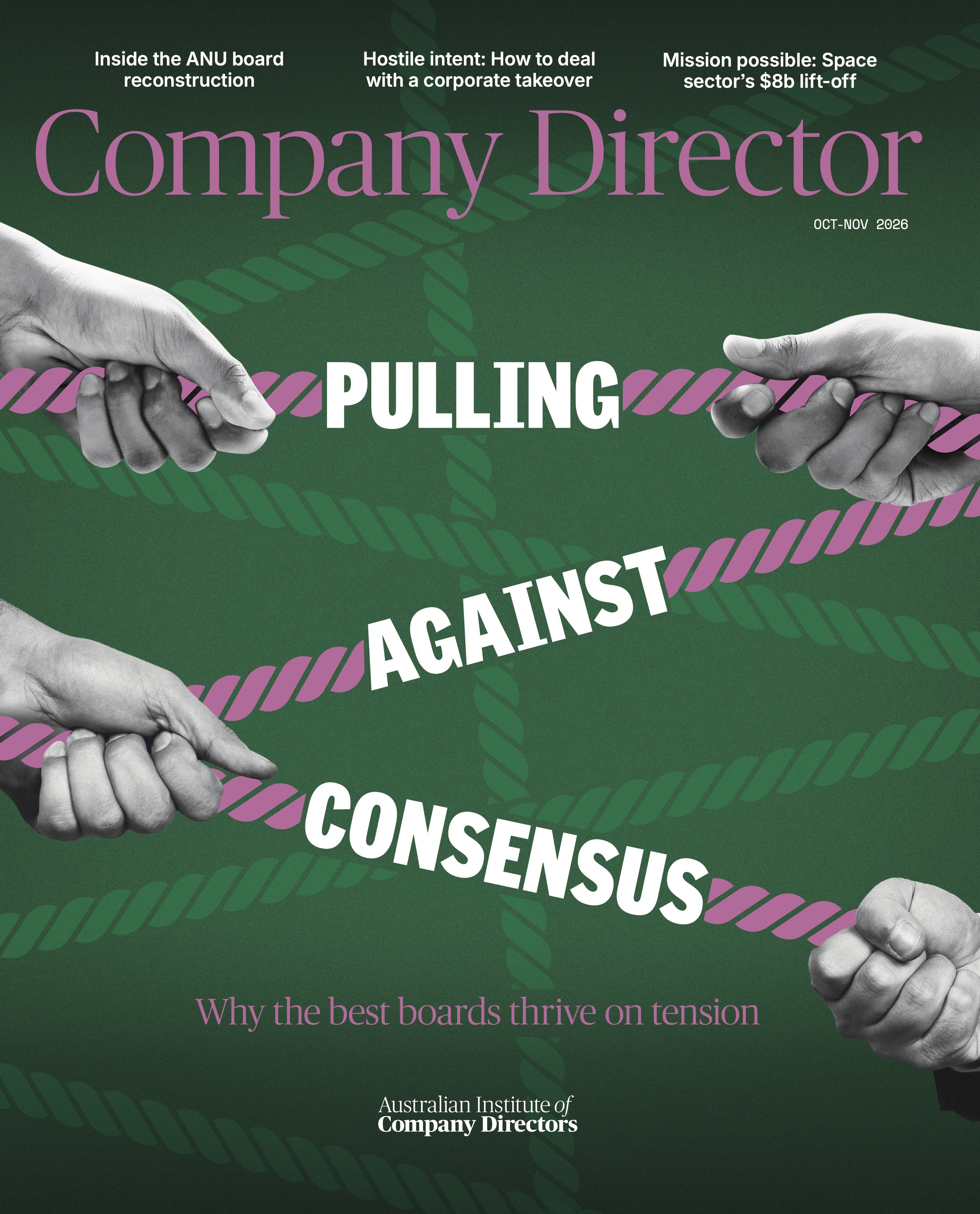
This article first appeared as 'Degree of disruption' in the Oct/Nov 2026 issue of Company Director Magazine.
Latest news
Already a member?
Login to view this content