

 This product has already been purchased.


- Traditional CVs and skills matrices only prove past competency, offering little insight into how a director will actually handle future uncertainty.
- Navigating today’s volatile corporate landscape requires intangible behavioral traits, including deep curiosity, emotional intelligence and a high tolerance for ambiguity.
- To build a truly resilient team, modern boards must move beyond technical checklists and actively assess candidates for character, judgement and boardroom chemistry.
Given the fast-changing, volatile environment most boards operate in, directors will rarely have enough information to make watertight decisions. Instead, they must rely on their personal attributes and behavioral dispositions to navigate uncertainty and drive effective decision making.
Sadly, “soft” skills aren’t easily discernible from CVs or skills matrices, which typically reflect what directors have done in the past, not how they will think or behave in the future.
Paul Smith, a board adviser, director and founder of Future Directors, explains. “CVs and matrices provide proof of a path of competency that is auditable, but they are backwards-looking by design, and not that useful when the future doesn’t look like the past.”
Gavin Nicholson FAICD, an Associate Professor in the School of Accountancy at Queensland University of Technology’s Business School, adds that CVs and skills matrices concentrate on individuals, but a good board is more than just the sum of the individuals who come together to make decisions.
“The question is, how does the individual contribute to the collective to improve the judgement the group is making?” And also, what skills does an individual need to do this?
The intangible toolkit
Here, Smith lists judgement, noting it’s more than being able to ask good questions. “It’s about choosing what to probe and when, and knowing when you’re slowing the room down.”
Nicholson believes directors should also be open-minded. “Research shows that experts who are sure they’re right about an area of uncertainty are more likely to be wrong than those who aren’t quite as sure.”
He adds that boards need experts on certain topics, but also must decide how much they will defer to those experts. “That’s where curiosity comes in. Just because an expert said something, doesn’t mean directors shouldn’t want to understand it themselves.”
Smith describes curiosity as a constant willingness to ask questions inwardly (about your actions), outwardly (about the actions of others) and the questions no-one else is thinking about.
Another valued skill is a “comfort with ambiguity”. “Boards by nature are there to steward and bring a bit of certainty, but we don’t live in a world like that,” says Smith. “It’s not about getting the question right. It’s about the quality of decisions made in times of uncertainty. That takes a particular temperament.”
Smith interprets emotional intelligence as having the ability to manage your own reactions when challenged in the boardroom, to read the room, understand the people around you and change your position when receiving new information.
Merran Kelsall AO FAICDLife – chair of Dementia Australia and a director of Australian Red Cross Lifeblood and CareSuper – believes there are also particular skills needed to challenge management.
“Some directors like massive amounts of detail and can drive management nuts because they’re delving too much into the operational side, but clearly, if you believe there’s a problem somewhere, you do need to have that delving,” she says.
The secret is finding the right balance and an effective way of doing so.
Kelsall says robust debate must be based on respect and trust. “That’s why it’s important to develop relationships outside formal meetings. There’s value in pre-board dinners and site visits.”
She notes some directors have the happy knack of defusing tension, not necessarily by cracking a joke, but rather by not taking things so seriously if people get too passionate or lose their tempers.
Steven Bowman FAICD, managing director of Conscious Governance, says a useful attribute is the willingness to use the organisation’s vision or purpose as a key lens for everything directors examine or say.
He also prizes the ability to see risk not just as a compliance issue, but also as a strategic advantage. Also vital is a director’s experience of failure. “Success teaches confidence while failure teaches judgement,” he says.
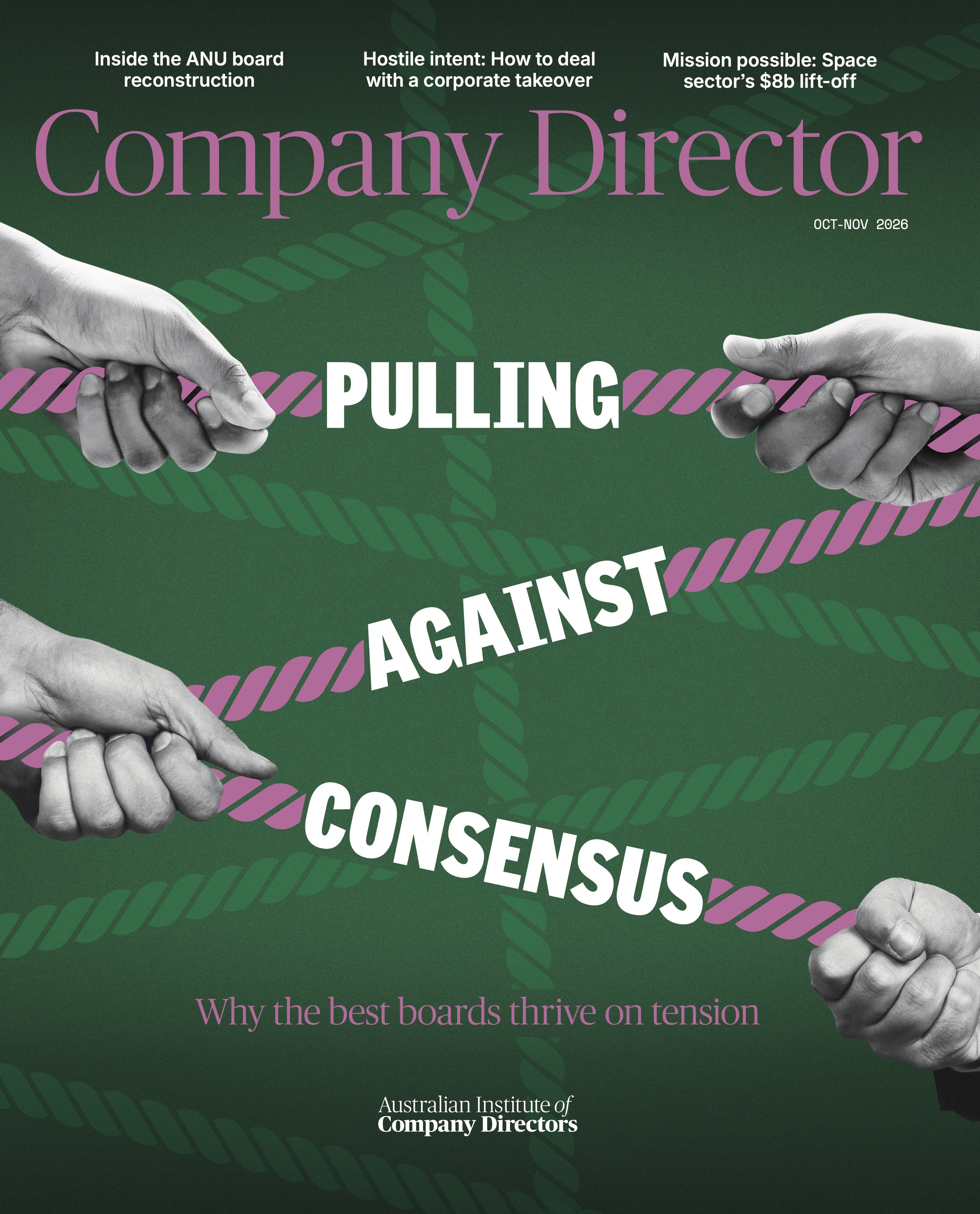
Getting the mix right: Skills, culture and fit
Smith says getting the mix of soft and hard skills right for a particular board involves a trade-off.
“You can have a team of stars who don’t get on, or you can have a team of people with a great culture, who disagree respectfully, but can get to an outcome, even though they might not all be superstars,” he says.
“The trick is to first decide what sorts of character traits and values are not negotiable on a board and then to evaluate if candidates have these.”
Kelsall says this requires judgement. “You try to work out if someone’s going to be a good fit, but it also depends on who you’ve already got around the table.
“It’s like a complex recipe with lots of bits that fit in to make all the spices come together and meld well. But it’s often hard to repeat because every board is different.”
Kelsall believes in having diversity of perspectives, experience and age on a board. “This leads to people asking questions that you’ll never think of. It’s a joy to have super-smart people who see the world differently and add a richness to a discussion that, if you were all the same, you couldn’t have.”
Assessing the behavioural traits
While CVs may not reveal much about “soft” skills, there are other ways to pick these up.
Bowman and Smith test for behavioural traits by asking directors in interviews how they would treat certain scenarios and by phoning the chair or CEO of the companies they have been a director of.
Smith asks questions during reference checks and uses a range of diagnostic tools to uncover directors’ strengths.
When replacing a departing director, Nicholson believes boards should examine the areas where the board needs to improve and ask, ‘What kind of person would help us to become better?’”
“Any good director wanting to join your board will also want to meet you and see how you operate,” he adds.
Latest news
Already a member?
Login to view this content