

 This product has already been purchased.

Climate-driven risks in Australia are accelerating in intensity and complexity. They compound, cascade, and amplify impacts across national systems, creating challenges for organisations, industries, and services.
Vicki Manson, Head of the Australian Climate Service
Australia’s first National Climate Risk Assessment (National Assessment), released in September 2025, provides a clearer picture of the risks we face now, and in the future. It draws on authoritative nationally consistent analysis and data from the Australian Climate Service, a partnership between the Bureau of Meteorology, CSIRO the Australian Bureau of Statistics and Geoscience Australia.
The National Assessment identifies climate risks that can disrupt operations, damage assets and ecosystem services, reduce productivity and erode business value. These risks affect not only physical infrastructure but also supply chains, workforce availability and financial performance. Understanding these risks and integrating them into governance, strategy, and risk management practices is critical to long-term performance in a changing climate.
Five key climate risks for business
The National Assessment describes some key climate risks that may be relevant to company directors as they assess risks to their organisations and develop management strategies.
1. Climate-sensitive industries and labour will be under increasing pressure
Agriculture, tourism, mining, and construction are highly exposed to climate risks. Rising temperatures and more frequent extreme heat events threaten outdoor worker safety and business productivity. Acute hazards, such as floods and bushfires, will damage assets and disrupt operations, while chronic changes like rising temperatures and shifting rainfall patterns will affect crop yields and livestock health.
Historical events show the scale of impact of extreme hazard events: 6,000 jobs lost at the height of the Millennium Drought and 7,000 jobs lost in the Black Summer bushfires (2019–20) (Bowman et al., 2020).
Rising temperatures, particularly across northern Australia, will make working outdoors unsafe for extended periods. By 2061, analysis from New South Wales (NSW) Treasury projects that 700,000 to 2.7 million additional workdays will be lost annually in NSW in agriculture, construction, manufacturing, and mining under high warming scenarios.
Unpleasant working conditions may push workers to leave communities, creating labour shortages and business shutdowns.
2. Critical infrastructure and supply chainsare vulnerable to disruption
Climate change poses serious threats to critical infrastructure including telecommunications, transport, and energy systems with likely flow-on impacts to businesses.
Telecommunications are highly vulnerable, especially in coastal areas. Energy systems are vulnerable to extreme heat, with higher potential disruption to generator output and system reliability.
Transport infrastructure faces increased risk from future climate extremes with more frequent and longer disruption predicted. Coastal cities and infrastructure, with dense populations and infrastructure, are especially vulnerable to sea level rise, storm surges, and coastal inundation.
Disruptions to supply chains have cascading consequences across the economy. Substantial damage to supply chains or increased demand for materials to rebuild after disasters can drive costs and inflation, with impacts including reduced productivity and economic growth.
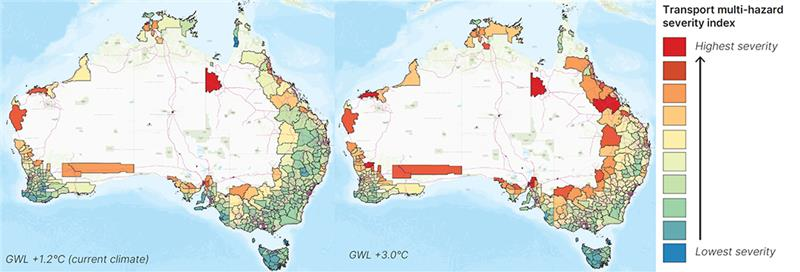
3. Increasing risks to communities and financial systems that support businesses
Extreme weather damages facilities, disrupts operations, and leads to financial losses. By 2030, an additional 40,000 businesses could be in areas of greater-than-average climate risk. Regional communities reliant on single industries are particularly vulnerable, facing reduced employment opportunities and mental health challenges.
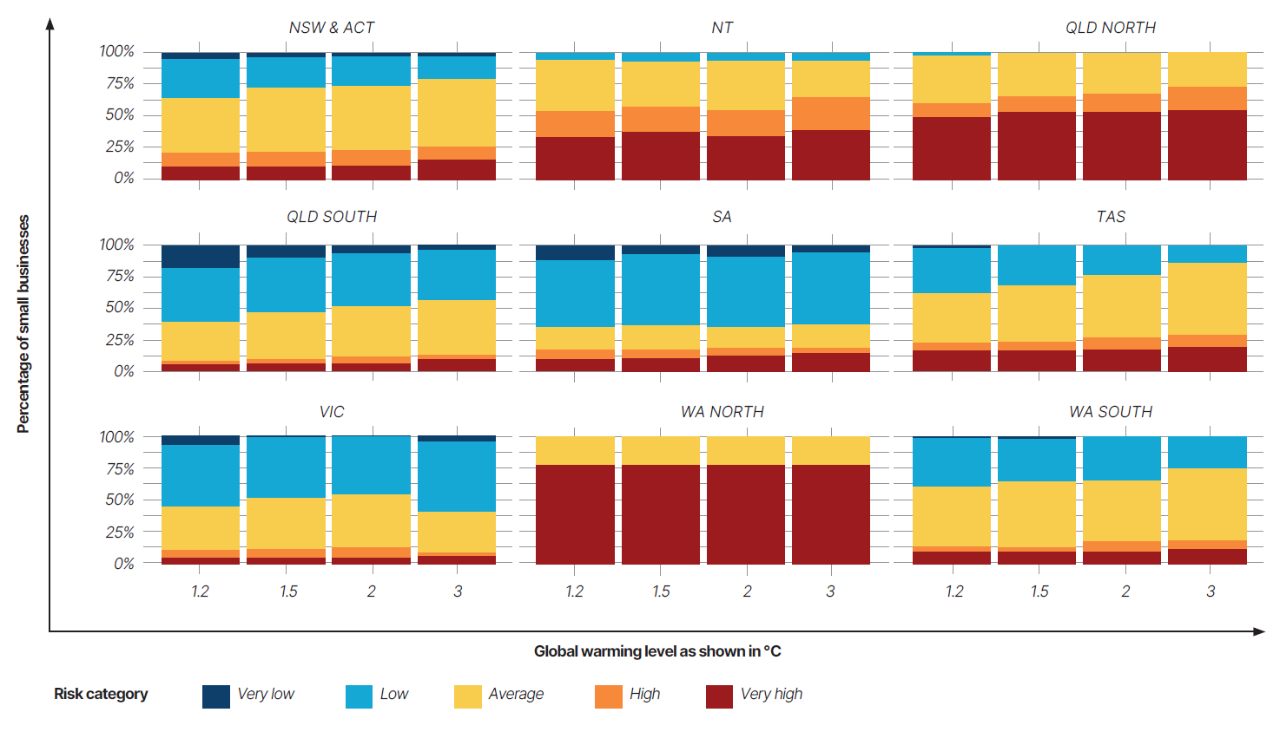
Asset damage from more frequent and more severe extreme events, particularly in coastal towns and cities, may have implications for the security of financial institutions, and the transmission of risk across the finance system through a complex web of interdependencies could lead to broader economic consequences.
4. Ecosystems are degrading, with the potential to impact industries
Ecosystem change poses growing risks to businesses by threatening the natural systems that support production, resilience against natural disasters, resource security, health and wellbeing. Climate pressures and human activity are accelerating ecosystem transitions, with widespread shifts in species and habitat composition expected, especially under higher warming scenarios.
These changes can disrupt industries reliant on natural services like pollination, aquaculture, and forestry. For companies and industry, the loss or transformation of ecosystems can lead to reduced crop yields, food, water and energy security, diminished tourism, as well as increased risks to health, assets and long-term operational stability for businesses.
Climate change is likely to have disproportionate impacts on Aboriginal and Torres Strait Islander peoples’ health and wellbeing, food and water security and their economic livelihoods because of their close connection to the health of Country.
5. Risks of maladaptation
The National Climate Risk Assessment is not a prediction or forecast; it lays out the likely impacts of climate change at 3 different global warming scenarios without further adaptation. Effective intervention can lead to positive outcomes, and the changing climate will open up opportunities for businesses and society – although this was not the focus of the work.
A clear finding was the interconnected nature of risk. Not considering system interactions may lead to maladaptive actions that do more harm than good. Organisations and institutions that adapt effectively to reduce risk in their own operations may have unintended negative consequences on other sectors or communities. For example, changes to agricultural practices or land-use may have unintended consequences for carbon sequestration, for eco-system health, or for future flood hazard dynamics. This complexity highlights the need for a systemic understanding of climate risk.
Australia’s National Adaptation Plan informing national action
Along with the National Climate Risk Assessment, the Australian Government has released Australia’s National Adaptation Plan.
The National Adaptation Plan establishes a framework for Australian Government action, including a vision and objectives for a well-adapted Australia and principles for action. It outlines current roles and responsibilities for adaptation – which is a shared responsibility for all levels of government, the private sector, communities, and individuals, and outlines current and future priorities for the Australian Government in developing support for adaptation action.
The National Adaptation Plan provides a platform for prioritising future Commonwealth action and leadership that is targeted, evidence-based and collaborative. The Plan includes principles to direct our future response, including that it will address nationally significant risks and the disproportionate impacts of climate change on vulnerable communities; consider urgency, effectiveness and co-benefits of action; and complement rather than duplicate action across other sectors and jurisdictions.
The National Assessment and National Adaptation Plan can be used as strategic tools to understand and proactively manage climate-related risks. These resources offer valuable insights to strengthen resilience and stay ahead of emerging challenges.
Further information
- For more information on climate risks to governance or the economy, view Australia's National Climate Risk Assessment Report.
- To find out more about the Australian Climate Service, see the website.
- To read the National Adaptation Plan, view National Adaptation Plan - DCCEEW.
Latest news
Already a member?
Login to view this content