

 This product has already been purchased.

Who gets Australia growing again? AICD members say it takes government and industry together.
This month our advocacy initiatives include productivity discussions with policymakers, what over-regulation costs business, why stewardship marks out strong boards.
Speaking up where it counts
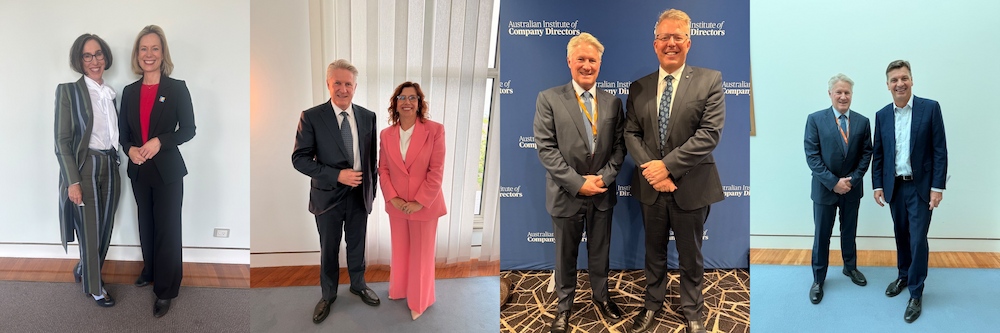
Each year, the AICD takes a delegation of senior members to Canberra to meet parliamentarians from across the political spectrum, senior public servants and members of the press gallery.
The goal is to ensure the people who set the rules hear directly from those who put them into practice.
For this year’s trip in October, we focused on three key areas that our members had told us were priorities: boosting productivity, helping boards make better decisions and building stronger organisations.
The delegation's purpose is "to be a bridge between government and industry on those really big issues facing the nation," according to AICD chief executive Mark Rigotti.
Conversations centred on the challenges facing boards, including AI, cybersecurity, non-financial reporting and burdensome regulation. However, the focus was on solutions. Which areas, if tackled, could start reversing the challenges directors see in the economy?
National resilience, particularly technology and supply chains, is an emerging priority for senior chairs. "That's not going to be an issue that industry or government can solve alone. It's probably the best example of where greater collaboration is needed," Rigotti said.
There were encouraging signs, too. Delegates found they were able to have "better conversations" across party lines as more policies take shape. Plus, there is a growing recognition of the need for a pro-growth response to Australia's dire economic woes.
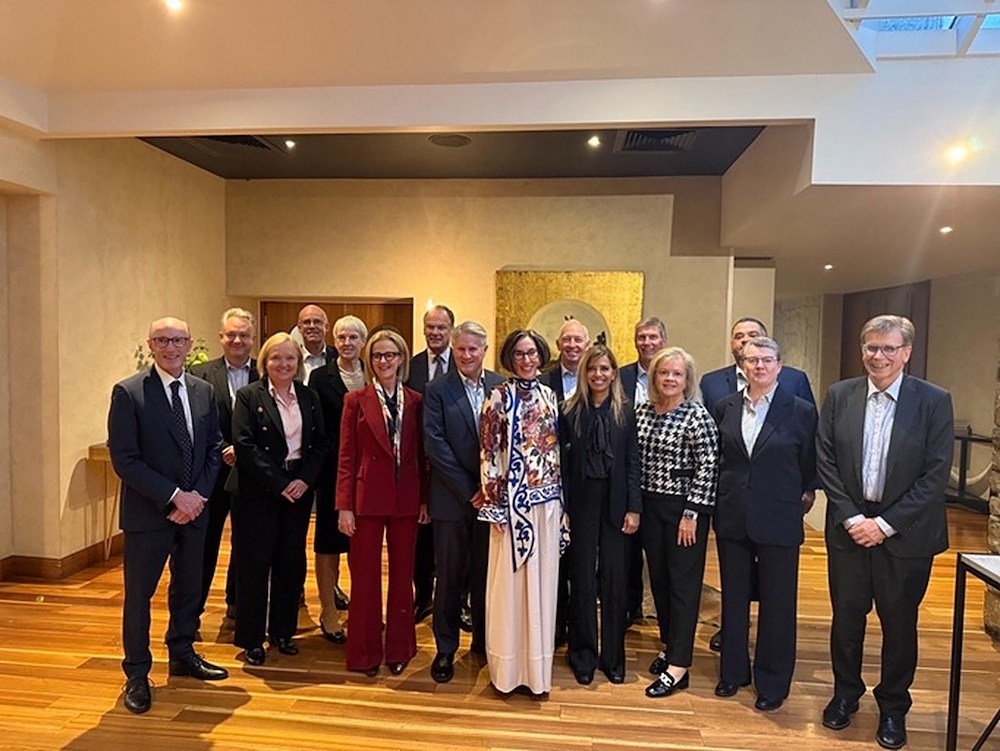
Stronger alignment between government and business was the most important theme of this year's delegation, according to invited attendee David Moffat FAICD, who chairs essential infrastructure services provider Ventia Services Group Limited.
"The biggest opportunity from the interactions is to build trust. A stronger understanding of the constraints and opportunities faced by government and business creates pathways for removing duplicate and excessive regulation while preserving social licence. Public policy without business consultation is costly, economically, and politically," he said.
Another attendee, Christine Holman FAICD, non-executive director of two ASX listed boards, said industry and government don’t have to agree on everything, but they need to be on the same side when seeking solutions that are in Australia’s best interest.
"Productivity, AI, cyber resilience, skills which were recurring themes, are areas that neither of us can fix alone. We didn’t go there asking for deregulation, rather ‘better, simpler, harmonised’ regulation to release greater productivity. But let’s be honest, reform is hard. Budgets are tight, there’s a Senate to deal with and the political cycle is short. So, business has to do the work to bring government along."
“Diverse voices strengthens the discussion, so having directors that are different and not just from listed entities are always helpful."
Holman stressed the value of candour. "Our value is in being principled and candid, including saying when business hasn't got it right or that there are different views of an issue, because that's what makes our priorities credible."
Looking ahead, she said the real test is what happens before the next delegation. "I'd like to see us do more of the heavy lifting before we go: pick one or two issues and come back with solutions that are properly worked through, and that don't just benefit the big end of town."
A handbrake on progress
A major new AICD report, The Stagnant Nation: Lifting Australia's Dynamism looks at why Australia's economy has slowed down over the last 20 years, with fewer new businesses starting up, less investment, less people switching to better jobs and less innovation.
The research, conducted by our partner Mandala, resulted in some concerning findings:
- Australia's regulatory burden is 33% higher than the average for developed countries.
- Productivity growth has dropped from 2.2% a year in the 1990s to just 0.1% today.
- Cutting federal red tape back to late-2000s levels could boost our economy by $20 billion a year.
To fix this, the AICD is calling for a joint business and government taskforce to eliminate unnecessary rules and unleash our nation’s potential.

Governor General Sam Mostyn: Leadership beyond self-interest
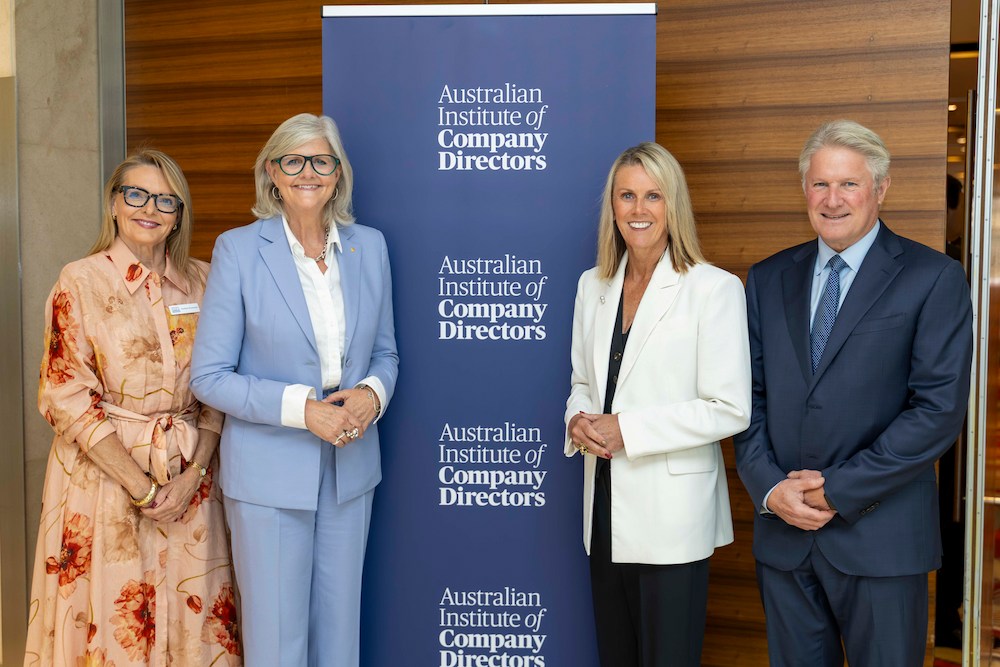
Stewardship should be a director's guiding principle. That was Governor General Sam Mostyn's message to attendees at the AICD's NSW Annual Lunch in Sydney on 4 November. "You don't join boards to advance your own career," she said. You join "because you believe that you have a set of skills that, combined with those around the table, is going to help steer an organisation through good times and hard."
Bringing those individual strengths together is central to Mostyn's view of a chair's role. In conversation with NSW Division President Samantha Martin-Williams FAICD, she likened the job to that of a "good conductor of an orchestra", drawing together the parts that make an organisation "sing, or play it's right tune."
Her test for great chairs is to ask, "are we [the board] the right composition to deal with the issues that this company or organisation faces and who's missing?"
"A diverse group doesn’t have to be dividing. The diversity of the group can be building a better case for how you approach a problem," Mostyn said. For example, "if you sit on a board dealing with mental health, you want someone with a lived experience on your board, because to talk about these things in theory can be terribly damaging."
She called the "art of active, deep listening" one of the greatest skills a director can bring to the table, a lesson from the late Dr Raymattja Marika on the Reconciliation Australia board. "I always look around board tables to see who's listening and who's waiting to talk," Mostyn said.
Asked what's changed since she appeared on the cover of Company Director in 2017, Mostyn pointed to credibility: "One of the key factors is and will be trust in institutions." This confidence is vital, especially at a time in history when the reputation of government and politicians is being regularly tested, debated and diminished.
The Governor General pointed to George Melgalogenis's recent book, Three Shocks, as compulsory reading for directors. "It outlines the current state of the demographics of our nation, explaining why there are cracks and fraying in our social cohesion," she said.
Mostyn also recalled a valuable and amusing lesson from late Australian businessman and philanthropist James Strong AO: "He talked about the director who’s constantly weeing in their wetsuit. They feel nice, warm and fuzzy, but no one else is getting that feeling."
“There are directors and CEOs and senior managers like that who feel very confident in themselves – having that warm, glowing feeling in the middle of presenting something where they’re adding no value at all but can’t see it. They feel great, but everyone else is wondering, what's going on here?” Mostyn added.
For directors, it's a warning against mistaking personal satisfaction for meaningful contribution. The true test is whether the organisation benefits.
AI progress and the productivity puzzle
AI is changing how work gets done but major performance gains remain elusive. The AICD's latest Director Sentiment Index (DSI) found that AI workforce changes typically involved redesigning roles rather than adding or axing positions, with many directors reporting only modest benefits from adoption.
The results also echo a larger reform challenge. Confidence has sunk to its lowest point since 2020, and almost four in ten directors expect to rein in spending over the coming year. Red tape, taxation and policy uncertainty top the list of obstacles, suggesting that new tech is only part of the answer – businesses also need fewer barriers to investment.
Curious what's steering boardroom thinking and where momentum might build next? Dive into the full report.
Board oversight in ASIC's spotlight
A Federal Court ruling on leadership failures at Sydney’s Star Casino earlier this year reinforces the need for board directors to actively oversee non-financial risk, according to AICD CEO Mark Rigotti in an interview with INTHEBLACK.
Star Entertainment's former CEO and general counsel were penalised for failing to escalate serious money-laundering risks, while seven non-executive directors were cleared of wrongdoing. Both executives are appealing the decision.
"There was a reaffirmation of fundamental governance principles [in the ruling]," Rigotti explained. “It is management’s job to do the running of the business, and it is the board’s job to oversee that and to have enough knowledge, interest and curiosity to do it well. Not be an absentee landlord."
He added that the case highlights the need for board papers to contain timely, targeted and manageable information, and the fact that AI cannot replace a director’s responsibility to read, understand and act on board materials.
For practical guidance on how this plays out in the boardroom, see the AICD's updated practice statement, Directors' oversight of company compliance obligations. It outlines how directors can meet their duty of care and diligence: guiding and monitoring the company, staying alert to red flags and acting on them, challenging management, and critically assessing the advice they receive. It also notes that board minutes should show this oversight in action.
Indigenous voices beyond the usual pathways
The AICD’s inaugural First Nations Sector Snapshot 2026 shows Indigenous directors bring deep governance experience to the table yet remain underrepresented on Australia's largest corporate and not-for-profit boards.
"The findings suggest capability is not the primary challenge," says AICD First Nations Lead Justin Agale. The real hurdle is opportunity, and the figures show where it narrows:
- Networks drive entry – 44.2% landed their first board role through professional networks, and 29.2% through community invitations.
- Formal training is high – 83.6% have completed governance-specific education.
- Access remains the barrier – 35.8% cited a lack of visibility or opportunity, 34.2% pointed to commercial board experience requirements. Only 10% felt limited by governance experience.
Tune in and stay informed
Three recent episodes from our Director Download podcasts series tackle key challenges facing boards.
- Episode 24: "Cyber Risk at AI Speed: How Boards Can Prepare" examines how rapid advances in AI compound threats and key governance questions for directors.
- Episode 23: "Australia's $20 Billion Productivity Opportunity" addresses the nation's economic slowdown and how regulatory frameworks can foster growth.
- Episode 22: "Can the World Economy Avoid Entering a Doom Loop?" explores growth forecasts, global debt, bond markets, and AI's long-term impact.
A growing appetite for economic insight
AICD Chief Economist Mark Thirlwell's Economic Weekly newsletter has just passed a staggering 60,000 subscribers on LinkedIn. Each edition unpacks interest rates, inflation, jobs figures and the global outlook, and what these things mean for boards. If you haven't already, subscribe to stay across the forces shaping your decisions.
A year of governance in action
The AICD's 2026 Annual Report is now available online, covering our work in education, membership and policy leadership. It brings together progress against our strategy, our financial results and how we manage the organisation – giving members a broader picture of the work behind these monthly updates.
Ready for what's next?
Discover the latest governance issues with these expert-led webinars – free for members:
- Governing with stakeholder insight – a guide for boards
- Essential Director Update 2026
- Directors and Officers Insurance: Are you covered?
Upskill quickly with focused, online short courses:
Have your say...
You can explore all formal policy submissions in our new Resource Library. Our advocacy is strongest when it is backed by real-world experience. If a specific rule or reform is making your role tougher, reach out to us.
Latest news
Already a member?
Login to view this content