

 This product has already been purchased.

Climate change has been a focus of boardroom risk conversations for years. A landmark international report approved in Manchester in February 2026 highlights that nature loss is also emerging as a significant concern for organisations, and that the two issues are increasingly interconnected. Adjunct Professor Peter Bridgewater MAICD explains why.
Boards are now well-versed in understanding the risks, opportunities, and reporting requirements associated with climate change. But climate is not the only systemic risk demanding attention. The World Economic Forum's Global Risk Assessments have included nature-related risks at progressively higher levels since 2020. The 2026 report places biodiversity loss and ecosystem collapse at number 26 among short-term risks – perhaps not alarming at face value – but that ranking risesto number two over a 10-year horizon, second only to extreme weather events.
‘Nature’ has become widely used shorthand for biodiversity and ecosystem services, and with it has come a growing constellation of frameworks, metrics and reporting standards – among them the Taskforce on Nature-related Financial Disclosures (TNFD) and the Science Based Targets Network (SBTN) – each designed to help businesses measure and manage their nature-related impacts. Taken together, however, they can present a daunting landscape, and boards may be tempted to park nature in the too-hard basket and focus on the more familiar terrain of climate risk.
There may be some welcome clarity on the horizon. In Manchester, England, from 2–8 February, an important intergovernmental meeting took place: the 12th session of the Intergovernmental Science-Policy Platform on Biodiversity and Ecosystem Services (IPBES, www.ipbes.net), established in 2012 to provide governments with an evidence base for biodiversity and ecosystem services policy.
The meeting approved a Summary for Policy Makers (SPM) of a landmark assessment of how business and biodiversity interact. That assessment and its SPM have real implications for Australian boardrooms weighing nature-related risks and opportunities. Some coverage has been stark – Business Green described the report as warning that "continued failure to account for nature-related risks threatens catastrophic economic fallout." So, what does the report actually say, and what does it mean for the boardroom and C-suite?
Key messages from the assessment
The assessment sets out 10 key messages. Read individually they may seem broad, but taken together they form a coherent framework for how organisations can think about, respond to, and manage their impact on nature:
- All businesses depend on and impact biodiversity, and can be agents of positive change.
- The current external conditions in which businesses operate are not always compatible with achieving a just and sustainable future, and perpetuate systemic risks.
- Collaboration and collective action are essential to create an enabling environment where businesses contribute to a just and sustainable future.
- All businesses have a responsibility to address their impacts and dependencies.
- Existing methods, knowledge and data for measuring impacts and dependencies can already inform decisions and actions, including across the value chain.
- Different methods to measure and manage impacts and dependencies are needed for different sectors, levels of decision-making and business purposes.
- Appropriate methods can be selected based on coverage, accuracy and responsiveness.
- Businesses could better measure and manage their impacts and dependencies by engaging appropriately with science and with Indigenous and local knowledge.
- The existing knowledge base needs to be strengthened by addressing important gaps.
- Creating an enabling environment can incentivise actions that are beneficial for businesses, biodiversity and society alike.
Relevance for directors and CEOs
Although IPBES is an intergovernmental body, this assessment was squarely aimed at business. "With the right policies, as well as financial and cultural shifts, what is good for nature is also what is best for profitability," said Professor Stephen Polasky, co-chair of the assessment. "To get there, the report offers tools for choosing more effective measurements and analysis."
Governments may take heed of the assessment's messages in refining or establishing new regulatory frameworks. In Australia's case, significant further changes to the EPBC Act, the Nature Repair Act and associated federal and state policies are unlikely in the near term – but the assessment provides boards with a useful guide for reflecting on the role and impact of their organisation on nature more broadly.
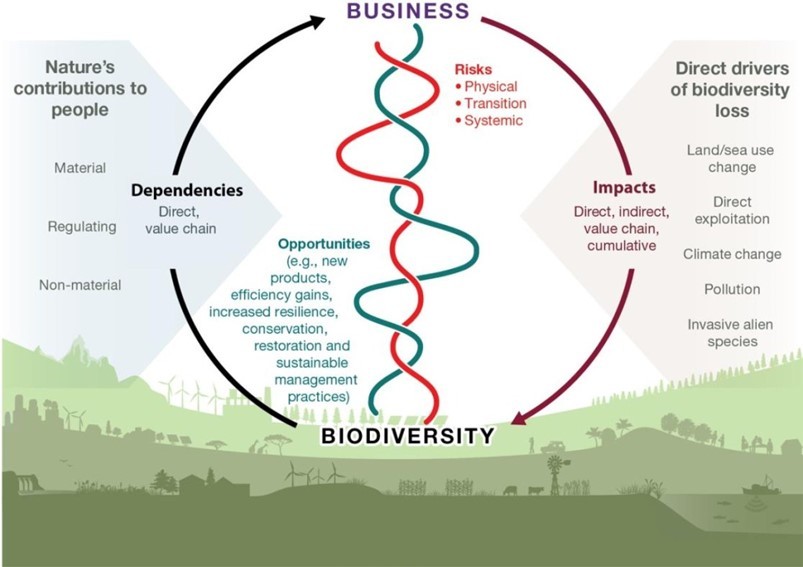
The SPM addresses at some length the ways in which business both impacts and depends on biodiversity and ecosystem services. As the figure below illustrates, this relationship is governed by feedbacks and interactions: reducing harmful impacts creates more room to manage dependencies constructively. IPBES uses the term ‘nature's contributions to people’ to encompass what business more commonly calls ecosystem services.
As shown in Figure 1, businesses have impacts that can be direct, indirect, through the value chain or cumulative. Risks and opportunities may interact and management of risks may create opportunities.
Practical implications
Areas worth reflecting on at board and executive level include:
- Does our organisation directly use biodiversity to produce products? If so, is that use being managed sustainably?
- Does our organisation have other direct impacts on biodiversity?
- Where our organisation produces financial products, what are the indirect impacts – that is, the extent to which capital is being supplied to those with direct biodiversity impacts?
- How can we engage our workforce on these issues? For example, could we support volunteering days with conservation or environmental organisations?
- What is the right level of reporting on nature impacts, even where those impacts appear minimal?
- When we consider our climate reporting, can we also link it to biodiversity and nature considerations, even if the latter are not yet at the same level of maturity?
- Have we asked management to provide a brief report on nature impacts at each board meeting – ‘brief’ is appropriate where impacts appear negligible.
- An annual workshop or similar event bringing together all environmental and sustainability considerations can help surface synergies and gaps.
Disclosure requirements on nature and biodiversity will almost certainly be mandated at various levels of government within the next decade. It is worth developing a solid understanding of the field now. But there is no need to be overwhelmed by the complexity of every available framework – engagement at a strategic level is a sound starting point. And, crucially, nature and climate are inextricably linked. As the old song goes: you can't have one without the other.
University of Canberra Adjunct Professor Peter Bridgewater FLS FISC MAICD advised the Australian Government on IPBES from 2016-2024, is special adviser to the International Science Council on Intergovernmental Environmental activities, and was formerly CEO of the Australian Nature Conservation Agency and Chair of the UK Joint Nature Conservation Committee.
[1] Source: Methodological assessment of the impact and dependency of business on biodiversity and nature’s contributions to people (business and biodiversity assessment) https://www.ipbes.net/business-impact.

Already a member?
Login to view this content