

 This product has already been purchased.


Overview
- The latest IMF outlook for the world economy depicts an international economic environment being reshaped by two major transformative forces: geopolitics (as manifested most recently in the Middle East war) and technology (as seen in the AI boom.
- So far, the world economy has absorbed these shocks surprisingly well, leaving the IMF impressed with its resilience over the past three years. As the negative supply shock from the Persian Gulf meets a positive demand shock driven by AI, the Fund’s forecasts for global growth are little changed from recent outings.
- But the IMF also warns that this resilience is not limitless. Energy inventories have been run down while energy prices remain elevated. Fiscal space is disappearing. Sovereign borrowing costs are rising. And those two transformative forces present significant ongoing risks.
- In Australia, the near-term macro-outlook is still dominated by the RBA and inflation. The September MPB minutes depict a central bank that is concerned inflation is too high, is worried that inflation expectations are rising, and is moving towards the view that capacity constraints are more binding, and the labour market adjustment required to return inflation to target is larger, than it had previously assumed.
- In addition, it is possible that the so-called ‘neutral rate’ has increased. If so, that would further support the case for additional policy tightening.
- More recent RBA communications have reinforced these hawkish messages, increasing the chances of a November rate hike.
- Meanwhile, the resilience of the domestic economy is being tested. The unemployment rate rose to a five-year high of 4.7% in September 2026. And business confidence suffered a third consecutive monthly decline last month, with the latest reading one of the lowest in the survey’s history. All of which helps explain recent RBA rhetoric regarding the need for ‘hard choices.’
On the domestic front, the minutes from the September Monetary Policy Board (MPB) meeting were quite hawkish, depicting among other things a central bank now considering whether a higher rate of unemployment than previously thought might be needed to tame inflation. Given that the MPB voted unanimously for a rate hike last month, that hawkish tone is perhaps not a surprise. But it is notable that the same tone has been sustained into this week’s commentary from Martin Place, with the RBA Deputy Governor recently providing a lengthy list of reasons to be concerned about inflation risk.
The latest RBA communications follow a September unemployment rate of 4.7% (a five-year high) as well as another drop in business confidence. Those data initially reduced expectations of another rate hike. But with Martin Place subsequently signalling its willingness to make ‘hard choices’ in the face of ongoing inflation pressures, the probability of another rate hike at the upcoming November MPB meeting has risen again.
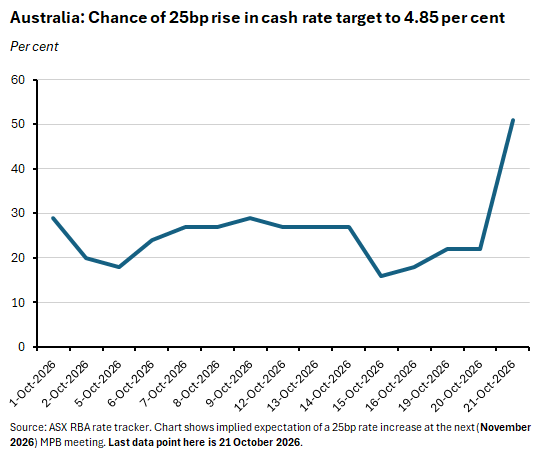
On the international front, last week saw the IMF release its latest forecasts for the world economy. These were little changed from the Fund’s previous projections, and the accompanying analysis spent some time examining the ongoing resilience of the international economic environment while also cautioning that this resilience had its limits. That note of caution seems well-placed after a couple of weeks that have delivered several warning signs: a tighter focus on the sovereign debt-political risk nexus following public unrest in France; renewed concerns regarding the durability of the AI boom after market jitters in the United States; local fallout from the failed Firmus IPO and other data centre woes here in Australia; and more geopolitical noise regarding both the Black and Red Seas.
Indeed, the tension between risk and resilience that the IMF identifies at the global level also applies to the domestic economy. That partly reflects the continuing risk of spillovers from the international environment. It also reflects a central bank balancing domestic risks to inflation and activity in a context where it judges that the former are elevated and where – to date – growth and the labour market have proved to be more resilient than expected. That mix is pushing Martin Place towards further policy tightening. Yet, as the IMF has just observed of global conditions, resilience has its limits.
Below we review the latest IMF World Economic Outlook, dig into the RBA minutes and other messages from the central bank, consider the implications for monetary policy of the current debate around the neutral interest rate, and catch up on the latest labour force data and business survey results. Plus there is our regular roundup of further reading and listening.
The IMF has been impressed by ongoing global economic resilience
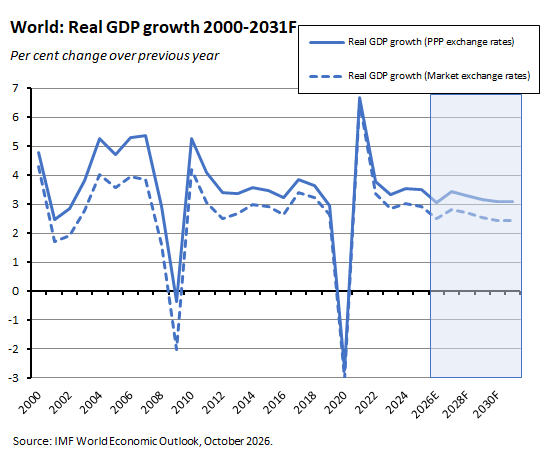
The IMF released its latest forecasts for the world economy last week. According to the October 2026 edition of the World Economic Outlook (WEO), real world GDP growth using purchasing power parity weights is expected to have slowed from 3.5% last year to 3.1% this year before rising to 3.4% in 2027. Measured on a market exchange rate basis (which gives greater weight to slower-growing advanced economies) growth is projected to slow from 2.9% in 2025 to 2.5% in 2026 before picking up to 2.8% next year. Those numbers are little changed from the July 2026 WEO update or the April 2026 WEO.
Underpinning those numbers are assumptions about the oil price (which is expected to average US$95.74/b this year and US$87.39/b next year on the assumption that the Strait of Hormuz starts to reopen in March 2027, leading to a return to pre-war conditions by October 2027) and interest rates (the 10-year US government bond yield is expected to average 4.5% this year and 4.6% in 2027).
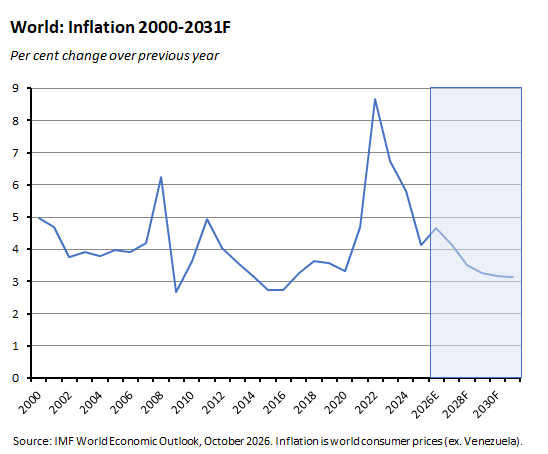
After picking up from 4.1% in 2025 to 4.7% this year due to higher food and energy prices, world consumer price inflation is forecast to fall back to 4.1% in 2027.
The Fund also presented updated forecasts for the Australian economy, where it now thinks growth will slow from 2% last year to 1.9% this year before easing again to 1.6% in 2027. After picking up from 2.8% last year, inflation is expected to run at around 3.9% this year before slowing to 3.1% in 2027. And the IMF expects Australia’s unemployment rate to climb from 4.2% in 2025 to 4.4% this year and to 4.7% next year.
One key feature of the October WEO is a focus on the reshaping of the global economic outlook by the ‘two major transformative forces’ of geopolitics and technology. Geopolitics is manifesting in the form of the current war in the Middle East as well as in conflicts in other regions and tensions in global trade relationships. The Middle East war has produced a large negative supply shock leading to higher and more volatile energy prices and hence to elevated global inflation outcomes. Technology, on the other hand, is so far playing out as a large positive demand shock, apparent in surging investment in AI and related hardware and infrastructure and an accompanying rise in related trade flows.
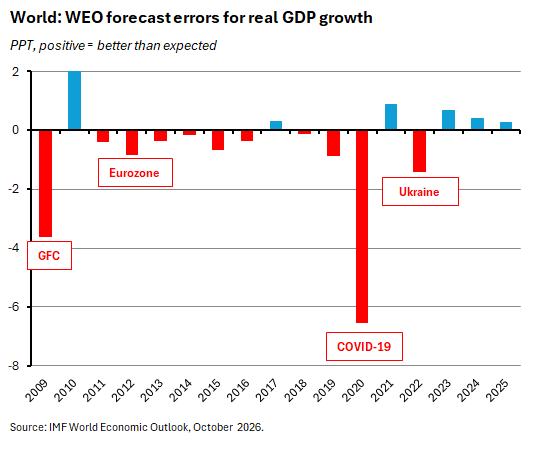
The WEO acknowledges that in recent years, ‘the global economy has exhibited a remarkable capacity to absorb shocks.’ One consequence of this is that, after serially overestimating global growth prospects in the post-GFC period, including the large hits to activity from the pandemic and the Russian invasion of Ukraine, the IMF has now underestimated global growth outcomes for the past three years in a row.
The IMF attributes that 2023-25 period of resilience to a mix of circumstantial and institutional factors, plus some offsetting forces. That includes the large cash buffers acquired by households and firms during the huge fiscal response to the COVID-19 pandemic; the opportunity afforded by the very low interest rates in the post-GFC period to strengthen private sector balance sheets and issue longer-term, fixed rate debt; the persistence of central bank credibility that kept inflation expectations anchored; and the adaptability of the private sector. In 2025, global resilience to the US ‘Liberation Day’ tariff shock was also a product of fiscal stimulus, easy financial conditions, and a marked increase in AI-related investment. In addition, the international trading system and global production networks proved able to reconfigure quickly, with a sharp decline in US-China bilateral flows offset by trade redirection to third markets.
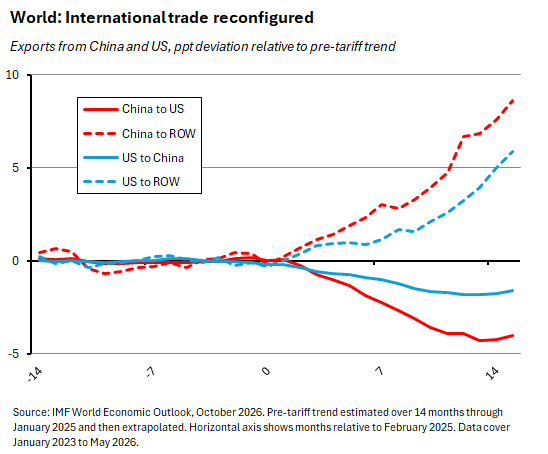
The Fund reckons that similar dynamics have operated this year, buffering the global economy against the adverse consequences of the war in the Persian Gulf. For example, the impact of the oil shock was offset by a combination of flexible supply responses, a drawdown in inventories, and a decline in the oil intensity of GDP (itself a product of a shrinking share of energy activities in the economy plus a diversification of energy away from fossil fuels towards electrification and renewables). Absent these factors, the spike in oil prices would have been much higher, and the damage to inflation and economic activity correspondingly larger.
In addition, the AI-driven investment boom has worked to offset the negative supply shock arising from the Gulf by delivering a positive demand shock to investment and exports. The WEO highlights rapid growth in net trade in AI hardware and surging capital expenditure associated with the building of data centres and the training and operation of AI models. Note, however, that the Fund also cautions that the same AI boom is contributing to inflationary pressures and to financial fragility. Still, as far as the global economy is concerned, it has mostly been a case of so far, so good.
But that economic resilience also has limits
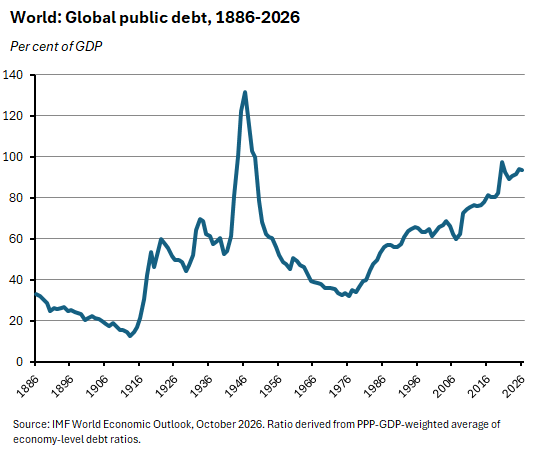
The Fund does worry about how long this resilience can last, however. The WEO warns that ‘the margins of adjustment are narrowing,’ noting that escalating conflict in the Middle East and in Russia-Ukraine continues to stress the global energy system, particularly in a context of depleted inventories. It also worries that the past willingness and ability of governments to deploy fiscal policy to offset external shocks is now constrained, as policymakers find themselves running out of fiscal space in the context of a large public debt stock and rising real interest rates.
In addition, and as already noted, the AI boom also comes with downside risks attached. Along with complicating central banks’ current efforts to tame inflation by putting upward pressure on some technology-related prices, the IMF flags that should expectations of AI-driven profitability and productivity be disappointed, there could be a sharp downturn in AI-related investment that would hit growth and a significant repricing in equity markets that could trigger financial turbulence.
The WEO also notes that financial markets could be vulnerable to a correction even in the absence of such an AI-driven shock, for example if investors abruptly reversed their hitherto relatively benign assessment of geopolitical risks.
Any large market repricing could also interact with fiscal fragilities, with the IMF noting that large sovereign refinancing needs mean government borrowers are exposed to any major shift in borrowing conditions.
Plus, there are the familiar concerns regarding conflict, cyber threats, and extreme weather events.
Still, and in keeping with the WEO’s recognition of economic resilience, the latest assessment of risks to the global outlook is not all gloom and doom. The Fund also sketches out the case for hoping for some pleasant surprises. Upside risks include the possibility of further momentum in the technology-driven trade and investment cycle as well as the scope for a faster-than-expected productivity payoff from those investments. A reconfigured international trading system could reduce trade costs, lower trade policy uncertainty and support activity. And more resilient supply chains and an accelerated energy transition could boost investment in the near term and improve global resilience in the medium term.
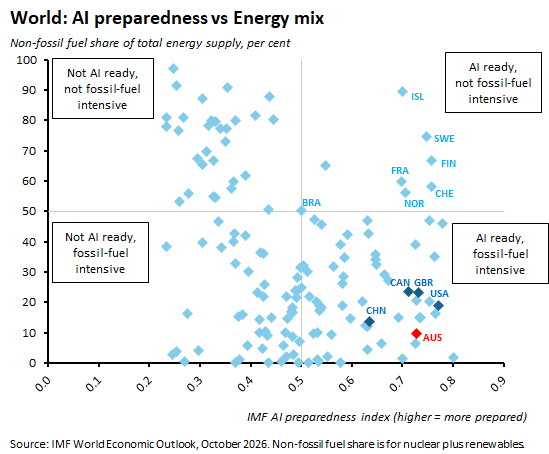
One final note on the WEO. The IMF argues that medium-term potential will be shaped by the same mix of geopolitical and technological forces. It follows that readiness to adopt AI and to reliably meet energy needs will be critical drivers of that potential. The Fund measures these indicators by fossil fuel reliance for energy (which it reckons exposes countries to geopolitical risk) and its own AI preparedness index, with the results mapped below.
The RBA minutes highlighted the RBA’s inflation concerns
The minutes of the 28-29 September Monetary Policy Board (MPB) meeting provided a useful overview of the state of thinking on inflation at Martin Place at the end of last month. In explaining the MPB’s unanimous vote to increase the cash rate target by 25bp last month, the discussion highlighted three main reasons for tightening monetary policy.
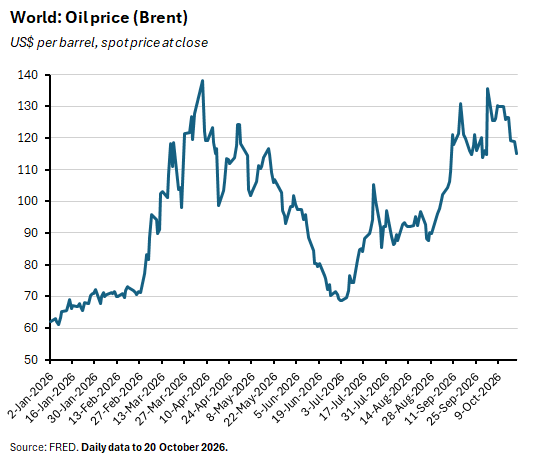
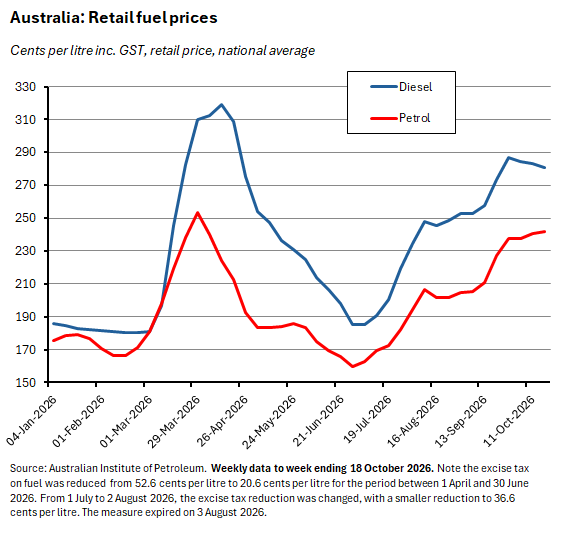
First, there were signs that upside risks to the inflation outlook had materialised. This was most obvious in the case of the Middle East war, where a resumption of the conflict meant that oil prices were now ‘significantly higher’ than had been assumed in previous RBA forecasts. There were also ‘growing indications of intensifying global cost pressures, particularly those associated with the extraordinary demand for AI.’ At the same time, there was further evidence that domestic capacity pressures may have been greater than the central bank had previously assessed: inflation outcomes had exceeded expectations, with domestic petrol and diesel prices 13% higher than had been forecast in August (such that RBA staff now anticipated ‘higher underlying inflation in the September quarter’ than in that same August forecast), economic growth had been somewhat stronger than expected, and the RBA’s own business liaison program was sending ‘increasingly prevalent messages…about broad-based cost pressures and growth in unit labour costs.’
Importantly, the minutes also suggest that the RBA has been unconvinced by the amount of labour market easing seen to date. While acknowledging that the ‘unemployment rate was now close to the assessment of full employment embedded in the [RBA’s] August forecasts’ the minutes go on to note that ‘staff were increasingly questioning whether the rate of unemployment that is consistent with the inflation target was higher than previously assessed (which would imply greater capacity pressures at present).’ Strong growth in unit labour costs, driven by low productivity growth rather than strong increases in nominal wages, appeared to support this view. And later in the discussion:
‘…members acknowledged that the trade-off between inflation and full employment had deteriorated because of global cost pressures…their strategy was still to return inflation to target in a timely manner, while preserving as many of the gains in employment as possible. However, executing this strategy in an environment of more persistent adverse supply shocks would require accepting slower growth in demand and employment than would otherwise be the case.’
Second, MPB members judged that ‘waiting for further confirmation of the outlook for inflation could be costly, given that inflation had already been above target for an extended period and there were concerning indications from surveys and liaison of a growing risk that medium-term inflation expectations in the business community may be rising.’ Meanwhile, downside risks to growth from another rate increase looked limited, since household and business balance sheets ‘appeared to have scope to buffer the impact of higher interest rates,’ business investment was resilient, and leading indicators suggested ‘little imminent risk of a sharp slowdown in activity.’
Third and finally, MPB members were concerned that the current level of the cash rate might not be restrictive enough to return the economy to balance ‘within a reasonable timeframe.’
As we know, the MPB judged that those three considerations were enough to offset any concerns regarding downside risks to activity and employment arising from falling house prices, war-related uncertainty, or monetary policy lags. Hence:
‘…all members judged that it was appropriate to increase the cash rate target by 25 basis points at this meeting…the August forecasts required a number of favourable developments to occur for inflation to return to target within the projected timeframe and…it no longer appeared likely all of these would eventuate…excess demand was greater than previously assessed…[and it was] prudent to reinforce the anchoring of medium-term inflation expectations, given the backdrop of a prolonged period of above-target inflation, the indications from liaison of persistent cost pressures and an economy that, while slowing, continued to display a degree of resilience.’
A higher neutral rate may require a higher cash rate
The third reason for tightening policy reflected the concern that, at 4.35%, the cash rate was not restrictive enough to tame inflation. Part of that assessment relates to another theme of last week’s MPB minutes, as well as of other recent commentary from Martin Place: developments in the neutral rate of interest.
The neutral rate is sometimes defined as the real rate of interest that is required to bring desired investment and saving into balance. Hence, factors that lead to an increase in investment (or a fall in saving) will lead to a higher neutral rate, and vice versa. In an open economy like Australia’s, both global and domestic factors will influence investment and saving, and therefore the neutral rate, with global factors likely to be particularly important.
The neutral rate can also be defined as the real rate of interest required to deliver full employment and stable (and at-target) inflation in the medium or long term. It follows from this definition that the neutral rate can also serve as a kind of summary measure for the monetary policy stance. If the current cash rate is below the nominal neutral rate (that is, below the real neutral rate plus expected inflation), then monetary policy will be expansionary. Alternatively, if the cash rate is above the neutral rate, then monetary policy will be contractionary.
It therefore also follows that changes in the level of the neutral rate will have implications for what cash rate setting will be contractionary (or expansionary). For example, if the neutral rate has risen, then all else equal, a higher level of the cash rate will now be needed to deliver the same kind of restrictive monetary stance that would previously have been associated with a lower policy setting.
One important complication here is that the neutral rate itself is not directly observable but instead has to be inferred through data such as inflation, growth, unemployment, and interest rates. That process could involve building a structural model or using financial market pricing, for example. The RBA uses a suite of models which rely on different approaches to estimate the neutral rate. And because these model-based estimates come with a large degree of uncertainty attached, the RBA also uses other approaches to assess the state of financial conditions in the economy, including a broad set of financial indicators (such as credit growth and risk premia) as well as its own macro forecasts and projections.
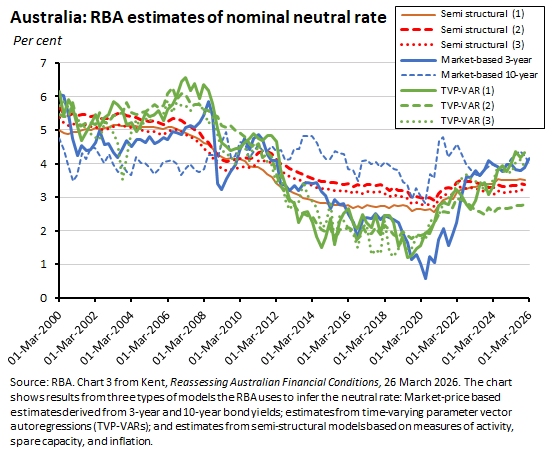
A second complication is that it is possible to think of two different concepts of the neutral rate. The first is a long run one, consistent with the definitions used above. The second is a short-run neutral rate, defined as the level of the cash rate that is neither expansionary nor contractionary over the next few years. This short-run rate will cycle around the long-run version, with shocks and structural changes (such as changes in risk appetite or fiscal policy settings) leading to temporary divergences between the two.
In the decade following the global financial crisis, most estimates suggested that there had been a significant fall in the neutral rate (see chart above). Potential explanations for this decline included lower investment due to slower economic growth, lacklustre productivity, higher risk aversion and higher savings due to some mix of the ‘global savings glut’ and higher inequality. More recently, in the aftermath of the COVID-19 pandemic, estimates of the neutral rate have started to rise again. This increase has been attributed variously to rising government debt, lower saving in response to population ageing, and increased investment spending, including on the energy transition. Importantly, as explained above, this increase in the neutral rate implies that a given level of the cash rate target is now less restrictive than it used to be.
All of which brings us back to last week’s MPB minutes, which opened with a discussion of global financial conditions, and particularly the increase in longer-term government bond yields across advanced economies we discussed a little while back. Members noted that most of this increase reflected a rise in real yields rather than a pickup in long-term inflation expectations, and that those higher long-term real yields appeared to be a product both of an increase in expected long-term neutral rates and in term premia (where the latter could reflect some combination of increased government and AI-related debt issuance, changes in the investor base, and greater uncertainty). The same trend was also apparent in Australian government bonds.
Members noted that the split between these two drivers was important, given that a higher neutral rate would imply looser financial conditions in Australia, absent any change in the cash rate. On the other hand, higher term premia would imply the opposite - tighter financial conditions.
According to the minutes, the RBA’s own model-based estimates of the neutral cash rate implied that the prevailing stance of monetary policy was only ‘somewhat restrictive’ with the cash rate target ‘around the top of the range of central estimates from these models.’ Members also ‘considered the tentative signs that the neutral rate in Australia had shifted higher once more, having already moved up materially since the pandemic, such that it was now above where it was when the cash rate was previously at its current level.’ Although they also ‘acknowledged that estimates of neutral were highly uncertain and therefore did not provide a direct guide for monetary policy.’
Then later in the discussion, the minutes report that members recognised that:
‘…if the signals from financial markets of a potentially higher global neutral interest rate were correct, it would imply that the…cash rate target of 4.35% was less restrictive than it had been two years earlier. Moreover, if monetary policy in Australia was unchanged, recent and prospective policy tightening by other central banks could cause financial conditions in Australia to loosen via a depreciation of the exchange rate.’
In other words, while it was certainly not the only consideration explaining last month’s rate hike by the RBA, trends in the neutral rate do appear to have had a material impact and could continue to do so.
More recent RBA messaging still sounds hawkish
This week delivered additional doses of RBA communication. First up was a fireside chat with Christopher Kent, the RBA Assistant Governor (Financial Markets). Much of the discussion touched on familiar issues around inflation and interest rates as covered above, with Kent noting the ‘difficult trade-offs we’re facing’ as the economy is hit by adverse supply shocks that make the trade-off between inflation, economic activity and unemployment harder. There was also a rare bouquet for Budget 2026 in the Q&A session, with a reflection that the impact of housing tax changes on investor incentives had been ‘helpful’ for the RBA’s fight against inflation.
Kent’s outing was followed by another fireside chat, this one with RBA Deputy Governor Andrew Hauser. Hauser told his audience that ‘we’re in a world of hard choices’ and that less than two weeks out from the next MPB meeting, ‘a few things are clear’:
‘The inflation outlook looks materially worse than we projected…oil prices are even higher, about a third higher than we assumed in the August projection…we’re seeing higher AI prices, tech prices feeding through into CPI, not just here but elsewhere. We continue to have this extraordinary sequence of positive demand shocks around the world. And we’re having a boom in data centre construction here in Australia as well…And then on domestic capacity pressures, well inflation’s been coming in at or a little bit above expectations, despite an apparent easing in the labour market…overlaid on all three of those is the basic fact that inflation’s been high for a very long time now. And we are beginning to see some signs that some people in the community are not sure if we’re going to bring inflation back into target at all…And look, that is the central banker’s nightmare. We can’t allow expectations to shift away from the target.’
He then juxtaposed that worrying inflation picture against a ‘more mixed’ picture on activity. The labour market has been weaker than the RBA expected (see next story), the housing market is correcting, growth in consumption is ‘tepid’ and confidence readings are weak. But demand growth in Australia’s trading partners is strong and the data centre boom is lifting business capex, providing pockets of economic strength.
That messaging suggests that, heading into November’s MPB meeting, the RBA remains more focused on managing inflation than on supporting activity. Rather like it was going into September’s meeting.
Meanwhile, the unemployment rate was at a five-year high last month
Accentuating Hauser’s point about ‘hard choices’, according to the ABS September 2026 Labour Force release, Australia’s seasonally adjusted unemployment rate was 4.7% last month. That was unchanged from August’s upwardly revised rate of 4.7% (previously reported as 4.6%), as the number of unemployed people rose by 9,000. The result was above the market consensus forecast for a 4.6% print and means that the unemployment rate is now at its highest level since October 2021.
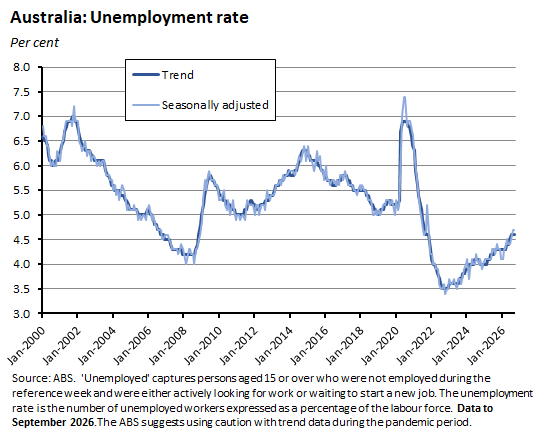
The unemployment rate has now risen by around 0.6ppt from the 4.1% rate at which it started this year and is about 1.3ppt higher than the post-pandemic low it reached back in late 2022. On the other hand, it also remains below the 5%+ rates (5.2% average across 2019) that characterised the pre-pandemic period. On a trend basis the unemployment rate remained steady at 4.6%.
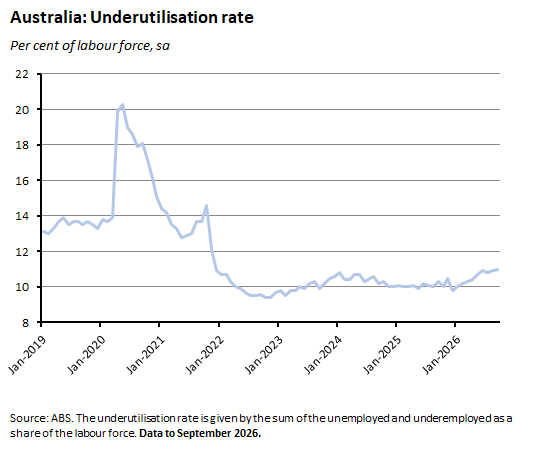
Australia’s underemployment rate rose by 0.1ppt to 6.3% in September, while the underutilisation rate rose by 0.2ppt to 11% (both on a seasonally adjusted basis). The underemployment rate has risen by around 0.4ppt since the start of this year, while the underutilisation rate is up by a full percentage point over the same period. The underutilisation rate is now at its highest level since November 2021.
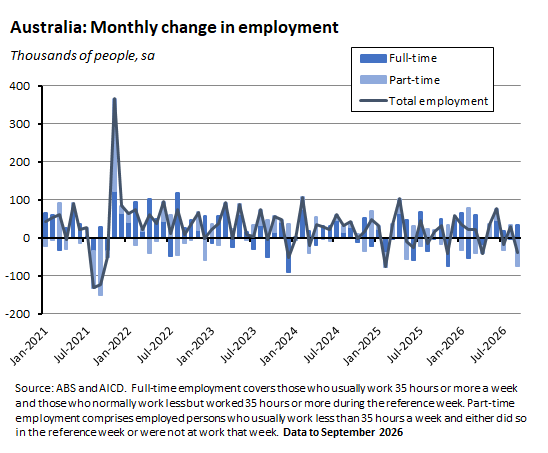
Total employment in September fell by 39,300 people (a 0.3% monthly decline), as a 34,400 increase in full-time employment was more than offset by a 73,700 slump in part-time employment. In contrast, the market had expected employment to increase by 20,000.
At the same time, hours worked were up 1.3 million (0.1%) over the month.
Both the participation rate (down 0.2ppt to 66.8%) and the employment to population ratio (down 0.3ppt to 63.6%) fell last month.
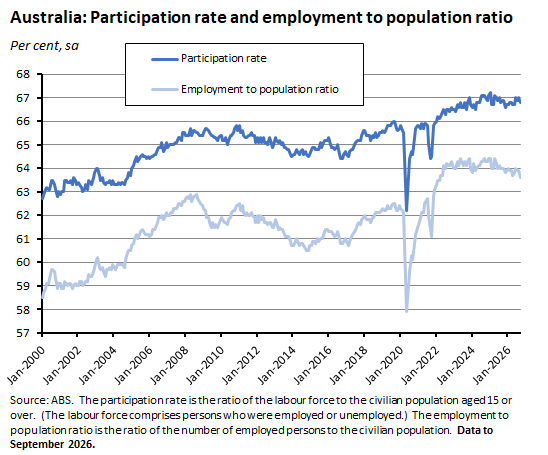
Summing up, September’s numbers sent a much cleaner signal of labour market loosening relative to the previous month’s more mixed messages, with weaker than expected results on both the unemployment rate and on employment. The labour market is also easing more quickly than the RBA expected in the August 2026 Statement on Monetary Policy, which only saw the unemployment rate reaching 4.7% by the December quarter of next year. However, as just discussed above, that signal of weakness has arrived against the backdrop of an RBA that is currently sounding more hawkish on the amount of labour market slack (that is, the amount of unemployment and underemployment) that it thinks will be required to return inflation to target.
Business confidence dropped again in September
In another sign of economic weakness, the NAB Monthly Business Survey for September 2026 reported a third consecutive monthly decline in business confidence, which was down four points to -13. According to NAB, its measure of business confidence is now 18 points below its long-run average and is in the bottom 5% of readings in the survey’s history.
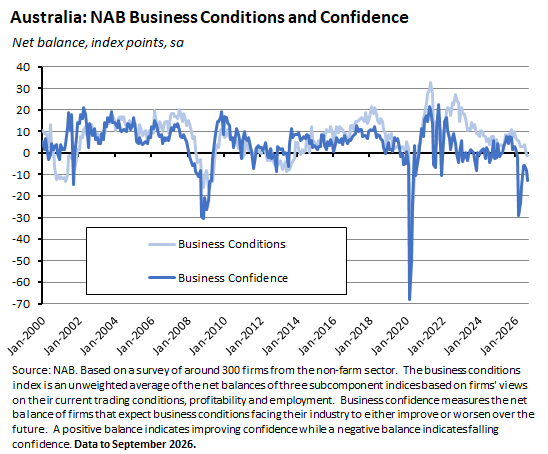
The index of business conditions remained steady at -1 last month, with small increases in the trading conditions and profitability subindices offset by a fall in the employment measure (which slipped to its lowest level in five years). That reading is below the series’ long-run average of seven index points.
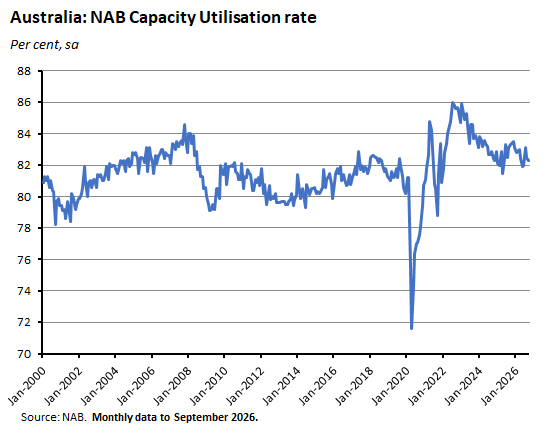
Capacity utilisation eased by 0.2ppt to 82.3%, although that fall in the aggregate measure included increased utilisation rates in five of the eight measured industries. Indeed, NAB noted that on a trend basis, five out of eight industries are now above their long-run averages, up from three in August.
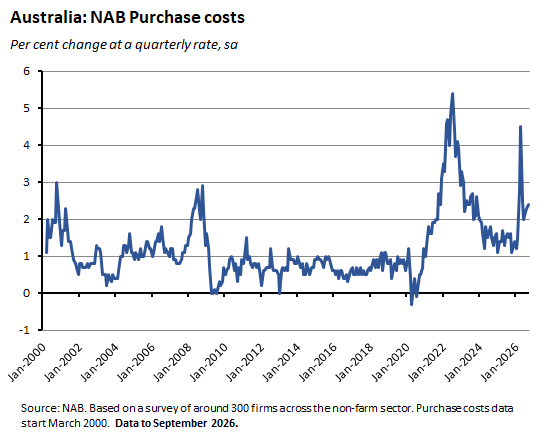
Meanwhile, business cost pressures persist. Purchase cost growth rose 0.1ppt over the month to stand at 2.4% at a quarterly rate while labour cost growth eased 0.1ppt to 1.7%. Final price growth was unchanged from the previous month, at 0.8%.
Further reading and listening
- Productivity Commission (PC) Deputy Chair Alex Robson asks, Do we need a new reform playbook? Robson argues that a lack of economic reform in Australia is not the product of a shortage of political will or courage, but rather the result of three important forces: (1) Abundance increases the value of scarcity which creates rents which are then capitalised into asset values, and the owners of those assets are motivated to defend their rents vigorously; (2) the remaining reforms to the Australian economy tend to be small (‘often smaller than the random noise in the economy’), scattered and hard to measure, making them harder to sell; (3) Baumol’s cost disease means that the cost to government of delivering services tends to rise over time, as does the cost of the taxes needed to fund them. His speech suggests elements of a new playbook that could correct for some of these forces.
- Also from the PC, a submission to the statutory review of the Safeguard Mechanism (a key part of Australia’s emissions reduction policy framework, which currently covers around 80% of heavy industry emissions).
- A new Grattan report calls for a big-bang tax reform package that would include raising the GST, cutting income taxes, and boosting welfare payments.
- Related, the e61 Institute considers, Is the GST regressive? The answer is, it depends, not least on what the government does with any revenue raised.
- From the RBA, links to papers and presentations from the central bank’s recent conference on Monetary Policy Trade-offs.
- In contrast to the case set out above, Jeff Borland thinks a 4.7% unemployment rate makes a November 2026 rate hike less likely.
- The PBO has published a guide to the 2026 Intergenerational Report.
- The October 2026 IEA Oil Market Report reckons that while a recovery in Middle East oil supply was ‘well underway in September, with Gulf crude oil exports approaching pre-war levels,’ the subsequent escalation in the conflict ‘is threatening to derail further gains.’ The IEA also notes that shipments of refined product have recovered much more slowly than crude oil flows, remaining at less than half their pre-war levels. Indeed, disruption to Middle East exports plus lower supply from Russia and some Asian countries has cut global diesel/gasoil availability by 1.5mb/d in Q2:2026 and 1.7mb/d in Q3:2026 compared to last year, ‘putting diesel markets under extreme pressure’ with diesel benchmark prices ‘nearly double the price of crude oil and their pre-crisis levels.’ The consequent tightness in markets is anticipated to persist well into next year.
- The IMF warns that higher borrowing costs are boosting fiscal pressures.
- Two from the OECD. First, a report looking at the relationship between corporate tax systems and business dynamism. And second, a policy brief on government approaches to securing AI compute.
- The Economist magazine analyses how middle powers can survive a predatory world order. In the magazine’s guide to middle powers, Australia is placed in the ‘rule-promoters’ category – rich, allied, but ‘militarily so-so.’
- Also from the Economist, an annus horribilis for Saudi Arabia’s Muhammad bin Salman.
- The WSJ’s Greg Ip reckons Donald Trump could end up saving Canada.
- The 2026 Sveriges Riksbank Prize in Economic Sciences in Memory of Alfred Nobel was awarded jointly to Robert E Hall and Michael Woodford ‘for microeconomic foundations of macroeconomic stabilisation.’ For more, see the ‘popular’ summary, ‘advanced’ summary, and commentary from the Economist magazine, the FT, and the WSJ.
- A new BIS Bulletin examines chokepoint disruptions and their macroeconomic consequences.
- FT Big Reads on Africa’s rapidly growing cities, Pakistan’s demographic time bomb, and whether AI is helpful for understanding a ‘Godzilla’ El Nino and extreme weather more generally.
- On the effectiveness of Victorian elites.
- The Odd Lots podcast examines France’s political and debt problems. Related, the Unherd podcast on France in crisis.
- The Ezra Klein show hosts a debate between Paul Kedrosky and Azeem Azhar on whether there is an AI bubble.
- The Conversations with Tyler podcast and Liaquat Ahamed on lessons from the 1873 financial crisis.
- The EconTalk podcast chats with Jesus Fernandez-Villaverde on the great fertility collapse.
Latest news
Already a member?
Login to view this content